2026 New Level 1&2 EV Charger review is for J1772 drivers who want one portable unit that can cover slow overnight charging and faster 240V top-ups.
The appeal is flexibility: adjustable current, a long cord, a delay timer, and a simple screen without app dependence.
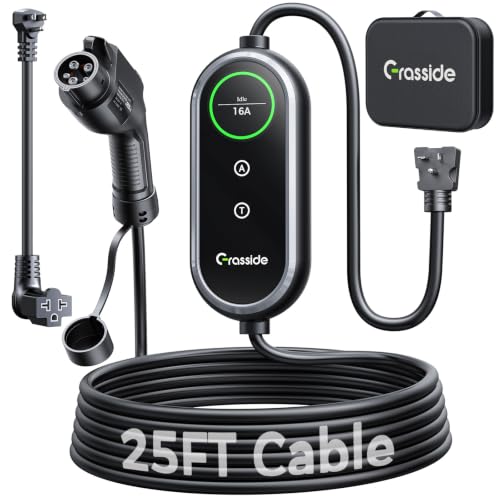
2026 EV Charger Review Summary
This charger makes the most sense for buyers who value a straightforward portable setup over smart-app extras.
If you need a charger that can live in the garage, travel in the trunk, and adapt to different outlets and circuits, this is a practical, low-friction option.
Its strongest selling points are the adjustable 8A/10A/12A/16A current settings, the 0-12 hour delay timer, the 25-foot cord, and the included carrying case.
The tradeoff is that Tesla owners need an adapter, and the product is designed around utility first rather than premium design flourishes.
Review Scorecard
| Category | Score | Editorial rationale |
|---|---|---|
| Outlet flexibility | 9/10 | Supports both NEMA 5-15/5-20 via adapter and NEMA 6-20 for broader home and travel use. |
| Charging control | 9/10 | Adjustable current and delay timer help match circuits and off-peak schedules. |
| Portability | 8/10 | The 25-foot cord and carrying case make it easy to store and move. |
| Monitoring | 8/10 | LCD readout shows voltage, current, power, and status without requiring an app. |
| Safety features | 8/10 | IP65 rating, rubberized connector, and overcurrent/overheat protection support everyday use. |
| Vehicle compatibility | 8/10 | J1772 support covers many EVs and PHEVs, but Tesla requires an adapter. |
| Overall buyer fit | 8/10 | Best for practical owners who want one charger for home, backup, and travel. |
Key Features and Specifications of 2026 EV Charger
This model is built around compatibility and control rather than complexity.
It uses a standard J1772 connector, so it targets most J1772 EVs and plug-in hybrids from brands such as BMW, Mercedes-Benz, Hyundai, Kia, Nissan, Rivian, Ford, Chevy, Volkswagen, and Toyota, according to the listing.
The outlet support is the key technical story.
The charger includes a NEMA 6-20 plug and a NEMA 5-15/5-20 to 6-20 adapter.
On 120V NEMA 5-15/5-20 outlets, it supports up to 12A for Level 1 charging.
On a 240V NEMA 6-20 outlet, it supports 16A for Level 2 charging.
Other useful listing facts:
- Adjustable current settings: 8A, 10A, 12A, and 16A
- Delay timer: 0 to 12 hours
- Cord length: 25 feet
- Display: LCD screen with voltage, current, power, and charging status
- Durability: IP65 waterproof rating
- Cable and connector: UL-listed cable and fully rubberized connector
- Protection: overcurrent, overheating, and electrical fault safeguards
- Support: 2-year care and support from the listed team
Taken together, these specs make the charger feel more like a dependable utility tool than a gadget.
That is a good thing if your main goal is simply to charge safely and on your own schedule.
Pros and Cons of 2026 EV Charger
Pros
- Flexible outlet support for home, garage, and travel use
- Adjustable current settings help match different circuits
- 25-foot cord gives practical reach for driveway or garage setups
- LCD screen keeps charging information visible at a glance
- Delay timer is useful for off-peak charging
- Portable design includes a carrying case for storage and travel
- IP65 rating and protection features add confidence for daily use
Cons
- Tesla drivers need a separate J1772-to-Tesla adapter
- Not a smart app-connected charger
- 120V charging is naturally slower than 240V Level 2 use
- Utility-focused design may feel basic to buyers who want premium hardware or app controls
The balance here is clear: the charger offers a lot of practical value, but it does not try to compete with app-heavy wall units.
If you want convenience and adaptability more than software features, the pros outweigh the cons.
Who Should Buy 2026 EV Charger?
This charger is a strong fit for drivers who want one portable charger that can handle multiple charging situations.
It is especially relevant if you split time between home charging and travel, or if you want a backup charger that can stay in the car.
It also suits owners who prefer manual control.
The adjustable current and delay timer are useful if you want to reduce strain on older circuits, match different outlets, or schedule charging during cheaper electricity windows.
You should likely skip it if you want a permanently mounted smart charger with app scheduling, energy tracking, or a cleaner wall-box setup.
It is also less attractive if you do not own a J1772 vehicle and do not want to manage an adapter for Tesla charging.
Charging Flexibility and Daily Use
Level 1 and Level 2 Range
The biggest practical advantage is that one charger covers both basic 120V charging and faster 240V charging.
That makes it easier to use as a daily charger, a backup charger, or a travel charger without buying separate equipment for each role.
Current Control for Different Circuits
The 8A/10A/12A/16A current options matter because not every circuit or charging situation is equal.
If you are plugging into different outlets over time, being able to dial current up or down is more useful than a fixed-output charger.
Cord Length and Placement
The 25-foot cord is a meaningful advantage in real garages and driveways.
It gives you more room to park without worrying as much about outlet placement, which is often the difference between a convenient setup and a frustrating one.
Screen and Timer Convenience
The LCD display keeps the essentials visible without needing a phone.
The delay timer is equally practical: set it and let the charger start later if you want charging to happen during lower-rate hours or after peak demand.
Alternatives to 2026 EV Charger
If you want to compare this charger with other Amazon-available options, these are sensible starting points:
- ChargePoint Home Flex
- Grizzl-E Level 2 EV Charger
- Emporia EV Charger
- Lectron Level 2 Portable EV Charger
ChargePoint Home Flex is the cleaner choice if you want a more established smart home charging ecosystem.
Grizzl-E is worth checking if you want a rugged wall-mounted approach.
Emporia is a strong comparison if energy monitoring matters.
Lectron is the closest style match if you want another portable, utility-first J1772 charger.
Is 2026 EV Charger Worth It?
Yes, if you want a portable J1772 charger that is adaptable, easy to read, and practical across different charging setups.
The combination of adjustable current, a delay timer, a 25-foot cord, and both Level 1 and Level 2 support makes it a sensible buy for home and travel use.
It is less compelling if you want app control, a fixed wall-mounted installation, or a premium smart-charging ecosystem.
But for buyers who care most about flexibility and straightforward function, this is a solid value-oriented choice.