A cable crossover can add rows, presses, flyes, pulldowns, curls, and dozens of other exercises to a home gym without requiring a full commercial setup. The challenge is finding a model that delivers useful range of motion while fitting limited wall, ceiling, and floor space.
This roundup compares 10 compact cable stations, folding racks, power cages, and functional trainers with different mounting, pulley, adjustment, and loading designs. Use the guide below to match the machine to your room, training style, and installation options.
Best 10 Cable Crossover Machines for Small Spaces Picks for 2026
Best Wall-Mount Pick
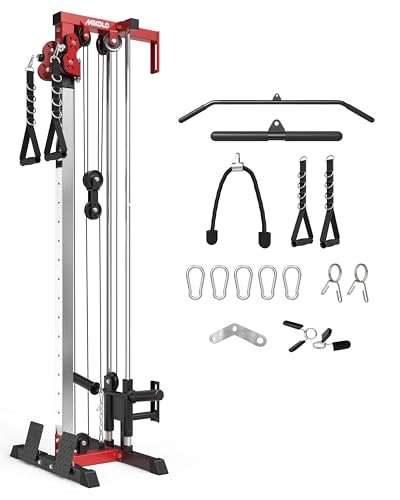
- Compact 26.9-by-25.6-inch footprint
- 19-position dual adjustable pulley
- 400-pound maximum load
Best For: Corner, garage, and home gyms needing a wall-mounted cable station
Best Folding Multi-Station

- Folds to 4.3 square feet
- Five configurable training modes
- Dual independent 1:1 pulleys
Best For: Apartments, garages, or basements needing rack and cable functionality
Best Ultra-Compact Option
GOIMU WM1 Wall Mount Cable Station

- Listed 3.28-square-foot footprint
- 17 adjustable pulley positions
- 1:1 and 2:1 cable ratios
Best For: Small rooms with suitable concrete or masonry walls
Best Heavy-Duty Versatility

- Wall-mount or free-standing installation
- 33 height settings with swivel arms
- 800-pound maximum recommendation
Best For: More spacious home gyms wanting extensive cable adjustability
Best Fold-Away Option
GMWD Wall-Mounted Cable Machine

- Folds flat against the wall
- 100+ exercise options
- 2:1 and 1:1 cable ratios
Best For: Apartments and compact gyms needing a foldable station
Best Freestanding Crossover

- 12.1-square-foot stated footprint
- High and low pulley training
- Includes pull-up bars and attachments
Best For: Small gyms wanting a freestanding functional trainer
Best All-in-One Rack
DP01 Power Cage with Cable Crossover

- Combines rack and cable training
- Independent dual pulley system
- 17.88-square-foot stated footprint
Best For: Home gyms needing barbell and cable stations together
Compact Plate-Loaded Pick
Mikolo Compact Functional Trainer

- About 20-square-foot footprint
- 17 adjustable pulley positions
- Includes bars, handles, and storage
Best For: Corner home gyms needing versatile plate-loaded training
Dual-Stack Training Center
Body-Solid Powerline Cable Crossover

- Two independent 160-pound stacks
- Wide selection of full-body exercises
- 10-year frame warranty
Best For: Dedicated home or light commercial gyms
Smallest Footprint Solution
WM2-V4 Wall-Mount Cable Station

- About 24 x 33-inch footprint
- 155-pound selectorized stack
- 33 positions with adjustable cable ratio
Best For: Apartments and compact gyms with suitable wall support
Best Wall-Mount Pick – Mikolo Compact Cable Station
For shoppers comparing cable crossover machines for small spaces, the Mikolo Wall Mount Cable Station combines a compact wall-mounted design with dual adjustable pulleys. Its 26.9-by-25.6-inch footprint and 82-inch height make it a practical option for a corner, garage, or home gym.
Best For: Home-gym users who want a wall-mounted cable station with a 400-pound maximum load capacity and included attachments.
Pros:
- Compact wall-mounted design suits corners and space-conscious gyms.
- Dual pulleys provide 19 height positions for unilateral or bilateral training.
- Includes a lat bar, cable bar, triceps rope, footboard, and plate sleeves.
- Uses a 14-gauge steel frame and aircraft-quality nylon-coated cables.
Cons:
- Wall mounting is required, so installation space and wall compatibility matter.
- Its 82-inch height may be limiting in rooms with low ceilings.
The Mikolo is a focused choice when floor space is at a premium. It offers useful cable versatility without the larger footprint of a traditional freestanding crossover machine.
Best Folding Multi-Station – WM3-V4 Folding Squat Rack
The WM3-V4 stands out among cable crossover machines for small spaces because it folds to 4.3 square feet for storage and expands to 12.3 square feet when deployed. It combines a power rack, cable crossover, lat pulldown, pull-up bar, and adjustable pulley system in one wall-mounted setup.
Best For: Small-space lifters who want one system for rack work, pull-ups, and cable training.
Pros:
- Folds down to 4.3 square feet for storage.
- Five configurations support folded, rack, functional-trainer, and crossover use.
- Dual independent 1:1 pulleys allow simultaneous training and supersets.
- Offers 15 adjustable pulley heights and supports more than 80 listed exercises.
Cons:
- Its multifunction design may require more involved installation and setup.
- It ships in two boxes, which may complicate delivery and assembly.
If your priority is maximum functionality in a limited room, the WM3-V4 is more than a cable machine. Its folding rack design helps reclaim floor space between workouts while preserving substantial training versatility.
Best Ultra-Compact Option – GOIMU WM1 Wall Mount Cable Station
The GOIMU WM1 is designed for tight rooms, with a listed 3.28-square-foot footprint and wall-mounted construction. For anyone researching cable crossover machines for small spaces, its 17 height positions, dual independent pulleys, and switchable 1:1 or 2:1 cable ratios add useful training flexibility.
Best For: Apartment, garage, and home-gym owners seeking a compact station for both heavier lifts and lighter cable work.
Pros:
- Very small wall-mounted footprint helps preserve floor space.
- 17 pulley height positions accommodate presses, rows, flys, and pulldowns.
- Switchable 1:1 and 2:1 ratios support different training styles.
- Includes a lat bar, cable bar, triceps/biceps rope, D-ring handles, and adaptor.
Cons:
- Installation is specified for concrete or masonry walls.
- Its maximum recommended load is 300 pounds, lower than some options in this roundup.
The WM1 is a strong fit when minimizing the equipment footprint is the main goal. Confirm that your wall can support the installation before choosing this compact station.
Best Heavy-Duty Versatility – Eonfit E1 2.0 Cable Station
The Eonfit E1 2.0 offers wall-mount or free-standing installation in a 55-by-36-inch footprint and 79-inch height. It is a versatile contender among cable crossover machines for small spaces, with 33 height settings, dual swivel arms, and a listed 800-pound maximum weight recommendation.
Best For: Serious home-gym users who can accommodate a wider station and want extensive adjustment range and a high stated capacity.
Pros:
- Wall-mount or free-standing setup provides installation flexibility.
- 33 height settings support pulldowns, rows, flys, curls, and other movements.
- Dual 3D free-motion arms swivel 360 degrees and use a 2:1 strength ratio.
- 14-gauge steel construction and four plate pegs support stability.
Cons:
- At 55 inches wide and 36 inches deep, it needs more room than the wall-only options.
- The supplied notes list different warranty durations for the main frame and other parts, so coverage should be reviewed carefully.
The E1 2.0 is best for buyers who need small-space efficiency without giving up adjustment range. Its free-standing option and broad exercise capability make it more adaptable, though not the narrowest choice here.
Best Fold-Away Option – GMWD Wall-Mounted Cable Machine
For shoppers comparing cable crossover machines for small spaces, the GMWD stands out with a wall-mounted, foldable design. Its adjustable arms, broad exercise selection, and switchable cable ratios provide functional-training versatility without requiring a large freestanding footprint.
Best For: Apartments, compact home gyms, and users who want a cable station that folds flat against the wall when not in use.
Pros:
- Wall-mounted and foldable design helps conserve floor space.
- Supports more than 100 exercises, including flyes, presses, pulldowns, curls, and woodchoppers.
- Offers 26 height adjustment holes, 13 arm-angle settings, and 2:1 or 1:1 cable ratios.
- Includes multiple attachments and wall-mounting hardware for wood or concrete surfaces.
Cons:
- Requires secure wall installation rather than a simple freestanding setup.
- Its listed dimensions and 165-pound weight still require adequate wall and ceiling clearance.
The GMWD is a strong space-saving choice when foldability matters most. Verify the wall structure, mounting location, and available height before ordering.
Best Freestanding Crossover – CC01 Triangular Cable Machine
The CC01 is a practical pick among cable crossover machines for small spaces, using a triangular frame to combine high and low pulley training in a footprint of about 12.1 square feet. It also adds pull-up capability and 15 height adjustment levels for varied full-body workouts.
Best For: Small home gyms that want a freestanding functional trainer with pulldown, rowing, crossover, and pull-up exercises.
Pros:
- Triangular design occupies a stated 12.1-square-foot footprint.
- Supports seated rows, lat pulldowns, chest flyes, pull-ups, and lower-body cable movements.
- Premium pulleys and PU-coated steel cables are designed for smooth operation.
- Includes a pulldown bar, low-row bar, handles, and triceps rope.
Cons:
- At 64.17 inches long, 53.94 inches wide, and 81.89 inches high, it needs substantial clearance.
- Assembly is estimated at about 1.5 hours and is recommended for two or three people.
The CC01 balances a compact stated footprint with broad training functionality. Measure both the floor area and overhead clearance, especially if installing it in an apartment or low-ceiling room.
Best All-in-One Rack – DP01 Power Cage with Cable Crossover
The DP01 combines a power cage, squat rack, lat pulldown, low row, pull-up bar, landmine, and cable crossover in one unit. For shoppers seeking cable crossover machines for small spaces, its stated 17.88-square-foot footprint offers a way to consolidate several strength-training stations.
Best For: Home gyms that need both barbell-rack training and independent cable work from one expandable station.
Pros:
- Combines a full cage, squat rack, functional trainer, and cable crossover.
- Independent dual pulleys support unilateral training, circuits, and partner workouts.
- Provides 31 cable height options plus 29 adjustment points for J-hooks and safety bars.
- Includes a pull-up bar, lat bar, triceps rope, handles, safety bars, J-hooks, and foot board.
Cons:
- Its 84.25-inch height may be unsuitable for rooms with limited ceiling clearance.
- The 57.87-inch depth and 46.46-inch width still require a dedicated training area.
- Its broad functionality may be more equipment than users seeking only cable exercises need.
The DP01 is best viewed as a compact multi-station gym rather than a cable-only machine. It makes sense when replacing several pieces of equipment is more important than minimizing the absolute footprint.
Compact Plate-Loaded Pick – Mikolo Compact Functional Trainer
If you need cable crossover machines for small spaces, the Mikolo offers a relatively compact footprint while retaining high- and low-pulley functionality. Its 52 x 56 x 82-inch frame fits a home-gym corner and supports plate-loaded training up to 350 pounds.
Best For: Home gym users who want a versatile, plate-loaded cable machine with built-in storage and included attachments.
Pros:
- Compact design occupies about 20 square feet.
- Seventeen pulley height positions support varied exercises.
- Includes a lat pulldown bar, row bar, and two cable handles.
- Storage hooks and weight posts help keep attachments organized.
Cons:
- Plate-loaded operation requires separate weight plates.
- At 82 inches tall, it may not suit rooms with low ceilings.
- Assembly and placement require planning for its 154-pound frame.
The Mikolo is a practical choice when floor space is limited but you still want pull-ups, lat pulldowns, rows, cable flys, and other full-body movements from one machine.
Dual-Stack Training Center – Body-Solid Powerline Cable Crossover
Among cable crossover machines for small spaces, the Body-Solid Powerline balances broad exercise coverage with a 42.3 x 62.6 x 83-inch footprint. Its independent weight stacks provide dedicated resistance for cable crossovers, presses, rows, pulldowns, and numerous lower-body movements.
Best For: Serious home or light commercial gyms that can accommodate a wider, heavier functional trainer and want dual independent weight stacks.
Pros:
- Dual 160-pound weight stacks enable independent, isolateral movements.
- Supports a wide range of high- and low-pulley exercises.
- Sturdy extra-wide frame has a powder-coated finish.
- Includes a 10-year frame and one-year parts warranty.
Cons:
- Its 62.6-inch width may be challenging in very tight rooms.
- The 476-pound machine is difficult to reposition after installation.
- Its 83-inch height requires adequate ceiling clearance.
This is the most substantial option in the group, making it better for dedicated training areas than apartments or especially tight corners. In return, it offers smooth exercise variety and independent resistance control.
Smallest Footprint Solution – WM2-V4 Wall-Mount Cable Station
For cable crossover machines for small spaces, the wall-mounted WM2-V4 stands out with a footprint of about 24 x 33 inches. It combines a 155-pound selectorized stack with optional plate loading, dual pulleys, and 33 adjustment positions for apartment, garage, or compact home-gym setups.
Best For: Users with very limited floor space who want a wall-mounted station with quick selectorized adjustments and flexible cable ratios.
Pros:
- Wall-mounted design uses only about a 24 x 33-inch footprint.
- Selectorized 155-pound stack reduces downtime between sets.
- Offers 33 height positions and a 2:1-to-1:1 ratio adapter.
- Aluminum pulleys and 14-gauge steel tubing support smooth, sturdy operation.
Cons:
- Wall mounting requires a suitable structure and careful installation.
- The listed one-year warranty is shorter than some competitors.
- Its 79.13-inch height still requires adequate vertical clearance.
The WM2-V4 is the strongest space-saving choice here, especially when every inch of floor area matters. Its combined selectorized and plate-loaded design also gives it more resistance flexibility than a basic wall-mounted tower.
How We Picked the Best Cable Crossover Machines for Small Spaces
We focused on the practical constraints that matter most in a compact gym: overall footprint, wall-mounting or folding capability, pulley adjustability, loading method, and exercise versatility. We also considered whether each design can support both high- and low-pulley movements, accommodate different user heights, and integrate with a rack or pull-up station.
Because product specifications and bundles can vary, verify the current dimensions, weight capacity, included attachments, mounting hardware, and warranty before ordering. A compact machine is only a good fit if your wall, floor, and ceiling can safely support it.
Quick Comparison
| Design | Best for | Main advantage | Potential trade-off |
|---|---|---|---|
| Wall-mounted station | Very small rooms | Minimal floor use | Requires secure installation |
| Folding rack with pulleys | Multi-purpose training | Combines rack and cable work | Needs clearance to fold and use |
| Power cage with crossover | Strength-focused lifters | Supports barbell and cable exercises | Larger footprint |
| Free-standing functional trainer | Flexible placement | No wall mounting in some setups | Usually uses more floor space |
| Weight-stack station | Fast, convenient workouts | Quick resistance changes | Heavier and often costlier |
Key Buying Factors for Cable Crossover Machines for Small Spaces
Measure the Complete Operating Zone
Do not measure only the folded or wall-mounted dimensions. Allow room for handles, benches, plates, pull-up movements, and the cable travel path. Check ceiling height as well, particularly for tall racks and high pulley exercises.
Choose the Right Mounting and Loading System
Wall-mounted units save floor space but need solid studs, masonry, or another appropriately reinforced surface. Plate-loaded systems can be economical and customizable, while integrated weight stacks are faster to adjust and keep plates off the floor. Confirm the machine’s stated capacity and whether plates are included.
Prioritize Pulley Range and Smooth Movement
More adjustment positions can make it easier to align the handles with your shoulders, chest, hips, or ankles. Look for independent pulleys, swiveling arms, and a useful high-to-low range. Cable routing, pulley materials, bearings, and alignment also affect how smooth the machine feels.
Check Versatility and Safety Details
If you want squats, presses, and pull-ups as well as cable work, a rack or cage may offer better value. Inspect safety arms, locking points, footplates, included handles, anchor hardware, and instructions. Secure every anchor before applying heavy resistance.
Who Should Buy Which Cable Crossover Machines for Small Spaces?
Choose a wall-mounted station when preserving floor space is the top priority and you have a suitable structural mounting surface. A folding rack is a strong choice for lifters who want cable exercises plus barbell training in one modular setup. A power cage suits users who need a more complete strength station and can accommodate a larger footprint.
For quick, low-hassle sessions, a weight-stack functional trainer is usually the most convenient option. Plate-loaded cable machines are better for buyers who already own Olympic or standard plates and want flexible resistance. If several people will use the machine, prioritize independent pulleys, broad adjustment ranges, smooth cables, and a generous operating area over the smallest folded dimensions.