Finding a treadmill that fits a taller frame takes more than checking the motor rating. A short running deck can restrict your stride, while a low handlebar or limited weight capacity may make workouts feel uncomfortable and unstable.
We compared 10 home treadmills across deck space, incline capability, motor performance, user capacity, controls, folding design, and portability. This guide focuses on the details that matter most when choosing a treadmill for walking, jogging, or running with a longer stride.
Best 10 Treadmills for Tall People Picks for 2026
Best Heavy-Duty Pick

- 400+ lb capacity with a quiet 3.5 HP brushless motor
- Four-position adjustable handles from 37 to 43 inches
- 20% automatic incline and shock-absorbing running pad
Best For: Incline workouts and compact home use with adjustable support
Best Budget Incline Option

- 400 lb capacity with a heavy-duty iron frame
- Three manual incline settings up to 16%
- Foldable design and quiet motor rated at up to 45 dB
Best For: Walking, jogging, and compact-space incline workouts
Best Compact Wide-Belt Pick

- 41-by-16.5-inch belt for a compact treadmill
- 0.6–10 MPH range with a quiet 2.5 HP motor
- Folds for storage and supports under-desk workouts
Best For: Home and office walking, jogging, and flexible compact use
Best for Tall Incline Walkers

- 51-inch extended handrails for users 5'7" and taller
- Steep 40% manual incline with a raised deck
- 350 lb capacity and multi-layer cushioning
Best For: Tall users focused on steep incline walking and stair-style workouts
Best All-Around Pick
FOUSAE 5-in-1 Incline Treadmill

- 0.6–7.5 MPH range with 10% incline
- 400-pound capacity and 3.0HP brushless motor
- App compatibility and 12 HIIT programs
Best For: Versatile home workouts and higher-capacity users
Best for Easy Controls

- Four control options, including handlebar buttons
- 36-by-16-inch cushioned belt with 10% incline
- Folds easily and supports up to 350 pounds
Best For: Walking, light jogging, and compact home setups
Best Compact Incline Pick

- 12% manual incline for hill-style workouts
- 38-by-15-inch cushioned running surface
- Folds quickly and supports speeds up to 6.2 MPH
Best For: Small spaces and incline-focused walking or jogging
Best Incline Walking Pad
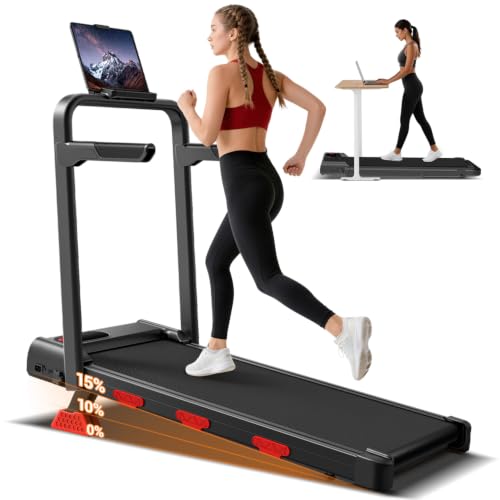
- Manual flat, 10%, and 15% incline options
- 350-pound capacity with 0.6–6.2 MPH speed range
- Compact design with quiet brushless motor
Best For: Walkers seeking incline training and high weight capacity
Best Compact Option
Terluxra Foldable Walking Pad Treadmill

- Foldable design for small homes and offices
- Shock-absorbing belt and honeycomb blocks
- Walking, jogging, and running modes up to 4 MPH
Best For: Space-conscious users focused on walking and light jogging
Best Lightweight Incline Model

- Manual 12% incline with 12 preset programs
- 0.6–6.2 MPH range and 300-pound capacity
- 48-pound frame with wheels for easier storage
Best For: Users wanting portable incline workouts and programmed exercise
Best Heavy-Duty Pick – 3.5 HP 20% Incline Treadmill
For shoppers comparing treadmills for tall people, this model stands out for its adjustable-height handles, sturdy 400-pound capacity, and incline-focused training. The 39.2-by-15.7-inch belt is compact, so it is better suited to walking and moderate running than to especially long strides.
Best For: Home users who want high weight capacity, adjustable handles, and automatic incline in a compact treadmill.
Pros:
- Adjustable handles offer four height settings from 37 to 43 inches.
- 3.5 HP brushless motor supports speeds up to 8.7 MPH.
- 20% automatic incline and seven-layer shock-absorbing running pad support varied workouts.
- Arrives 90% pre-assembled and includes transport wheels.
Cons:
- The 39.2-inch belt may feel short for tall users with long running strides.
- Its compact design prioritizes space savings over a full-size running deck.
This is a capable choice for incline walking, jogging, and space-conscious home workouts. Tall runners should compare the belt length carefully before buying, but the adjustable handles and 400-pound capacity make it a flexible option for many users.
Best Budget Incline Option – CURSOR 16% Incline Treadmill
This CURSOR treadmill is a practical pick for shoppers seeking treadmills for tall people without a large home-gym footprint. Its 16% manual incline and 400-pound capacity add versatility, while the 37.5-by-15-inch belt is most appropriate for walking, jogging, and steady running.
Best For: Walkers and light runners who need high weight capacity, incline training, and easy storage.
Pros:
- Manual incline adjusts through 0%, 8%, and 16% settings.
- Heavy-duty iron frame supports up to 400 pounds.
- Three LED display screens make workout metrics easy to view.
- Quiet brushless motor operates at up to 45 dB and folds for storage.
Cons:
- The 37.5-inch belt may not provide enough room for long-stride running.
- Incline adjustment is manual rather than automatic.
- Maximum speed is 7 MPH.
Its strong capacity and foldable design make it appealing for compact spaces, but tall users should treat the shorter belt as a limitation. It is better positioned as a walking and jogging treadmill than as a dedicated distance-running machine.
Best Compact Wide-Belt Pick – Acezoe Foldable Walking Pad
The Acezoe is worth considering among treadmills for tall people because its 41-by-16.5-inch belt is wider and longer than several compact alternatives. It combines walking-pad versatility with a handlebar, Bluetooth speaker, heart-rate sensors, and speeds up to 10 MPH.
Best For: Home or office users who want a relatively wide compact treadmill for walking, jogging, and occasional running.
Pros:
- 41-by-16.5-inch running surface provides useful room for a compact model.
- Four-in-one design supports walking, jogging, running, and under-desk workouts.
- Quiet 2.5 HP motor reaches speeds from 0.6 to 10 MPH.
- Foldable frame, transport wheels, and no-assembly setup simplify storage.
Cons:
- Weight capacity is limited to 300 pounds.
- The product notes list up to 10% incline but do not specify the incline adjustment method.
- Its compact format may still be restrictive for very long running strides.
This model offers a useful balance of belt space and portability, especially for users who alternate between desk walking and faster workouts. Tall runners should still verify that the 41-inch deck accommodates their stride before relying on it for regular running.
Best for Tall Incline Walkers – CURSOR 40% Incline Treadmill
Among treadmills for tall people, this CURSOR model is the most specifically designed for taller users. Its 51-inch handrails, 38.6-by-15.4-inch belt, and elevated deck at maximum incline support upright posture during steep walking and stair-style training.
Best For: Users 5’7″ and taller who prioritize steep incline walking, extended handrails, and stable support.
Pros:
- Extended 51-inch handrails are designed for users 5’7″ and taller.
- Five manual incline settings reach a steep 40% grade.
- Reinforced base and anti-shake pads support up to 350 pounds.
- Seven-layer belt and eight silicone shock absorbers cushion each step.
Cons:
- The 38.6-inch belt may still be short for long-stride running.
- Incline adjustment is manual.
- Maximum speed is limited to about 6.2 MPH, making it more suitable for walking than fast running.
This is the clearest match for tall users who want a supportive posture and serious hill simulation rather than high-speed running. Its extended handrails are a standout feature, while the shorter deck and moderate speed point toward incline walking and light jogging.
Best All-Around Pick – FOUSAE 5-in-1 Incline Treadmill
For shoppers comparing treadmills for tall people, the FOUSAE offers a versatile home workout setup with a 40-by-16-inch deck, speeds up to 7.5 MPH, and a 10% incline. Its higher weight capacity and multiple workout modes make it a flexible option for walking, jogging, and running.
Best For: Home users who want the broadest range of workout modes, app connectivity, and a higher 400-pound weight capacity.
Pros:
- Supports walking, jogging, and running at speeds from 0.6 to 7.5 MPH.
- Includes a 10% incline, 12 HIIT programs, and app compatibility.
- Uses a 3.0HP brushless motor with noise below 30 dB.
- Offers a 400-pound maximum weight recommendation and cushioned deck.
Cons:
- The 40-inch deck may still feel short for some tall runners with long strides.
- Its feature-rich design may be more than casual walkers need.
The FOUSAE stands out for combining the fastest speed range, incline training, app features, and the highest stated weight capacity in this group. Tall users should still compare the deck length with their stride before choosing it for regular running.
Best for Easy Controls – WELLFIT Folding Treadmill
The WELLFIT is a compact choice among treadmills for tall people, with a handlebar, multiple control methods, and a 36-by-16-inch cushioned belt. Its 6.2 MPH top speed suits walking and light jogging, while the folding frame and wheels simplify storage.
Best For: Walkers and light joggers who prioritize simple controls, compact storage, and desk-compatible use.
Pros:
- Provides handlebar, remote, app, and app voice controls.
- Features a self-aligning belt designed to reduce belt drift.
- Includes a 10% manual incline and five-layer cushioning.
- Supports users up to 350 pounds and folds for storage.
Cons:
- The 36-inch deck is shorter than the FOUSAE option and may limit long-stride running.
- The 6.2 MPH maximum speed is better suited to walking and light jogging than faster running.
WELLFIT focuses on convenience rather than high-speed training. The handlebar controls, belt-alignment feature, and compact folding design are useful for everyday walking, but taller users should carefully assess whether the 36-inch deck provides enough room for their stride.
Best Compact Incline Pick – 3.0HP Folding Treadmill
For those seeking compact treadmills for tall people, this folding model pairs a 12% manual incline with a 38-by-15-inch running surface. It reaches 6.2 MPH and folds down for storage, making it practical for walking and moderate jogging in smaller homes.
Best For: Space-conscious users who want stronger incline training and a simple, lightweight treadmill.
Pros:
- Offers the highest incline in this selection at 12%.
- Uses a 3.0HP brushless motor with noise below 50 dB.
- Includes six-layer cushioning and a smart memory display.
- Folds down quickly and has built-in wheels for moving it.
Cons:
- The 38-inch deck is relatively short for long-stride running.
- Its 300-pound capacity is the lowest among these three models.
- The incline is manual rather than automatically adjustable.
This model is a sensible small-space choice when incline walking matters more than top speed or a long running deck. Taller users may appreciate the 38-inch surface, but it remains better suited to walking and moderate jogging than extended running sessions.
Best Incline Walking Pad – LONTEK 15% Incline Treadmill
For shoppers comparing treadmills for tall people, the LONTEK offers useful incline options and a sturdy 350-pound capacity. Its compact design suits home offices and apartments, though the 37.4-inch belt is better suited to walking and light jogging than a long running stride.
Best For: Walkers who want manual incline options, quiet operation, and a high weight capacity in a compact treadmill.
Pros:
- Three manually configured levels: flat, 10%, and 15% incline.
- Supports up to 350 pounds and runs from 0.6 to 6.2 MPH.
- Quiet brushless motor operates below 45 dB and includes an LED metrics display.
- Folds or stores under furniture and includes a detachable phone or tablet holder.
Cons:
- The 37.4-by-15-inch belt may feel short or narrow for taller users with a long stride.
- Incline adjustment is manual rather than motorized.
The LONTEK is a practical choice when incline training, portability, and capacity matter more than a full-length running deck. Taller users should compare the belt dimensions with their natural stride before buying.
Best Compact Option – Terluxra Foldable Walking Pad Treadmill
The Terluxra is a small, foldable walking pad for home or office use. Among treadmills for tall people, its 40.9-inch length is still compact, so it is most appropriate for walking and light jogging rather than unrestricted running by users with longer strides.
Best For: Space-conscious users who need a portable walking and light-jogging treadmill with simple controls.
Pros:
- Folds for storage under a bed, beside a sofa, or in a corner.
- Shock-absorbing honeycomb blocks and a multilayer belt help reduce impact and noise.
- Remote control and LED display track speed, distance, time, and calories.
- Offers walking, jogging, and running modes up to 4 MPH.
Cons:
- The 40.9-inch deck may be restrictive for taller users or users with a long stride.
- Its 242-pound maximum capacity is lower than the other listed options.
- The 4 MPH top speed limits sustained running.
This Terluxra model prioritizes compact storage and basic walking functionality. Taller shoppers should treat it as a walking-focused machine and verify that the short deck accommodates their stride comfortably.
Best Lightweight Incline Model – Aiteid 12% Incline Treadmill
The Aiteid combines a manual 12% incline, a 300-pound capacity, and speeds up to 6.2 MPH. For those comparing treadmills for tall people, its 39-inch belt offers more length than a mini walking pad but remains better suited to walking and moderate jogging than full-stride running.
Best For: Home users who want incline workouts, preset programs, and a lightweight treadmill that is easy to move.
Pros:
- Manual incline reaches 12% for more demanding hill-style workouts.
- 3.0 HP brushless motor supports speeds from 0.6 to 6.2 MPH.
- Includes 12 preset programs, pause functionality, and an LED display.
- Weighs 48 pounds and has built-in wheels for easier storage.
Cons:
- The 39-by-15-inch belt may be short or narrow for taller users with extended strides.
- Incline adjustment is manual.
- Its stated noise level is up to 55 dB, so it may not be as quiet as the LONTEK.
The Aiteid stands out for combining portability with incline and programmed workouts. It is a sensible fit for taller users who mainly walk or jog, but stride length should be checked carefully before purchase.
How We Picked the Best Treadmills for Tall People
We prioritized models that offer a more accommodating workout area, dependable drive systems, useful incline ranges, and practical support for home use. Deck dimensions are especially important for taller users, so verify the listed walking or running surface before buying; a product’s overall footprint is not the same as its usable deck length.
We also considered weight capacity, handlebar design, noise, folding mechanisms, display and app features, and whether each treadmill suits steady walking, interval training, or regular running. Because product specifications can vary by seller and model revision, confirm current measurements and limits on the product page.
Quick Comparison
| What to Compare | Why It Matters | Best For |
|---|---|---|
| Deck length | Provides room for a longer stride | Tall walkers, joggers, and runners |
| Motor output | Helps maintain speed under load | Frequent use and running |
| Incline range | Adds intensity without increasing speed | Hill workouts and calorie-focused training |
| Weight capacity | Improves stability and operating headroom | Larger users or shared households |
| Folding and portability | Reduces storage demands | Apartments and multipurpose rooms |
Key Buying Factors for Treadmills for Tall People
Deck Length and Stride Room
For running, look for the longest deck that fits your room and budget. Taller users with a long stride generally benefit from more front-to-back space, while walkers may be comfortable with a shorter surface. Leave clearance around the treadmill as recommended by the manufacturer.
Motor, Speed, and Stability
A stronger motor can feel smoother during longer sessions, incline work, and repeated speed changes. If you plan to run regularly, choose a model with a speed range and continuous-duty performance appropriate for running rather than selecting by peak horsepower alone. A rigid frame and a generous capacity rating can also reduce movement.
Incline, Controls, and Comfort
Auto incline is convenient for intervals and hill simulations, but steep settings can increase strain and require secure handrails. Check whether controls are easy to reach while moving, and consider cushioning, belt width, display visibility, and noise if the treadmill will be used near living or sleeping areas.
Folding Design and Features
Compact walking pads and folding treadmills are useful when space is limited, but portability often comes with a smaller deck, lower top speed, or reduced stability. App compatibility, Bluetooth speakers, and preset programs are secondary to fit, safety, and mechanical performance.
Who Should Buy Which Treadmills for Tall People?
Choose a heavy-duty, longer-deck model if you are tall, run frequently, or want the most stable platform. An incline treadmill is a strong match for users who prefer hill training or brisk walking without high speeds. A folding treadmill works well for moderate home workouts when storage matters, while a walking pad is best for light walking, under-desk use, or small spaces—provided its deck accommodates your stride.
Before ordering, measure your available floor area, check ceiling clearance for incline use, compare the deck dimensions with your stride, and confirm the maximum user weight and warranty. Those checks will do more for comfort and long-term satisfaction than extra programs or connected features.