The best slant boards can support calf stretching, heel-elevated squats, mobility routines, and posture-focused activities without taking up much space. The right model depends on your intended use, preferred incline, weight capacity, and storage needs.
We compared 10 options ranging from compact adjustable stretch boards to sturdy squat wedges and writing surfaces, highlighting the features that matter most before you buy.
Best 10 Slant Boards Picks for 2026
Best for Young Writers

- 20-degree writing surface
- Lightweight, stackable plastic design
- Replaceable clip and non-slip strip
Best For: Children practicing handwriting, reading, or desk work
Best for Heavy-Duty Squats

- 1,500-pound stated capacity
- Anti-slip textured silicone surface
- Includes a pair, bag, poster, and guide
Best For: Squats, weightlifting, ankle mobility, and calf stretching
Best for Adjustable Calf Stretching
Five-Angle Wooden Stretch Board

- Five settings from 23 to 45 degrees
- Folding, portable 4.6-pound design
- Includes workout poster and instructions
Best For: Progressive calf, ankle, heel, and leg stretching
Best for Rehab and Versatility
StrongTek Adjustable Wooden Slant Board

- Five incline positions from 15 to 35 degrees
- Full-coverage anti-slip surface
- Durable wood build with side handle
Best For: Stretching, squats, mobility work, and recovery exercises
Best Portable Foam Pick

- Five angle configurations for progressive stretching
- Lightweight, foldable, and easy to clean
- 960-pound stated weight capacity
Best For: Portable calf stretching, squats, and ankle mobility
Best Multi-User Wooden Option
Portable Adjustable Wooden Slant Board

- Four positions from 30° to 45°
- Wood platform weighs about 4.5 pounds
- Suitable for home, gym, office, or clinic use
Best For: Versatile stretching and rehabilitation across fitness levels
Best Sturdy Training Board
Professional Wooden Slant Board
- Five settings from 15° to 35°
- 500-pound capacity with reinforced supports
- Textured top, slip-resistant base, and carry handle
Best For: Structured mobility, stretching, squats, and strength routines
Best Heavy-Duty Pick

- 1,000-pound stated capacity
- Wide non-slip hardwood platform
- Designed for stretching and weighted squats
Best For: Home gyms and high-load training
Best for Angle Variety
- Five settings from 20° to 45°
- Foldable with a carry handle
- Supports stretching and mobility work
Best For: Progressive stretching and rehabilitation
Best Portable Premium Option

- Four adjustable incline positions
- Folding frame with handle and magnetic closure
- 500-pound stated capacity
Best For: Portable mobility, warm-ups, and recovery
Best for Young Writers – Classroom Writing Slant Board
This portable slant board is designed for writing and reading, using a 20-degree surface to support positioning, posture, handwriting legibility, and writing endurance. Its lightweight plastic construction and large handle make it practical for classroom or home use.
Best For: Children who need a dedicated writing surface for classroom practice, homework, or reading activities.
Pros:
- 13-by-13-inch writing surface with a standard 20-degree incline.
- Lightweight design weighs less than 1.5 pounds and includes a large carrying handle.
- Removable heavy-duty clip holds up to 20 sheets and can be replaced.
- Rubber strip helps keep the board from sliding on work surfaces.
Cons:
- The fixed 20-degree angle does not offer adjustable positioning.
- Designed for indoor writing use rather than exercise or stretching.
Choose this model if your priority is a simple, stackable writing aid for children. Its portable format and replaceable clip add convenience for regular classroom use.
Best for Heavy-Duty Squats – 15-Degree Squat Wedge
This pair of slant boards is built for squat training, heel elevation, and lower-body mobility work. The 15-degree angle, full-foot platform, textured silicone surface, and 1,500-pound capacity suit strength-training routines that require stable support.
Best For: Adults performing squats, calf stretches, ankle-mobility drills, or weightlifting exercises.
Pros:
- 15-degree bevel supports heel elevation during squats and stretches.
- High-density ABS core is rated for a 1,500-pound load capacity.
- Leaf-textured silicone surface provides anti-slip grip.
- Set includes two wedges, a carrying bag, training poster, and instruction guide.
Cons:
- The fixed 15-degree angle offers less adjustment than multi-angle boards.
- Its exercise-focused design is not intended for desk or handwriting use.
This is a practical pick when stability and load capacity matter more than angle versatility. The full-foot size and included training materials make it especially useful for structured gym sessions.
Best for Adjustable Calf Stretching – Five-Angle Wooden Stretch Board
This adjustable wooden slant board offers five incline settings for gradually progressing calf, ankle, heel, and leg stretches. It arrives ready to use, folds for transport, and includes a workout poster for home or gym routines.
Best For: Beginners and experienced exercisers who want multiple stretching angles in a portable board.
Pros:
- Adjusts to 23, 30, 35, 40, and 45 degrees.
- Supports stretching for calves, glutes, heels, ankles, and legs.
- Portable folding design weighs 4.6 pounds.
- Includes a workout poster and instructions.
Cons:
- The listed maximum weight recommendation is 300 pounds.
- Wood construction is heavier than a lightweight plastic writing board.
- It is intended for stretching and exercise rather than squat-specific heavy loading.
Consider this model if you want to vary stretching intensity as your mobility improves. Its broad angle range makes it more adaptable than fixed-angle slant boards, while the folding format supports travel and storage.
Best for Rehab and Versatility – StrongTek Adjustable Wooden Slant Board
This StrongTek slant board combines five incline settings with a full-coverage non-slip surface and side handle. Its hardwood plywood construction is designed for stretching, squats, recovery work, and general ankle and calf mobility across different fitness levels.
Best For: Users seeking one adjustable board for stretching, rehabilitation-oriented exercises, squats, and portability.
Pros:
- Five positions range from 15 to 35 degrees.
- Full-coverage anti-slip treads support stable foot placement.
- High-quality Lauan hardwood plywood is built for durability.
- Side handle and no-assembly design make it easy to carry and use.
Cons:
- At 9 pounds, it is heavier than several portable alternatives.
- Its listed dimensions and free-standing design may require more storage space.
- The supplied information does not specify a maximum weight capacity.
This is a strong all-purpose choice for buyers who value adjustability and a secure surface. The heavier wood build favors stability and durability, while the handle helps with moving it between workouts or rooms.
Best Portable Foam Pick – Adjustable Squat Wedge Block
If portability and flexible positioning matter, this lightweight option is one of the more versatile slant boards for calf stretching, squats, and ankle mobility. Its foldable design and multiple angle settings make it easy to adjust at home, in the office, or on the go.
Best For: Users who want a lightweight, portable slant board with multiple incline settings for stretching, squats, and mobility work.
Pros:
- Five configurations, including 8.5°, 17°, 25.5°, 34°, and a 180° position
- Lightweight EPP construction weighs about 1 pound and is easy to clean
- Supports up to 960 pounds according to the supplied specifications
- Foldable, detachable design is convenient for storage and travel
Cons:
- The foam construction may feel less substantial than a wooden board
- The compact standing area may not suit every foot size or exercise style
This is a practical choice when convenience is a priority. Its broad angle range and low weight are useful for gradual stretching and portable workouts, while the one-year after-sales service adds some reassurance.
Best Multi-User Wooden Option – Portable Adjustable Wooden Slant Board
This wooden option offers a broad platform and four incline positions, making it a straightforward choice among slant boards for calf stretching, squats, and rehabilitation exercises. Its 4.5-pound weight keeps it portable enough for use at home, the office, gym, or clinic.
Best For: Beginners, experienced athletes, and households or clinics seeking a simple wooden board with a generous surface.
Pros:
- Four adjustable positions from 30° to 45°
- Suitable for stretching, weight-bearing exercises, posture work, and rehabilitation training
- Wood construction provides a solid platform
- Designed for use across a range of ages and fitness levels
Cons:
- It weighs more than the foam alternative at about 4.5 to 5 pounds
- The supplied notes do not specify a weight-capacity rating
- It offers fewer angle positions than some competing boards
Choose this model if you prefer a traditional wood platform and higher starting angles. The adjustable range is focused on more pronounced inclines, so it may be especially appealing for users already comfortable with calf stretching.
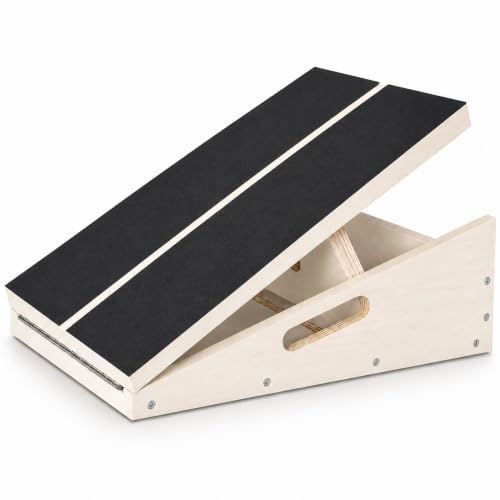
Best Sturdy Training Board – Professional Wooden Slant Board
For shoppers prioritizing a sturdy build and exercise versatility, this professional wooden board is a strong contender among slant boards. It combines five angle settings with a textured top, slip-resistant base, side handle, and a stated 500-pound capacity.
Best For: Users who want a durable board for calf stretching, ankle mobility, squats, calf raises, balance drills, and warm-ups.
Pros:
- Five settings from 15° to 35° support gradual progression
- 500-pound capacity with reinforced wooden supports
- Textured standing surface and slip-resistant base help provide secure contact
- Includes side carry handles, an exercise guide, and a three-year warranty
Cons:
- At about 8.5 pounds, it is less portable than the lightweight foam model
- The wooden construction may take up more storage space
This is the most feature-focused choice of the three for structured training. Its angle range starts lower than the other wooden model and its stability-oriented design makes it suitable for users who want one board for stretching, strength, and mobility routines.
Best Heavy-Duty Pick – EVERYMATE Wooden Slant Board
If you want a sturdy option among slant boards for stretching and weighted exercises, the EVERYMATE is built from hardwood plywood with a 1,000-pound stated capacity. Its wide, sandpaper-covered surface and bottom ribs provide a stable platform for calf stretches, squats, lunges, and mobility work.
Best For: Home gyms, strength training, ATG or VMO squats, rehabilitation exercises, and users who prioritize high load capacity.
Pros:
- Supports up to 1,000 pounds according to the supplied specifications.
- Wide 19.7-inch platform with a full anti-slip surface and bottom grip features.
- Preassembled hardwood design includes multiple carry handles.
- Suitable for calf, hamstring, hip, ankle, and squat-focused exercises.
Cons:
- Only one incline level is listed.
- At about 3.11 kg, it is heavier than some compact foldable options.
- The fixed wedge design may be less convenient for users wanting several angles.
The EVERYMATE stands out when stability and capacity matter more than adjustability. It is a practical choice for demanding workouts, though users seeking a lighter or multi-angle board may prefer another design.
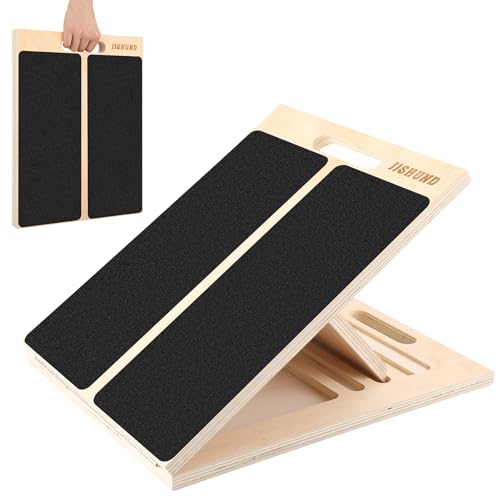
Best for Angle Variety – Adjustable Wooden Slant Board
This adjustable slant board offers five incline positions, making it easier to match the stretch intensity to your experience or exercise. The wooden triangular structure, sandpaper top, and bottom anti-slip pad support calf stretching, ankle mobility, squats, and lower-body flexibility work.
Best For: Beginners, rehabilitation routines, progressive stretching, and users who want multiple fixed angles in one portable board.
Pros:
- Five adjustable angles from 20° to 45°.
- Foldable design with a hollow carry handle for transport and storage.
- Anti-slip sandpaper surface and bottom pad help limit movement.
- Thickened multilayer wood supports loads of about 200 pounds.
Cons:
- Its stated load capacity is lower than the other listed options.
- Weighs 4.8 pounds, despite its portable design.
- It may have less capacity for heavy weighted exercises.
The main advantage here is flexibility: five settings let you progress from gentle mobility work to deeper stretching. It is a sensible choice when adjustability is more important than maximum weight capacity.
Best Portable Premium Option – Frylr Folding Slant Board
The Frylr combines adjustable positioning with a folding wooden frame, making it one of the more travel-friendly slant boards in this roundup. It offers four incline settings, a wide non-slip foot surface, a carry handle, and a magnetic closure for storage at home, in an office, or at the gym.
Best For: Users who want a foldable board for daily mobility breaks, warm-ups, recovery sessions, and lower-body stretching in multiple locations.
Pros:
- Four fixed angles: 20°, 25°, 30°, and 40°.
- Folding design includes an integrated handle and magnetic closure.
- 12-layer wood construction has a stated 500-pound capacity.
- Non-slip foot surface and bottom grip pads support a planted setup.
Cons:
- It is not described as offering as many angles as the five-position alternative.
- Folded dimensions may still require dedicated storage space.
- The supplied details contain differing weight information, so buyers should verify the current listing.
Frylr is a strong middle ground for shoppers who want portability without giving up a substantial stated load capacity. Its folding format and four angles make it especially convenient for regular mobility work away from a dedicated gym.
How We Picked the Best Slant Boards
We evaluated these Slant Boards by intended use, construction, adjustability, traction, portability, and stated load capacity. Because a writing board has different requirements from a squat wedge, we considered how well each design fits its primary purpose rather than treating every model as interchangeable.
We also looked for practical details such as non-slip surfaces, stable bases, carrying handles, foldable or portable designs, and multiple angle settings. Capacity figures are manufacturer claims, so users should stay within the stated limit and follow the product’s instructions.
Quick Comparison
| Best For | Look For | Most Useful Feature |
|---|---|---|
| Calf stretching | Adjustable incline and secure traction | Progressive stretch angles |
| Heel-elevated squats | Wide, stable wedge and high capacity | Confident foot placement |
| Travel or home storage | Foldable or lightweight construction | Easy portability |
| Writing and posture | Broad, smooth sloped surface | Improved page positioning |
| Physical therapy | Stable base and controlled angles | Repeatable positioning |
Key Buying Factors for Slant Boards
Angle and Adjustability
A fixed wedge is simple and quick, while an adjustable board lets you select a gentler or deeper stretch. Multiple positions are especially useful when several people share the board or when you are gradually increasing mobility work.
Stability and Traction
Look for a broad base, textured or non-slip contact points, and a surface that keeps your feet from sliding. Stability matters most during loaded squats, balance-sensitive stretches, and rehabilitation exercises.
Capacity and Construction
Wooden boards can offer a firm, durable platform, while compact molded wedges may be easier to clean and carry. Choose a capacity comfortably above your body weight plus any external load, and inspect the board regularly for cracks, loosened hardware, or worn grip material.
Size and Portability
A larger platform may feel more secure, but it takes up more storage space. Handles, folding features, and lighter construction are useful if you move the board between rooms, take it to a gym, or travel with it.
Intended Use
Writing Slant Boards prioritize surface angle and page support; exercise models prioritize traction, durability, and foot placement. If you need both functions, check the dimensions and surface design carefully rather than assuming an exercise wedge will work well as a desk accessory.
Who Should Buy Which Slant Boards?
Choose an adjustable calf-stretch board if you want to vary intensity or share the equipment. A sturdy high-capacity squat wedge is better for strength training and loaded heel elevation. Portable or foldable wooden models suit home users with limited storage, while a dedicated writing slant board is the better choice for handwriting posture and desk-based positioning.
For physical therapy or pain-related mobility work, select a stable model with manageable angles and consult a qualified professional when appropriate. Whichever design you choose, begin with a comfortable position, use controlled movement, and stop if you experience sharp pain.