Choosing among pull-up bars for seniors requires more than comparing weight limits. The right support should match the user’s strength, bed or chair setup, available floor space, and the type of assistance needed.
This roundup includes bedside trapeze bars, free-standing transfer aids, and couch-support handles designed to help with repositioning, sitting, standing, and transfers. Use the guide below to narrow the options by stability, adjustability, installation, and ease of use.
Best 10 Pull Up Bars for Seniors Picks for 2026
Best Bedside Mobility Pick
VEVOR Height-Adjustable Trapeze Bar

- 300-pound steel-frame capacity
- Adjustable height and support strap
- Wheeled freestanding bedside design
Best For: Bed-to-wheelchair transfers and repositioning
Best Portable Standing Aid

- Compact 15.52-ounce design
- Textured rubber non-slip grips
- Designed for two-person assistance
Best For: Portable assisted standing from chairs, beds, or cars
Best Heavy-Duty Bed Trapeze
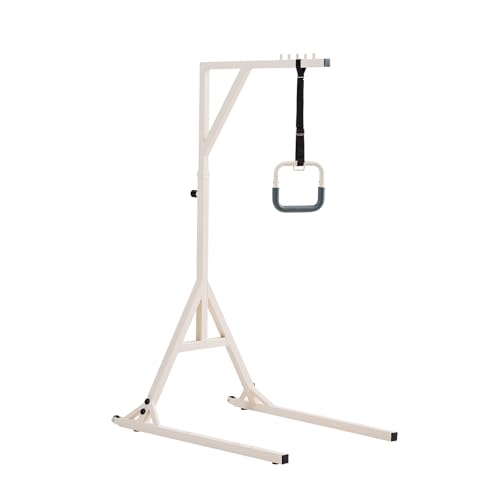
- 350-pound stated weight capacity
- Reinforced triangular support structure
- Adjustable strap, handle, and overall height
Best For: Higher-capacity bedside transfers and repositioning
Best Compact Contact-Free Aid

- Contact-free assisted-standing design
- Lightweight 7.4-ounce construction
- Portable for chairs, sofas, and cars
Best For: Travel-friendly assisted transfers in multiple locations
Best Heavy-Duty Bedside Support

- 330-pound carbon-steel capacity
- Height and lanyard adjustability
- Wide base with locking casters
Best For: Frequent bedside repositioning and transfers
Best Couch Transfer Aid

- Supports up to 250 pounds
- Adjustable handle and base
- Designed for compatible furniture
Best For: Standing assistance beside couches and chairs
Best Space-Saving Bed Clamp

- 250-pound steel-frame capacity
- Clamp-on, space-saving design
- Adjustable and horizontally sliding chain
Best For: Compatible home or medical beds with sturdy headboards
Best Bedside Support
Adjustable Floor-Stand Trapeze Bar

- Adjustable 9.5-inch handle
- 250-pound iron-frame capacity
- Disassembles for storage or transport
Best For: Bedside repositioning and transfers
Best Heavy-Duty Floor Stand

- 250-pound Q195 steel capacity
- Adjustable handle strap positioning
- Optional floor anchoring hardware
Best For: Stable home-care or institutional bedside assistance
Best Space-Saving Option

- No bedside floor frame required
- 350-pound strap capacity
- Fits 90- to 110-inch ceilings
Best For: Compact rooms with suitable ceiling support
Best Bedside Mobility Pick – VEVOR Height-Adjustable Trapeze Bar
For shoppers comparing pull up bars for seniors, this freestanding VEVOR trapeze bar is designed primarily as a bedside transfer aid. Its adjustable height, strap, non-slip handle, and wheeled base can help users reposition or move between a bed and wheelchair with greater independence.
Best For: Seniors and people with limited mobility who need a sturdy, movable bedside support in home care, nursing home, or hospital settings.
Pros:
- Supports up to 300 pounds with a reinforced Q195 steel frame.
- Height and handle strap adjust to different users and bed setups.
- Two casters make the 42.6-pound unit easier to reposition.
- Non-slip handle and tool-light installation support everyday use.
Cons:
- Its 39-inch width and 68.1-inch height require adequate space.
- At 42.6 pounds, it is not especially lightweight to move without the casters.
- This is a bedside transfer aid rather than a conventional doorway exercise bar.
Choose this model when stable bed mobility is the priority. It offers useful adjustability and mobility, but buyers should measure the available space and distinguish its assisted-transfer design from a standard pull-up bar.
Best Portable Standing Aid – Liberty Lift Standing Aid
Among pull up bars for seniors, the Liberty Lift is a compact standing aid rather than a full-size exercise bar. Its textured rubber grips and lightweight design make it suitable for assisted transfers from seats, vehicles, or other indoor and outdoor locations.
Best For: Seniors or people recovering from knee replacement who need a portable, two-person standing aid.
Pros:
- Rated for up to 450 pounds according to the product title.
- Textured rubber grips help reduce hand slippage.
- Compact dimensions and 15.52-ounce weight make it easy to carry.
- Can be used indoors, outdoors, or around a car.
Cons:
- Use requires two people, including one helper strong enough to assist the user.
- It does not function as a freestanding or fixed exercise bar.
- The product notes do not provide height adjustment or a detailed installation system.
This is a practical choice for portability and short assisted transfers, but it is not intended for independent lifting. Follow the supplied safety guidance and ensure the assisting person can manage the user’s weight.
Best Heavy-Duty Bed Trapeze – VEVOR 350-Pound Trapeze Bar
For seniors needing more substantial bedside support, this VEVOR model combines a freestanding floor stand with a height-adjustable trapeze and strap. It is built for transfers, repositioning, and light upper-body strengthening rather than conventional hanging pull-ups.
Best For: Bedridden patients, seniors, and people with limited mobility who need a higher-capacity bedside transfer aid.
Pros:
- Heavy-duty steel frame supports up to 350 pounds.
- Triangular reinforcement is designed to reduce wobbling and tilting.
- Product height, handle height, and strap position can be adjusted.
- Two casters aid movement, while the non-slip handle supports a secure grip.
Cons:
- The 43.7-inch width and 68.7-inch height may not suit smaller rooms.
- Its 39.5-pound weight can make manual repositioning difficult.
- Like other bed trapezes, it is not a standard doorway pull-up bar.
The increased capacity and reinforced base make this the stronger choice for users who need robust bedside assistance. Check room dimensions and bed compatibility before purchasing, and use it as a mobility aid rather than assuming it replaces supervised care.
Best Compact Contact-Free Aid – Lift Assists Standing Aid
This portable standing aid offers a different approach to pull up bars for seniors: it provides a contact-free grip for assisted rising from sofas, chairs, or cars. Its small plastic body and no-slip handles are convenient when support is needed in multiple locations.
Best For: Seniors, patients, or caregivers seeking a lightweight aid for assisted transfers at home or on the go.
Pros:
- Contact-free design helps the user rise without direct physical contact.
- Non-slip handles provide a more secure grip for the user and helper.
- Lightweight 7.4-ounce construction is easy to transport.
- Suitable for indoor and outdoor use, including sofas, chairs, and cars.
Cons:
- It is an assisted standing device, not a fixed pull-up or bedside bar.
- The supplied notes do not state a specific weight capacity.
- Its small footprint may offer less leverage than a larger standing aid.
This model makes sense when portability and minimal-contact assistance matter most. Buyers who need a stable bedside frame or independently usable support should consider a freestanding trapeze instead.
Best Heavy-Duty Bedside Support – Adjustable Bed Trapeze Bar
For shoppers comparing pull up bars for seniors, this freestanding bed trapeze bar is designed to assist with sitting up, turning, repositioning, and transfers. Its adjustable height, wide base, and 330-pound capacity make it a substantial option for home mobility support.
Best For: Seniors or adults with limited mobility who need bedside assistance and prefer a freestanding, height-adjustable design.
Pros:
- Supports up to 330 pounds with a carbon-steel frame.
- Height adjusts from 35.4 to 74.8 inches, with multiple pull-rod positions.
- Wide 36-by-24-inch base and locking swivel casters support positioning.
- Can assist with sitting up, turning, transfers, and arm strengthening.
Cons:
- At 29.7 pounds, it is heavier than a compact bedside aid.
- The large freestanding base requires adequate floor space.
- Users should follow the included installation instructions before use.
This is a strong choice when stability and adjustability matter more than a small footprint. The wheeled base adds positioning convenience, while the high weight capacity suits frequent daily assistance.
Best Couch Transfer Aid – Stander CouchCane
Among pull up bars for seniors, the Stander CouchCane focuses on getting up from seated furniture rather than bedside lifting. Its ergonomic handle and adjustable frame provide leverage for sitting, standing, and transferring from compatible chairs, couches, and recliners.
Best For: Adults and seniors who need support rising from a compatible four-legged chair, couch, or recliner.
Pros:
- Ergonomic grab handle supports up to 250 pounds.
- Handle height adjusts from 31 to 40.5 inches.
- Base length adjusts from 17 to 33 inches to fit many furniture styles.
- Can reduce reliance on caregiver assistance during seated transfers.
Cons:
- It is not intended for freestanding use.
- Compatibility requires four-legged furniture with feet 17 to 33 inches deep.
- Its 250-pound capacity is lower than some heavy-duty bedside options.
The CouchCane is a practical furniture-based aid for users who struggle primarily with standing from a seat. Check the dimensions and furniture compatibility carefully, since the base must sit beneath the chair or couch.
Best Space-Saving Bed Clamp – VEVOR Medical Trapeze Bar
This VEVOR model is a clamp-on option for shoppers seeking pull up bars for seniors that attach directly to a bed. The adjustable chain and sliding handle support repositioning and transfers, while the compact design avoids the larger floor footprint of a freestanding frame.
Best For: Seniors or adults with limited mobility using a compatible bed with a headboard less than 2 inches thick.
Pros:
- Q195 steel frame supports up to 250 pounds.
- Clamp design saves space compared with bulky freestanding trapeze bars.
- Metal chain adjusts handle height and moves horizontally along the support arm.
- Can assist with bed transfers, repositioning, and upper-body strengthening.
Cons:
- Must be securely attached to a bed headboard before use.
- Compatibility is limited to headboards under 2 inches thick that can support body weight.
- It weighs 20.1 pounds, so installation may require care.
This is a useful space-conscious alternative when the bed meets the stated attachment requirements. Verify the headboard thickness and strength before purchase, because secure installation is essential to safe use.
Best Bedside Support – Adjustable Floor-Stand Trapeze Bar
For shoppers comparing pull up bars for seniors, this floor-standing trapeze bar is designed specifically for bedside repositioning and transfers. Its adjustable handle, iron frame, and broad compatibility with beds, chairs, and couches make it a practical mobility aid for home care.
Best For: Seniors or adults with limited mobility who need bedside support for changing position or getting in and out of bed.
Pros:
- Adjustable 9.5-inch handle with multiple positioning options.
- Heavy-duty iron construction supports up to 250 pounds.
- Floor-standing I-shaped base fits most beds, chairs, and couches.
- Disassembles into six tubes for storage or transport.
Cons:
- At 15.24 kg, it is relatively heavy to move.
- Floor installation may be needed for the stated 300-pound base requirement.
- Designed for mobility assistance rather than a conventional doorway workout.
Its adjustable grip and portable frame make this a flexible choice when bedside independence is the priority. Follow the assembly instructions and use the base hardware as directed for the most stable setup.
Best Heavy-Duty Floor Stand – VEVOR Bed Mobility Trapeze
Among pull up bars for seniors, this VEVOR trapeze focuses on stable, floor-supported assistance for getting up, repositioning, and transferring. Its Q195 steel frame, adjustable strap, and optional floor anchoring suit home-care and institutional settings.
Best For: Seniors, disabled users, and people with limited mobility who need a sturdy standing aid beside a bed.
Pros:
- Heavy-duty steel frame supports up to 250 pounds.
- Triangular reinforcement helps limit wobbling and tilting.
- Handle height and horizontal strap position can be adjusted.
- Includes hardware and base holes for floor anchoring.
Cons:
- Weighs 33.3 pounds and may be difficult to reposition frequently.
- Floor anchoring requires installation and a suitable surface.
- The 38-inch width should be checked against the available bedside space.
This is a strong option when stability and adjustability matter more than portability. Anchoring the base as directed can provide additional confidence during transfers.
Best Space-Saving Option – Ceiling-Mounted Bed Trapeze
This ceiling-mounted option offers a different approach to pull up bars for seniors by removing the need for a bedside floor frame. The adjustable strap and wide handle help users pull up, reposition, or transfer while keeping the area around the bed less cluttered.
Best For: Rooms with suitable ceiling support where a compact, permanently mounted bedside assist is preferred.
Pros:
- Ceiling mounting eliminates bedside and floor support.
- Durable strap supports up to 350 pounds.
- Adjustable 45- to 68-inch strap suits 90- to 110-inch ceilings.
- Lightweight 1.5-pound design is easy to handle before installation.
Cons:
- Ceiling weight capacity must be verified before purchase.
- Installation is less flexible than a free-standing bar once mounted.
- It is intended for ceilings 7.5 to 9 feet high.
This design is especially useful when floor space is limited, but the ceiling must be structurally suitable. Confirm the mounting surface and dimensions before installation for safe use.
How We Picked the Best Pull Up Bars for Seniors
We focused on products intended to support common mobility tasks such as repositioning in bed, sitting up, standing from a chair, and transferring between surfaces. The selection includes free-standing trapeze frames, bedside and hospital-bed supports, clamp-mounted designs, and portable standing aids.
We compared stated weight capacities, adjustment options, handle design, portability, installation requirements, and the likely stability of each format. Capacity is only a starting point: users should also consider whether the device is designed for pulling, pushing, balance support, or partial weight-bearing assistance.
Quick Comparison
| Support Type | Best For | Main Advantage | Important Limitation |
|---|---|---|---|
| Free-standing trapeze | Bed mobility without permanent installation | Adjustable placement and broad compatibility | Needs adequate floor space and a stable base |
| Bedside trapeze | Pulling up or repositioning in bed | Direct overhead assistance | Must match the bed frame or mounting location |
| Clamp- or ceiling-mounted trapeze | Dedicated bedroom or clinical setups | Can provide a fixed support point | Installation and compatibility are critical |
| Standing aid or couch cane | Getting up from chairs and couches | Compact, hand-level support | Not a substitute for an overhead bed trapeze |
Key Buying Factors for Pull-Up Bars for Seniors
Match the Device to the Task
Bed trapezes are designed primarily for upper-body assistance while lying or sitting. Standing aids and couch canes are better suited to rising from a seated position. If the user needs help with transfers, verify that the product’s instructions specifically allow that use.
Check Capacity and Stability
Choose a stated weight capacity comfortably above the user’s weight, while accounting for force generated during pulling or shifting. A high rating does not guarantee stability on every floor, bed, or chair. Check base dimensions, frame construction, clamp security, and the manufacturer’s setup instructions.
Prioritize Adjustability and Grip Comfort
Height adjustment can make the handle easier to reach and reduce awkward strain. Look for nonslip grips, a handle shape the user can close their hand around, and adjustment points that lock securely. Users with limited hand strength may need larger or padded grips.
Consider Installation and Space
Measure the bed, frame, mattress height, chair, and surrounding floor area before ordering. Free-standing models generally need clear space for their base, while mounted options require compatible hardware or professional installation. Avoid placing any support where it can slide, tip, or interfere with walking paths.
Review Safety and Supervision Needs
These products provide assistance, not guaranteed fall protection. Follow assembly instructions, inspect bolts and chains regularly, and stop using the device if it rocks, bends, or loosens. A clinician or occupational therapist can help determine whether a trapeze, grab bar, transfer rail, or different mobility aid is appropriate.
Who Should Buy Which Pull Up Bars for Seniors?
Choose a free-standing trapeze if the user needs adjustable bed support and cannot permanently modify the room. Choose a bedside or mounted trapeze for a compatible hospital-style bed or a dedicated installation where a fixed overhead handle is preferred. Choose a standing aid or couch cane when the main challenge is rising from a sofa or chair rather than repositioning in bed. For users with substantial weakness, balance problems, or unpredictable transfers, seek professional guidance before relying on any of these pull-up bars for seniors.