A good window fan can cool a room, exchange stale air, and reduce reliance on central air—but the right model depends on more than blade size. Remote controls, reversible airflow, fit, noise, and weather resistance all affect how useful a fan is day to day.
We’ve gathered 10 window fans with remote controls, including compact twin-fan designs, thermostat-equipped models, weather-resistant options, and smart fans with app control. Use the guide below to narrow the list based on your room, window, and cooling routine.
Best 10 Window Fans with Remote Controls Picks for 2026
Best Programmable Pick
Bionaire Reversible Window Fan

- Reversible intake, exhaust, and exchange airflow
- Programmable thermostat with LED display
- Fits 24- to 36-inch windows
Best For: Temperature-based cooling and flexible ventilation
Best Easy-Clean Option
Holmes Digital CleanBreeze Window Fan

- Reversible twin-blade airflow
- Digital controls plus remote operation
- Removable back panel for dust removal
Best For: Convenient cleaning and flexible placement
Best Window-Fit Flexibility
Comfort Zone Reversible Twin Fan

- Three modes: cool, circulate, and exhaust
- Adjusts from 23.5 to 37 inches
- Includes fabric cover and bug screen
Best For: Flexible installation and multi-mode ventilation
Best Expandable Fit
Shinic 9-Inch Reversible Remote Window Fan

- Intake, exhaust, and circulation modes
- Expandable from 23.5 to 37 inches
- Includes foam sealing tape and removable feet
Best For: Flexible window installation and remote-controlled ventilation
Best Simple Twin Design
Amazon Basics 9-Inch Reversible Window Fan

- Reversible intake and exhaust airflow
- Three speeds with digital controls
- Expandable panels fit 25- to 32-inch windows
Best For: Straightforward ventilation in small to medium rooms
Best Smart Controls
Shinic 9-Inch WiFi Twin Window Fan

- WiFi, app, remote, and voice control
- Three modes and three speed settings
- Adjustable width from 23.5 to 37 inches
Best For: Connected homes needing flexible remote ventilation
Best All-Around Pick
shinic Reversible Window Fan with Remote

- Four speeds with reversible intake and exhaust airflow
- Remote, timer, and LED thermostat control
- Fits 26- to 39.7-inch horizontal windows
Best For: Bedrooms and offices needing automated, remote-controlled ventilation
Best Simple Twin-Fan Option
Comfort Zone 9-Inch Reversible Window Fan

- Twin fans with reversible intake and exhaust airflow
- Auto-locking expanders fit 22.25- to 33-inch windows
- Portable tabletop design with removable fabric cover
Best For: Basic, portable ventilation without remote or thermostat controls
Best for Thermostat Control
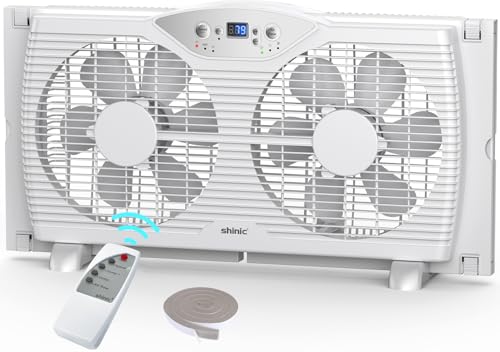
- Three modes: intake, exhaust, and air exchange
- Remote thermostat control from 60°F to 85°F
- Adjustable panels fit 23.5- to 37-inch windows
Best For: Rooms needing automated temperature monitoring and remote airflow control
Best Programmable Pick – Bionaire Reversible Window Fan
For shoppers comparing window fans with remote controls, the Bionaire stands out for combining reversible airflow, three speed settings, and temperature-based operation. Its digital display and included extenders make it a practical choice for everyday room cooling.
Best For: Bedrooms, living spaces, and users who want programmable temperature control.
Pros:
- Supports intake, exhaust, or simultaneous air exchange.
- Programmable thermostat and LED temperature display.
- Fits 24- to 36-inch windows with included extender panels.
- Includes a remote control and requires no assembly.
Cons:
- Limited to three speed settings.
- Designed for indoor use and requires a standard outlet.
The Bionaire is a strong all-around option when automatic temperature control matters as much as remote operation. Its broad window-fit range and reversible airflow add flexibility for cooling and ventilation.
Best Easy-Clean Option – Holmes Digital CleanBreeze Window Fan
The Holmes CleanBreeze is a practical choice among window fans with remote controls, offering electronically reversible airflow, three speeds, and digital controls. Its removable back panel also makes routine dust removal easier.
Best For: Homes that want remote operation, reversible airflow, and simpler fan cleaning.
Pros:
- Intakes fresh air, exhausts warm air, or exchanges airflow simultaneously.
- Three speeds with digital controls and a remote.
- Removable back panel supports quick dust removal.
- Removable feet allow tabletop or flat-surface placement.
Cons:
- Only three speed settings are available.
- The notes do not specify an adjustable window-width range.
Choose the Holmes if maintenance convenience is a priority. The CleanBreeze panel, reversible twin-blade design, and included feet make it useful both in a window and on a flat surface.
Best Window-Fit Flexibility – Comfort Zone Reversible Twin Fan
The Comfort Zone is one of the more versatile window fans with remote controls, with cooling, circulation, and exhaust modes plus adjustable accordion expanders. A fabric cover and bug screen add practical seasonal convenience.
Best For: Bedrooms and other rooms needing adjustable installation width and multiple airflow modes.
Pros:
- Offers cool, circulate, and exhaust modes.
- Remote adjusts speed, function, and power from a distance.
- Expanders fit windows from 23.5 to 37 inches and lock in place.
- Includes a fabric cover and bug screen.
Cons:
- Its listed 431 CFM airflow capacity is lower than some larger-capacity models.
- At 52 dB, it has the highest listed noise level among these four options.
- The supplied notes do not include a thermostat.
This model makes sense when installation flexibility and dedicated airflow modes are more important than automatic temperature control. Its wide adjustment range and included screening accessories are useful for seasonal window use.
Best Low-Profile Design – Vornado TRANSOM Window Fan
The Vornado TRANSOM is a low-profile option for shoppers seeking window fans with remote controls and a more streamlined installation. It combines four speeds, electronic exhaust reversal, auto temperature control, and a foam-block sealing system.
Best For: Single- or double-hung windows that need a compact, adjustable ventilation fan.
Pros:
- Four speed settings provide more airflow adjustment than three-speed models.
- Electronically switches between fan and exhaust modes.
- Fits 26- to 40-inch-wide windows using the Soft-fit foam block system.
- Includes remote control and auto temperature control.
Cons:
- Can only be installed horizontally.
- Window screen removal may be necessary depending on window depth.
- Requires a window opening at least 8 inches tall.
The TRANSOM is a compelling pick for buyers who value a low-profile form and precise control. Check the window dimensions and screen clearance carefully before purchasing, since installation requirements are more specific.
Best Expandable Fit – Shinic 9-Inch Reversible Remote Window Fan
If you need window fans with remote controls for a range of window sizes, this Shinic model is a practical option. It offers intake, exhaust, and circulation modes, three speeds, and an expandable panel that adjusts from 23.5 to 37 inches.
Best For: Buyers who want flexible installation and remote-controlled airflow for bedrooms, living rooms, bathrooms, or other indoor spaces.
Pros:
- Three airflow modes: intake, exhaust, and circulation.
- Adjustable panel fits windows from 23.5 to 37 inches.
- Includes removable feet, handles, ETL certification, and foam sealing tape.
- Remote control and three speed settings support convenient adjustments.
Cons:
- Remote requires two AAA batteries, which are not included.
- At 49 dB, it may not be the quietest choice for noise-sensitive users.
Its broad adjustment range and included sealing strip make this a well-equipped choice for buyers focused on fit and airflow flexibility. The 450 CFM capacity and 70-watt motor provide useful everyday ventilation, while the portable design allows free-standing use when needed.
Best Simple Twin Design – Amazon Basics 9-Inch Reversible Window Fan
For shoppers seeking window fans with remote controls and straightforward operation, this Amazon Basics twin fan keeps the feature set simple. It provides three speeds, reversible intake or exhaust airflow, digital controls, and expandable side panels for standard windows.
Best For: Small to medium bedrooms and other indoor spaces where basic reversible airflow and a standard-window fit are the priorities.
Pros:
- Switches between intake and exhaust airflow.
- Three speed settings support personalized comfort.
- Expandable side panels fit windows from 25 to 32 inches wide.
- Includes a remote and uses a copper motor for consistent operation.
Cons:
- Its adjustment range is narrower than models extending to 37 inches.
- The supplied notes describe digital controls but do not list a noise rating.
This twin-fan design is a sensible pick if your window falls within its 25- to 32-inch range and you want uncomplicated intake and exhaust control. It has fewer installation extras than some competitors, but its compact 9-inch format and three-speed operation suit everyday bedroom ventilation.
Best Smart Controls – Shinic 9-Inch WiFi Twin Window Fan
This Shinic model stands out among window fans with remote controls by adding WiFi, app, and voice operation. Along with its included remote, it provides intake, exhaust, and circulation modes, three speeds, and an adjustable width from 23.5 to 37 inches.
Best For: Connected homes where users want to manage window ventilation through SmartLife, Alexa, Google Assistant, a remote, or onboard buttons.
Pros:
- Supports SmartLife app control and Alexa or Google Assistant voice commands.
- Offers three speeds and intake, exhaust, and circulation functions.
- Accordion expanders adjust from 23.5 to 37 inches.
- Includes removable feet, a handle, remote control, and ETL certification.
Cons:
- Smart features may be unnecessary for shoppers who only want manual operation.
- Remote operation requires setup beyond the included physical controls.
With several control methods and a wide expansion range, this is the most versatile option of the three for connected-home users. Its 450 CFM airflow, 70-watt power draw, and 49 dB listed noise level provide useful context when weighing smart convenience against basic fan functionality.
Best All-Around Pick – shinic Reversible Window Fan with Remote
For shoppers comparing window fans with remote controls, this shinic model combines four speeds, reversible airflow, and thermostat automation. Its remote lets you adjust settings from across the room, while the included spacer blocks help create a fit for 26- to 39.7-inch horizontal window openings.
Best For: Bedrooms, offices, and other rooms where remote operation, scheduled cooling, and flexible airflow matter.
Pros:
- Reversible intake and exhaust modes help bring in cooler air or remove heat and odors.
- Four speeds, a timer, and LED digital thermostat provide flexible control.
- Includes six spacer blocks and fits 26- to 39.7-inch windows with an opening at least 8 inches tall.
- Low-profile, enclosed design is rated at 47 dB and has no exposed blades.
Cons:
- Horizontal installation only.
- Remote requires two AAA batteries, which are not included.
- Its 26-inch width may be too large for smaller windows.
This is the most feature-rich option of the three, particularly if you want thermostat-based operation and four speed levels. Confirm your window dimensions and horizontal installation requirements before buying.
Best Simple Twin-Fan Option – Comfort Zone 9-Inch Reversible Window Fan
If you want window fans with remote controls but prefer a straightforward manual design, the Comfort Zone CZ319WT offers twin-fan airflow with two speed settings. Its auto-locking expanders fit 22.25- to 33-inch windows, and the unit can also stand on a tabletop or other flat surface.
Best For: Buyers seeking a portable twin window fan with simple reversible ventilation and no battery-dependent controls.
Pros:
- Reversible function switches between drawing in fresh air and exhausting hot or stale air.
- Auto-locking accordion expanders provide a snug fit for 22.25- to 33-inch windows.
- Two speed settings accommodate gentler or stronger airflow.
- Removable fabric cover helps protect against bugs and debris when the fan is not in use.
Cons:
- Only two speed settings are available.
- Airflow direction is manually reversed rather than controlled by remote.
- The listed noise level is 53 dB.
This model is a practical choice for basic intake and exhaust ventilation, especially when portability is useful. However, it does not provide the remote control or thermostat features found on the other options.
Best for Thermostat Control – shinic Twin 9-Inch Window Fan
For shoppers looking at window fans with remote controls, this twin shinic model adds three airflow modes, three speeds, and programmable thermostat operation. The remote adjusts speed, direction, and temperature, while adjustable side panels accommodate windows from 23.5 to 37 inches.
Best For: Rooms where automatic temperature control, visible temperature readings, and reversible air exchange are priorities.
Pros:
- Supports intake, exhaust, and air-exchange modes for flexible ventilation.
- Programmable thermostat operates from 60°F to 85°F and displays temperature on LED lights.
- Remote controls speed, airflow direction, and temperature from across the room.
- Includes adjustable side panels and foam sealing tape for a better window fit.
Cons:
- It has three speed settings rather than four.
- The listed dimensions are 23.5 inches wide without feet installed, so window clearance should be checked carefully.
- Foam sealing tape is supplied as a single 2.23-foot roll.
This is a strong match for buyers who want more than basic airflow control. Its thermostat, LED display, and remote make it especially convenient, provided your window is compatible with the 23.5- to 37-inch fit range.
How We Picked the Best Window Fans with Remote Controls
We focused on models that combine practical airflow control with convenient remote operation. The selection covers single- and twin-fan designs, reversible intake and exhaust modes, multiple speed settings, programmable or built-in thermostats, expandable side panels, and weather-resistant construction. We also considered fit ranges, control layouts, noise-related features, and whether a fan is better suited to spot cooling, whole-room circulation, or ventilation.
Because window dimensions and installation conditions vary, specifications should be checked carefully before purchase. A fan that performs well in a wide opening may not be appropriate for a narrow bedroom window, while a compact model may not move enough air for a large living space.
Quick Comparison
| Feature | What to look for | Best suited to |
|---|---|---|
| Fan design | Single fan or twin independent fans | Single fans suit compact spaces; twin fans offer more flexible airflow |
| Airflow modes | Intake, exhaust, circulate, or reversible operation | Homes needing both cooling and stale-air removal |
| Controls | Remote, digital panel, thermostat, or Wi-Fi app | Users who want control from bed, a desk, or across the room |
| Installation | Expandable panels, spacers, and stated width range | Windows with nonstandard or wider openings |
| Durability | Weather-resistant housing or protected placement | Windows exposed to humidity or occasional outdoor conditions |
Key Buying Factors for Window Fans with Remote Controls
Measure the Window First
Measure the clear opening—not just the frame—and compare it with the fan’s minimum and maximum width. Expanders, spacers, and locking panels can improve stability, but they cannot compensate for an incompatible window. Also confirm whether the unit is designed for vertical, horizontal, or either orientation.
Choose Airflow for the Job
Reversible models can pull cooler outdoor air inside, exhaust warm or stale air, or alternate between both. Twin fans may offer independent intake and exhaust operation, while a circulation mode can move air without exchanging it. For bedrooms, prioritize quieter operation and low-speed control; for kitchens or workshops, exhaust capability may matter more.
Check Remote and Thermostat Features
A remote is most useful when it controls the functions you actually need, such as speed, direction, mode, timer, or temperature. Thermostat-equipped fans can cycle automatically, which may improve comfort and reduce unnecessary operation. Digital displays are convenient, but bright LEDs may matter in a bedroom.
Consider Noise, Power, and Protection
Look for low-noise claims or multiple speed settings if the fan will run overnight. Weather-resistant construction is helpful when the unit sits near rain or damp air, but it does not make every fan safe for direct water exposure. Use the manufacturer’s installation guidance and avoid blocking the window’s secure closure.
Who Should Buy Which Window Fans with Remote Controls?
- For bedrooms: Choose a quieter compact model with a remote, several speeds, and thermostat or timer functions.
- For flexible ventilation: Pick a reversible twin-fan design with intake, exhaust, and circulation modes.
- For larger rooms: Consider a higher-airflow model with broader coverage and sturdy window fit.
- For unusual window sizes: Favor adjustable expanders, spacer blocks, or a clearly stated wide fit range.
- For connected homes: A Wi-Fi-enabled fan may be worthwhile if app control and scheduling are more important than simple operation.
- For humid or exposed locations: Select a weather-resistant housing and follow placement limits carefully.