Indoor cycling is easier to structure when you can see consistent power data, whether you use a smart trainer or add power-meter pedals to your existing setup.
We selected 10 bike trainers with power meter options for different budgets and training styles, including direct-drive, wheel-on, and pedal-based systems.
Best 10 Bike Trainers with Power Meter Picks for 2026
Best Quiet Smart Trainer

- 2,000W output with ±2% stated accuracy
- Simulates gradients up to 18%
- ANT+ and BLE compatible
Best For: Quiet indoor training with Zwift and similar software
Best Dual-Sided Pedal Meter

- Dual-sided power measurement
- Stated ±1% accuracy
- Bluetooth and ANT+ connectivity
Best For: Road cyclists wanting portable power data
Best High-Power Smart Trainer

- 2,500W maximum power
- Simulates gradients up to 25%
- Stated ±1% accuracy without calibration
Best For: High-intensity virtual training and route simulation
Best Single-Sided Pedal Meter

- Left-pedal power sensing
- Stated ±1% accuracy
- Power Phase and Rider Position metrics
Best For: Road riders seeking detailed single-sided power data
Premium Smart Trainer
Elite Justo Direct Drive Smart Trainer

- Built-in power meter with ANT+ and Bluetooth connectivity
- Up to 24% slope simulation and 2,300W maximum output
- Compatible with major devices and Shimano 9–12-speed road cassettes
Best For: Connected indoor training with advanced resistance and power data
Power-Meter Pedals
Magene P715 Dual-Sensing Power Meter Pedals
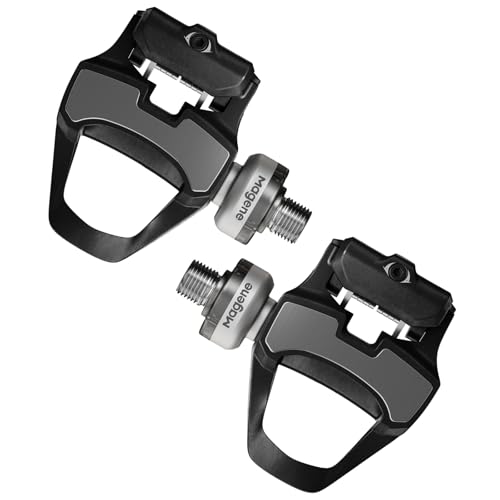
- Measures left and right leg power at stated ±1% accuracy
- SPD-SL compatible with one-minute installation
- ANT+ and Bluetooth connectivity with 120-hour battery life
Best For: Road cyclists adding dual-sided power data to a trainer setup
Simple Magnetic Stand
Portable Foldable Magnetic Bike Trainer
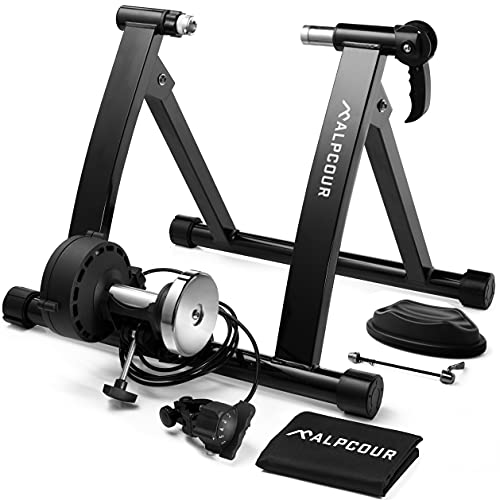
- Six fixed magnetic resistance levels
- Foldable stainless-steel frame with carrying bag
- Supports most 26–28-inch and 700c wheels
Best For: Portable basic indoor riding when power is tracked separately
Best Smart Wheel-On Trainer

- Electromagnetic resistance
- ANT+ FE-C and Bluetooth
- +/- 5% stated accuracy
Best For: App-connected training without removing the rear wheel
Best Budget Magnetic Stand
Sportneer Magnetic Bike Trainer

- Six resistance levels
- Fits 26–28-inch and 700C wheels
- Stable wide-base design
Best For: Basic indoor workouts without app-based power tracking
Best Fluid Resistance Option

- Fluid resistance mechanism
- Fits road, mountain, and hybrid bikes
- Zwift-compatible listing
Best For: Versatile fluid-resistance training with smart features verified
Best Quiet Smart Trainer – ThinkRider X2Max
The ThinkRider X2Max is a practical choice among bike trainers with power meter functionality if you want a direct indoor setup with broad software compatibility. Its electromagnetic resistance provides up to 2,000 watts, reports power with stated ±2% accuracy, and simulates gradients up to 18%.
Best For: Riders seeking a quiet, stable smart trainer for Zwift and other compatible cycling software.
Pros:
- Supports both ANT+ and Bluetooth Low Energy connections.
- Provides up to 2,000 watts of power and ±2% stated power-meter accuracy.
- Simulates gradients up to 18% and produces about 58 dB of noise at 30 km/h.
- I-beam triangular construction helps maintain riding stability.
Cons:
- Cassette is not included.
- Its 18% simulated gradient and 2,000-watt output are below the XXPRO’s ratings.
The X2Max balances useful training features, quiet operation, and a sturdy iron frame. It is a sensible option when compatibility and indoor realism matter more than maximum resistance capacity.
Best Dual-Sided Pedal Meter – Favero Assioma Duo
Favero Assioma Duo Power Meter Pedal | Why We Like The Favero Assioma DUO Pedal
Check Price On AmazonThe Favero Assioma Duo is a pedal-based option for cyclists comparing bike trainers with power meter setups. It measures power on both sides, uses Favero’s IAV calculation system with stated ±1% accuracy, and connects through either Bluetooth or ANT+.
Best For: Road cyclists who want dual-sided power measurement with built-in cadence and motion sensing.
Pros:
- Measures power from both sides of the bike.
- Offers stated ±1% accuracy through the IAV power calculation system.
- Works with Bluetooth and ANT+ devices.
- Includes an inbuilt cadence sensor and gyroscope, with up to 50 hours of rechargeable battery life.
Cons:
- Designed for road bikes rather than a broad range of bike types.
- It is a pedal power meter, not a resistance trainer that simulates gradients.
Choose the Assioma Duo when you want power data to travel with the bike rather than remain tied to one indoor trainer. Its dual-sided readings and wireless connectivity make it a flexible measurement upgrade for road riding.
Best High-Power Smart Trainer – ThinkRider XXPRO
The ThinkRider XXPRO is built for demanding indoor workouts and stands out among bike trainers with power meter capability for its 2,500-watt maximum output. Its direct-drive motor provides stated ±1% data accuracy without calibration, while resistance simulation reaches a 25% gradient and includes downhill changes.
Best For: Riders who want high resistance capacity, realistic route simulation, and flexible wired or wireless use.
Pros:
- Direct-drive motor delivers stated ±1% data accuracy without calibration.
- Supports up to 2,500 watts and simulates gradients up to 25%.
- Can simulate downhill sections according to map slope.
- Supports Bluetooth, ANT+, bike GPS, PC, and Zwift, and can self-generate electricity.
Cons:
- Its iron frame weighs and measures more than a compact pedal-based power meter.
- It is specified for road bikes, limiting the stated bike-type compatibility.
The XXPRO is the strongest trainer in this group for maximum output and gradient simulation. Self-power generation adds setup flexibility, while direct drive and broad connection support suit structured virtual training.
Best Single-Sided Pedal Meter – Favero Assioma Uno
Favero Assioma Uno Power Meter Pedal | Why We Like The Favero Assioma UNO Pedal
Check Price On AmazonThe Favero Assioma Uno is a left-pedal power meter for riders evaluating bike trainers with power meter alternatives. It provides stated ±1% accuracy, communicates over Bluetooth and ANT+, and adds cadence, gyroscope, and advanced IAV metrics including Power Phase and Rider Position.
Best For: Road cyclists who want a single-sided pedal power sensor with detailed riding metrics.
Pros:
- Uses a left-pedal power sensor with stated ±1% accuracy.
- Supports Bluetooth and ANT+ for broad device compatibility.
- Includes a cadence sensor and gyroscope.
- Provides IAV Power Phase and IAV Rider Position metrics.
Cons:
- Measures power from the left side rather than both sides.
- It is intended for road bikes and does not provide trainer resistance or gradient simulation.
The Assioma Uno offers a straightforward way to add power data without replacing your indoor trainer. It is a good fit for road riders who value wireless connectivity and extra pedaling metrics in a single-sided design.
Premium Smart Trainer – Elite Justo Direct Drive Smart Trainer
The Elite Justo is a strong choice for cyclists comparing bike trainers with power meter functionality. Its direct-drive design, electronic resistance, built-in power meter, wireless ANT+ and Bluetooth connectivity, and 24% slope simulation support structured indoor training across apps and compatible devices.
Best For: Riders who want a feature-rich smart trainer for road or mountain bikes and connected indoor workouts.
Pros:
- Built-in power meter with ANT+ and Bluetooth power, speed, and cadence support
- Simulates gradients up to 24% and delivers up to 2,300W at 40 km/h
- Works with smartphones, tablets, bike computers, sports watches, Windows, and Mac
- Includes quick-release and 12x142mm thru-axle adapters
Cons:
- At 46.7 pounds, it is less convenient to move than a compact trainer
- Only Shimano 9/10/11/12-speed road cassettes are included as a compatibility option; other options are sold separately
The Justo stands out when accurate training data and broad device compatibility matter more than portability. Its substantial build and high slope simulation make it a capable centerpiece for a dedicated indoor setup.
Power-Meter Pedals – Magene P715 Dual-Sensing Power Meter Pedals
The Magene P715 pedals offer a practical way to add power measurement to a compatible bike trainer setup. They independently measure left and right leg power with stated ±1% accuracy, connect through ANT+ or Bluetooth, and install in about one minute for straightforward training-data upgrades.
Best For: Road cyclists who want dual-sided power data while keeping their existing SPD-SL cleats.
Pros:
- Dual-sensing left- and right-leg power measurement with stated ±1% accuracy
- Compatible with SPD-SL pedal systems
- Supports Bluetooth and ANT+ connections to computers, apps, and trainers
- Provides up to 120 hours of battery life and includes two power-meter pedals
Cons:
- Designed for road bikes and SPD-SL systems rather than broad pedal compatibility
- This is a pedal-based power meter, not a standalone resistance trainer
The P715 is best viewed as a power-sensing upgrade rather than a complete indoor trainer. It can complement a compatible trainer by supplying bilateral power data without requiring a full trainer replacement.
Simple Magnetic Stand – Portable Foldable Magnetic Bike Trainer
This foldable magnetic stand is a basic option for indoor riding, but it is not a bike trainer with a built-in power meter. It uses a tire-contact magnetic resistance unit with six manually selected levels, making it suitable for riders who already track power separately or simply want an affordable stationary setup.
Best For: Road and mountain bike owners seeking portable, uncomplicated indoor resistance training.
Pros:
- Six resistance settings controlled from the handlebar
- Foldable stainless-steel frame includes a carrying bag
- Front wheel riser, anti-slip pads, and wide base support stability
- Compatible with most 26–28-inch and 700c wheels
Cons:
- No built-in power meter or stated wireless connectivity
- Tire-contact magnetic resistance is less feature-rich than a smart direct-drive trainer
- Compatibility is limited to the listed wheel sizes
This stand makes sense for simple indoor conditioning, travel, or use with a separate power-meter pedal system such as the Magene P715. Buyers specifically seeking integrated power measurement should consider a smart trainer instead.
Best Smart Wheel-On Trainer – Saris M2 Smart Trainer
For cyclists comparing bike trainers with power meter features, the Saris M2 is a smart wheel-on option with stated accuracy of +/- 5%. It uses electromagnetic resistance and connects to compatible indoor cycling apps through ANT+ FE-C and Bluetooth.
Best For: Riders who want app-connected indoor training without removing the bike’s rear wheel.
Pros:
- Wheel-on design requires no bike disassembly.
- Supports ANT+ FE-C and Bluetooth connectivity, including Zwift compatibility.
- Electromagnetic resistance provides controlled, consistent workouts.
- Includes a steel quick-release skewer and one month of Rouvy.
Cons:
- Its listed accuracy is +/- 5%, rather than a tighter power measurement range.
- At 69 decibels at 20 mph, it may not be ideal for noise-sensitive spaces.
The M2 is the strongest fit here for structured, connected training. Its app support and stated accuracy make it more suitable for data-focused workouts than a basic magnetic stand.
Best Budget Magnetic Stand – Sportneer Magnetic Bike Trainer
The Sportneer is a straightforward magnetic stand for indoor riding, with six manually selected resistance levels. It fits many 26–28-inch and 700C road or mountain bikes and includes a quick-release skewer and front wheel riser block.
Best For: Riders seeking an adjustable, stable indoor stand for basic workouts rather than app-based power training.
Pros:
- Six resistance levels can be adjusted from the handlebar-mounted remote.
- Fits many road and mountain bikes with 26–28-inch or 700C wheels.
- Wide base, low center of gravity, and five adjustable anti-slip feet support stability.
- Includes a quick-release lever and front wheel riser block.
Cons:
- The supplied notes describe magnetic resistance but do not list a power meter or app connectivity.
- Noise can vary with tire type and tread.
- Thru-axle bikes require the appropriate non-standard version and adapter.
This trainer is better suited to simple indoor conditioning than to a roundup focused specifically on bike trainers with power meter functionality. Its appeal is easy setup, broad wheel compatibility, and adjustable resistance.
Best Fluid Resistance Option – Saris Fluid2 Indoor Trainer
Saris Fluid2 Indoor Bike Trainer, Fits Road and Mountain Bikes, Compatible with Zwift App
Check Price On AmazonThe Saris Fluid2 is a wheel-on indoor trainer using fluid resistance for road, mountain, and hybrid bikes. The supplied listing also identifies a smart-equipped option and Zwift compatibility, but it does not provide a specific power-meter accuracy rating.
Best For: Cyclists who want fluid resistance and broad bike compatibility, with smart-training needs confirmed before purchase.
Pros:
- Fluid resistance provides the trainer’s resistance mechanism.
- Compatible with road, mountain, and hybrid bikes.
- Listed as compatible with Zwift, with a smart-equipped option available.
- Backed by a limited lifetime warranty.
Cons:
- The supplied notes do not specify power-meter accuracy or detailed connectivity standards.
- The listing’s “smart equipped option” may require checking the exact configuration.
- It is a wheel-on design, so tire contact remains part of setup.
The Fluid2 makes sense for riders who prioritize fluid resistance and bike versatility. If power data is essential, verify that the selected version includes the smart equipment and measurement features you need.
How We Picked the Best Bike Trainers with Power Meter
We focused on how each option measures or supports power-based training, rather than treating every indoor trainer as equivalent. The selection includes direct-drive smart trainers with built-in power measurement, pedal-based power meters that work indoors or outdoors, and wheel-on trainers that can provide a lower-cost entry point.
We also considered resistance range, stated accuracy, connectivity, compatibility, installation, portability, noise, battery life, and whether the product works with popular training platforms such as Zwift. Because these products serve different purposes, the best choice depends on whether you need precise power data, app-controlled resistance, or simply a stable indoor riding setup.
Quick Comparison
| Type | Best For | Main Advantage | Watch Out For |
|---|---|---|---|
| Direct-drive smart trainer | Structured indoor workouts | Realistic resistance and integrated connectivity | Higher price and bike setup time |
| Power-meter pedals | Indoor and outdoor use | Power data follows your bike | Requires compatible cleats and careful installation |
| Wheel-on smart trainer | App-based training on a budget | Simple compatibility and lower cost | Tire pressure and setup affect readings |
| Basic magnetic or fluid trainer | Casual indoor riding | Affordable and easy to store | Usually lacks native power measurement |
Key Buying Factors for Bike Trainers with Power Meter
Power Accuracy and Consistency
Look for a clearly stated accuracy rating and stable readings across different efforts. Dual-sided pedals can show left-right contribution, while single-sided meters are often less expensive. Smart trainers measure power at the trainer, so drivetrain losses and bike setup can produce readings different from pedal-based systems.
Resistance and Gradient Simulation
For virtual climbs and interval sessions, check maximum resistance and simulated gradient. Higher figures are useful for powerful riders and steep virtual routes, but they matter less for easy endurance riding. Direct-drive models generally offer the most responsive resistance changes.
Connectivity and Compatibility
Confirm support for the devices and apps you use. ANT+ and Bluetooth connectivity can link a trainer or power meter to a phone, tablet, bike computer, or computer. Also verify cassette, axle, cleat, wheel-size, and frame compatibility before buying.
Setup, Noise, and Storage
Direct-drive trainers require removing the rear wheel and fitting the correct cassette or freehub. Wheel-on models are quicker to share between bikes but need consistent tire pressure. Foldable stands are convenient for occasional use, while heavier smart trainers provide greater stability.
Who Should Buy Which Bike Trainers with Power Meter?
Choose a direct-drive smart trainer if you want the most immersive indoor workouts, automatic resistance control, and reliable data without relying on tire contact.
Choose power-meter pedals if you want one measurement system for indoor training, outdoor rides, and multiple compatible bikes. Dual-sided models suit riders who value detailed data; single-sided options can reduce cost.
Choose a wheel-on smart trainer if you want app compatibility and controlled resistance with simpler installation. Choose a basic magnetic or fluid trainer if affordability, portability, and uncomplicated riding matter more than advanced power analysis.