The right heart rate monitor can turn cycling data into more useful training decisions. Whether you ride indoors, train by zones, or prepare for race day, a dependable sensor helps you track effort beyond speed and power alone.
We selected 10 heart rate monitors for cycling across chest-strap and armband designs, with attention to accuracy, connectivity, comfort, battery life, water resistance, and compatibility with bike computers, watches, phones, and training platforms.
Best 10 Heart Rate Monitor for Cycling Picks for 2026
Most Accurate Pick

- Highly accurate heart rate measurement
- Bluetooth, ANT+, and 5 kHz connectivity
- Waterproof with up to 400-hour battery life
Best For: Cyclists prioritizing accuracy and broad connectivity
Advanced Training Pick

- Transmits heart rate and HRV data
- Records workouts without a watch
- Rechargeable battery lasts up to two months
Best For: Garmin users wanting detailed training data
Rechargeable Value Pick

- ANT+ and Bluetooth connectivity
- Over 100 hours of rechargeable battery life
- Slim, secure strap with status LEDs
Best For: Cyclists wanting convenient rechargeable training data
Simple Garmin Pick

- Real-time heart rate and HRV data
- Up to one year of battery life
- Machine-washable strap with 3 ATM rating
Best For: Garmin cyclists seeking essential, low-maintenance tracking
Best Comfortable Armband

- Soft, breathable armband design
- Bluetooth pairing with up to three devices
- 38-hour operating battery
Best For: Cyclists who prefer an armband and Bluetooth connectivity
Best Everyday Chest Strap
- High-accuracy heart rate sensing
- Works with HRM-compatible equipment and apps
- Up to 400 hours of battery life
Best For: Everyday cycling with a conventional chest strap
Best Dual-Protocol Value
- Bluetooth 4.0 and ANT+ connectivity
- Up to 300 hours of battery life
- Works with bike computers and training apps
Best For: Cyclists using mixed ANT+ and Bluetooth equipment
Best Armband Pick

- Optical armband design with adjustable placement
- ANT+ and Bluetooth connectivity
- Up to 24-hour battery life with HRV mode
Best For: Cyclists who prefer an armband over a chest strap
Best Long-Battery Pick
- 400+ hours of replaceable-battery life
- Dual ANT+ and Bluetooth connectivity
- Soft, adjustable, sweat-resistant strap
Best For: Frequent cyclists who want minimal charging
Best Value Sensor

- ANT+ and Bluetooth support for cycling devices
- 800-hour replaceable CR2032 battery
- LED connection indicator and IP67 protection
Best For: Cyclists wanting a simple, long-lasting chest sensor
Most Accurate Pick – Polar H10
The Polar H10 is a strong choice if you want a highly accurate heart rate monitor for cycling with broad device compatibility. Its chest strap supports Bluetooth, ANT+, and 5 kHz connections, including simultaneous Bluetooth and ANT+ use.
Best For: Cyclists who prioritize measurement accuracy, flexible connectivity, and waterproof training gear.
Pros:
- Widely recognized for precise heart rate measurement.
- Supports Bluetooth, ANT+, and 5 kHz connections.
- Waterproof and equipped with internal memory for multiple hours.
- Battery lasts up to 400 hours with the included CR2025 battery.
Cons:
- Uses a replaceable coin-cell battery rather than a rechargeable battery.
- The listed M-XXL size may not suit every cyclist.
The Polar H10 stands out for riders who want dependable data across cycling computers, phones, and compatible equipment. Its comfortable, interference-resistant strap and long battery life make it a practical training companion.
Advanced Training Pick – Garmin HRM 600
The Garmin HRM 600 is designed for data-focused athletes seeking a heart rate monitor for cycling that can transmit real-time heart rate and HRV data to compatible Garmin cycling computers, watches, equipment, and apps.
Best For: Garmin users who want advanced workout recording, HRV data, and a rechargeable strap system.
Pros:
- Sends real-time heart rate and HRV data to compatible devices.
- Can record workouts when a watch cannot be worn and sync them to Garmin Connect.
- Machine-washable strap is available in two sizes.
- Rechargeable battery provides up to two months of use.
Cons:
- Some running-dynamics features require a compatible smartwatch.
- Its broader feature set may be more than casual cyclists need.
For cyclists already invested in Garmin’s ecosystem, the HRM 600 offers more than basic heart rate transmission. Workout recording, daily metrics, swim support, and rechargeable power make it the most feature-rich option in this group.
Rechargeable Value Pick – Wahoo TRACKR
The Wahoo TRACKR is a practical heart rate monitor for cycling when you want real-time data without relying on disposable batteries. It combines ANT+ and Bluetooth connectivity with a slim strap and a rechargeable battery rated for more than 100 hours of active use.
Best For: Cyclists who want a comfortable, rechargeable monitor that connects easily to training apps and equipment.
Pros:
- Supports both ANT+ and Bluetooth connections.
- Rechargeable battery offers over 100 hours of active battery life.
- Soft, secure strap is designed for intense exercise.
- LED indicators show detection, battery, and connection status.
Cons:
- Listed as one size, offering less sizing flexibility than some competitors.
- The supplied compatibility details specifically list smartphones rather than cycling computers.
The TRACKR balances essential training connectivity with convenient charging. Its status LEDs and secure strap are useful during rides, while ANT+ and Bluetooth support give you several ways to connect.
Simple Garmin Pick – Garmin HRM 200
The Garmin HRM 200 is a straightforward heart rate monitor for cycling that sends real-time heart rate and HRV data to compatible Garmin devices, cycling computers, fitness equipment, and apps. It uses a replaceable battery and a machine-washable strap for low-maintenance use.
Best For: Garmin cyclists who want essential heart rate and HRV tracking with long battery life.
Pros:
- Transmits real-time heart rate and HRV data.
- Compatible with Garmin cycling computers, smartwatches, apps, and equipment.
- User-replaceable battery lasts up to one year.
- Machine-washable strap and 3 ATM water rating support regular use.
Cons:
- It does not include the advanced workout-recording features listed for the HRM 600.
- The supplied listing identifies the available size as M-XL.
The HRM 200 is a sensible option for cyclists who want Garmin compatibility without paying for a more feature-heavy monitor. Its long battery life, washable strap, and durable construction suit frequent training.
Best Comfortable Armband – COROS Heart Rate Monitor
If you want a heart rate monitor for cycling that avoids a traditional chest strap, the COROS armband offers a soft, breathable fit and Bluetooth connectivity for compatible bike computers, phones, apps, and indoor trainers. Its wear detection and 38-hour operating battery make it convenient for regular workouts.
Best For: Cyclists who prefer an armband and use Bluetooth-compatible training equipment.
Pros:
- Soft, breathable fabric band designed for comfortable sports use.
- Can pair with up to three devices at once via Bluetooth.
- Wear detection automatically powers the monitor on and off.
- Provides up to 38 hours of operation per charge.
Cons:
- Bluetooth only; it is not compatible with ANT+ devices.
- Not intended for daily heart rate tracking.
- USB charging cable is included, but a Type-C adapter is not.
The COROS is a practical choice when comfort and easy wear matter more than broad protocol compatibility. Check that your cycling devices support Bluetooth before buying.
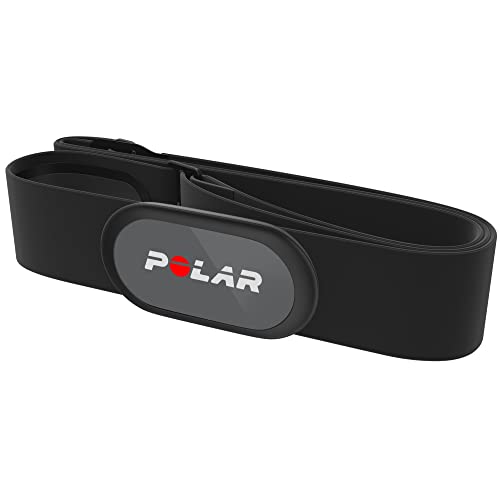
Best Everyday Chest Strap – Polar H9 Heart Rate Sensor
Polar H9 Heart Rate Sensor – ANT + / Bluetooth - Waterproof HR Monitor with Soft Chest Strap, M-XXL
Check Price On AmazonThe Polar H9 is a straightforward heart rate monitor for cycling built around a traditional chest strap. It uses high-accuracy sensors, connects with HRM-compatible equipment and smartphone apps, and offers up to 400 hours of battery life from its included CR2025 cell.
Best For: Cyclists seeking a proven, affordable chest-strap sensor for everyday training.
Pros:
- Designed for broad compatibility with HRM-compatible equipment.
- Works with popular smartphone apps for turning a phone into a tracker.
- Uses high-accuracy heart rate sensors.
- Offers up to 400 hours of battery life.
Cons:
- Chest-strap design may be less comfortable than an armband for some riders.
- The included battery is a CR2025; other sizes may damage or malfunction the sensor.
- Available strap sizing should be checked before purchase.
With long battery life and wide stated compatibility, the H9 is a sensible option for cyclists who want a conventional chest strap without unnecessary complexity. Select the strap size that matches your chest measurement.
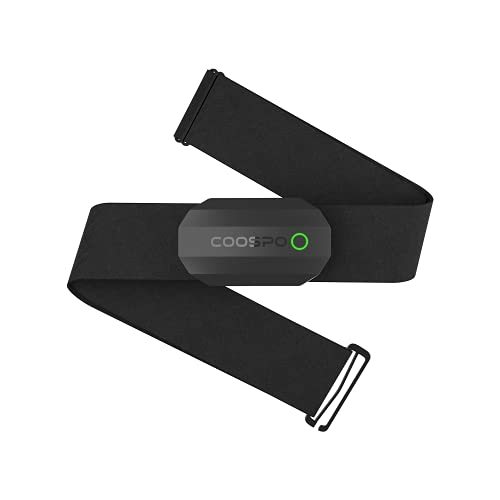
Best Dual-Protocol Value – COOSPO H808S Chest Strap
The COOSPO H808S is a heart rate monitor for cycling aimed at riders who need flexible device compatibility. Its chest strap supports both Bluetooth 4.0 and ANT+, works with bike computers and training apps such as Zwift and Strava, and provides up to 300 hours of battery life.
Best For: Cyclists connecting one sensor to ANT+ and Bluetooth bike computers, watches, or apps.
Pros:
- Supports both Bluetooth 4.0 and ANT+ transmission.
- Compatible with bike computers, sports watches, and several fitness apps.
- Provides stated accuracy of within ±1 BPM.
- IP67 waterproof construction and up to 300 hours of battery life.
Cons:
- The electrode zones should be moistened before use.
- The strap is recommended for replacement after six months or 300 washes.
- Pair the sensor in the app rather than through the phone’s general Bluetooth settings.
The H808S stands out for cyclists who use mixed training hardware because it supports both major wireless protocols. Its setup and strap-care requirements are minor trade-offs for that flexibility.
Best Armband Pick – Scosche Rhythm+ 2.0
The Scosche Rhythm+ 2.0 is a comfortable alternative to a chest strap for cyclists who want a heart rate monitor for cycling. Its optical sensor connects through ANT+ or Bluetooth to compatible watches, bike computers, fitness equipment, and apps.
Best For: Cyclists who prefer an adjustable forearm, bicep, or tricep armband and want HRV features in addition to live heart-rate tracking.
Pros:
- Supports both ANT+ and Bluetooth connections for compatible cycling devices and apps.
- Lightweight, breathable fit stays secure during intense workouts.
- Up to 24 hours of battery life and IP68 water resistance.
- HRV mode can stream RR interval data to compatible HRV apps.
Cons:
- Requires recharging considerably more often than the chest-strap options in this roundup.
- An armband may not suit cyclists who prefer chest-strap placement.
Choose this model if comfort and flexible placement matter more to you than long battery intervals. Its dual connectivity and app support make it a versatile training companion for indoor or outdoor rides.
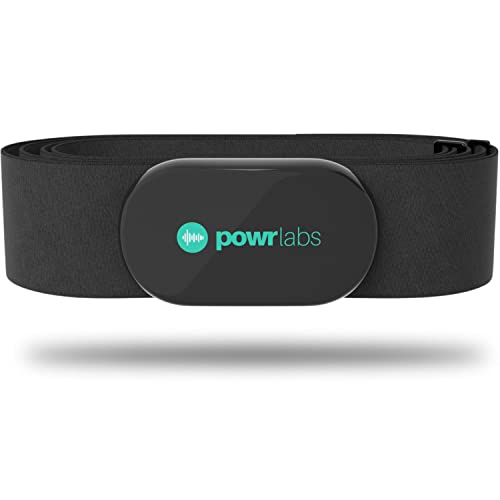
Best Long-Battery Pick – POWR LABS Chest Strap
The POWR LABS chest strap is a practical heart rate monitor for cycling when you want dual-device compatibility and minimal charging. It sends heart-rate data over ANT+ or Bluetooth to compatible cycling computers, smartwatches, Peloton, and fitness apps.
Best For: Frequent riders who want a soft, adjustable chest strap with a replaceable battery rated for more than 400 hours.
Pros:
- Dual ANT+ and Bluetooth connectivity works with Garmin, Wahoo, Polar, Peloton, and numerous apps.
- Soft, seamless fabric adjusts across a broad chest-size range.
- 400+ hours of battery life reduces charging interruptions.
- IPX67 protection is designed for sweat, rain, and swimming under a wetsuit.
Cons:
- Chest-strap placement may be less appealing than an armband for some users.
- Pairing requires wearing the strap before starting the pairing process.
This is a strong choice for riders who value dependable connectivity and exceptional battery longevity. The replaceable battery and sweat-resistant construction are especially convenient for regular training.
Best Value Sensor – GEOID HS500
The GEOID HS500 offers the core features needed from a heart rate monitor for cycling, including ANT+ and Bluetooth support, automatic wake-up, and compatibility with bike computers, watches, smartphones, and training apps. Its LED indicator confirms connection status before a ride.
Best For: Cyclists seeking a straightforward chest-strap sensor with broad app compatibility and an approximately 800-hour battery.
Pros:
- Connects through ANT+ or Bluetooth to cycling computers, watches, and training apps.
- 800-hour CR2032 battery is replaceable and designed for low energy use.
- IP67 waterproof construction helps handle sweat and wet conditions.
- LED feedback confirms readiness and connection, while updated algorithms address movement and sweat interference.
Cons:
- Swimming is not recommended despite the IP67 rating.
- Bluetooth pairing should be completed through the fitness app rather than directly through phone settings.
The HS500 is a sensible option for riders who want long battery life and compatibility with popular cycling platforms without extra features such as HRV streaming. Its connection indicator can also make pre-ride setup easier.
How We Picked the Best Heart Rate Monitor for Cycling
We focused on monitors that support the connections cyclists use most, especially ANT+ and Bluetooth. We also considered sensor consistency during intervals and sustained efforts, fit security, sweat and water resistance, battery expectations, setup simplicity, and compatibility with common cycling computers and apps.
Chest straps generally provide the most responsive readings during changing intensity, while optical armbands can be easier to wear and more comfortable for riders who dislike chest straps. The best choice depends on your training style, preferred devices, and tolerance for charging or battery replacement.
Quick Comparison
| Type | Best For | Main Advantage | Potential Trade-Off |
|---|---|---|---|
| Chest strap | Structured training and intervals | Fast, consistent readings | Requires a snug fit and moisture contact |
| Armband | Comfort-focused everyday riding | Simple, less restrictive fit | Optical readings can vary with movement or fit |
| Dual-protocol monitor | Multi-device cyclists | Works with ANT+ and Bluetooth systems | May require more initial pairing setup |
Key Buying Factors for a Heart Rate Monitor for Cycling
Connectivity
Choose ANT+ if you primarily use a cycling computer, indoor trainer, or ANT+ compatible watch. Bluetooth is useful for phones, tablets, and many training apps. Dual-band models offer the most flexibility, particularly if you switch between indoor and outdoor equipment.
Accuracy and Response Time
For interval workouts, threshold sessions, and zone-based training, look for a secure sensor that responds quickly to intensity changes. A properly fitted chest strap is usually the safest choice for demanding workouts.
Comfort and Fit
The monitor should stay in place without feeling restrictive. Chest straps need firm contact across the torso, while armbands should sit securely without sliding. Auto-wear detection and easy adjustment can make regular use more convenient.
Battery Life and Durability
Long battery life reduces maintenance, while rechargeable designs can simplify ownership. For frequent outdoor riders, water resistance and sweat protection are important safeguards against premature failure.
Who Should Buy Which Heart Rate Monitor for Cycling?
Choose a Premium Chest Strap for Serious Training
Racers, structured-training cyclists, and athletes who need dependable interval data should prioritize a high-quality chest strap with dual connectivity and a secure sensor fit.
Choose a Simple Chest Strap for Everyday Rides
Recreational cyclists and indoor riders can save money with a straightforward ANT+ and Bluetooth model that covers their preferred computer or app without unnecessary extras.
Choose an Armband for Comfort
An optical armband is a practical alternative if chest straps chafe, shift, or feel uncomfortable. It suits steady rides and general fitness tracking, though riders should confirm that its readings meet their needs during hard intervals.
Check Compatibility Before Buying
Before ordering, verify the monitor’s supported protocols and your device’s pairing requirements. Also check whether the product uses a replaceable coin-cell battery or requires USB charging, and confirm the fit range if you are between sizes.