A low ceiling can make standard pull-up equipment awkward, but the right bar can still provide a secure setup without wasting valuable overhead space. This roundup compares 10 options suited to compact home gyms, including no-drill doorway bars, joist-mounted designs, and versatile freestanding equipment.
Focus on available height, mounting strength, clearance, grip options, and installation requirements before choosing. The best fit depends as much on your room structure and workout style as it does on weight capacity.
Best 10 Pull Up Bar for Low Ceilings Picks for 2026
Best Ceiling-Mount Flexibility
Ultimate Body Press Ceiling Mount Pull Up Bar

- Reversible risers fit 16- or 24-inch joist spacing
- Four ergonomic grip positions
- 300-pound maximum weight recommendation
Best For: Flexible ceiling-mounted home gym setups
Best No-Drill Heavy-Duty Option
Sportneer Adjustable Doorway Pull Up Bar

- Fits 29.5- to 37-inch door frames
- No-drill fixative and dual gear locks
- Integrated adjustable cotton handlebar
Best For: Renters with compatible solid wood door frames
Best Joist-Mounted Capacity
Shnlie 42-Inch Joist Pull Up Bar

- 440-pound maximum weight recommendation
- 42-inch-wide bar with six foam pads
- Includes mounting hardware and installation guidance
Best For: Fixed wood-joist or beam installations
Best Certified Doorway Choice
Sportneer No-Drill Doorway Pull Up Bar

- Fits 29.5- to 37-inch door frames
- No-drill design with dual gear locks
- Tested to ASTM, EN957, and CA65 standards
Best For: Removable doorway workouts in low-clearance rooms
Best Adjustable Ceiling Pick
Kipika 48-Inch Ceiling-Mounted Pull-Up Bar

- Adjustable height from 25.8 to 41 inches
- 500-pound maximum weight recommendation
- Eight-hole design with multiple grip positions
Best For: Adjustable low-clearance ceiling installations
Best Joist-Mount Value
Fitarc Joist-Mount Pull-Up Bar
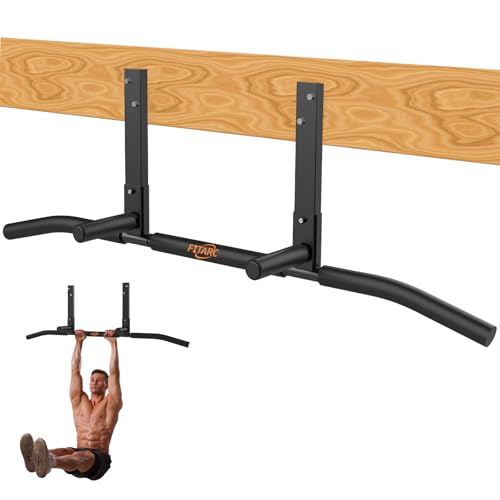
- Compact 12.9-inch-high ceiling-mounted design
- 440-pound maximum weight recommendation
- Four padded grips for multiple hand positions
Best For: Basement or garage gyms with wooden joists
Best Doorway Alternative
ProsourceFit Adjustable Pull-Up Bar

- Fits doorframes from 24 to 39 inches
- Supports up to 220 pounds
- Useful for pull-ups, dips, leg raises, and crunches
Best For: Removable doorway workouts in space-limited homes
Best Adjustable Ceiling Mount

- Four adjustable height settings
- Five grip positions with ball grip
- 400-pound capacity and accessory rings
Best For: Home gyms with secure ceiling or joist mounting points
Best Freestanding Option

- Adjusts across 11 height levels
- Folds for easier storage
- Adds dip and core exercises
Best For: Renters and low-ceiling rooms needing a portable station
Best Wide-Grip Joist Mount

- 42-inch width for varied grips
- Two adjustable height settings
- 350-pound alloy-steel capacity
Best For: Cross-training setups with solid joist, beam, or wall mounting
Best Ceiling-Mount Flexibility – Ultimate Body Press Ceiling Mount Pull Up Bar
If you want a pull up bar for low ceilings but still need room for a full range of motion, this ceiling-mounted Ultimate Body Press model keeps workouts away from the wall. Its reversible risers support installation below 16-inch floor joists or 24-inch ceiling joists.
Best For: Home gyms that need flexible ceiling placement, multiple grips, and open floor space.
Pros:
- Reversible risers accommodate 16- and 24-inch joist spacing.
- Four angled grip positions help vary pull-up and chin-up workouts.
- Includes a mounting template, hardware, instructions, and USA technical support.
- Supports up to 300 pounds and includes a 10-year limited warranty.
Cons:
- Requires ceiling installation and drilling.
- The 300-pound capacity is lower than some competing options.
- Bodyweight resistance trainers are sold separately.
This is a strong choice when ceiling height and placement flexibility matter more than a no-drill setup. Confirm your joist spacing and available overhead clearance before installing.
Best No-Drill Heavy-Duty Option – Sportneer Adjustable Doorway Pull Up Bar
For shoppers seeking a pull up bar for low ceilings, a doorway model can avoid overhead ceiling clearance issues altogether. This Sportneer bar adjusts from 29.5 to 37 inches and installs without drilling, provided you have a compatible solid wood door frame.
Best For: Renters and users who want a removable, no-drill bar for a 29.5- to 37-inch solid wood doorway.
Pros:
- No-drill installation uses large PVC friction mats and four metal fixed points.
- Dual 360-degree gear locks help resist loosening during use.
- Adjustable width supports pull-ups, sit-ups, push-ups, and stretching.
- Features an integrated, sweat-resistant cotton handlebar.
Cons:
- Designed for solid wood door frames only.
- Paint or plaster may peel because of strong adhesion.
- The manual specifies a 297-pound maximum, despite the 440-pound product listing.
This is a practical low-ceiling alternative when a suitable doorway is available. Measure the frame carefully, follow the manual’s 297-pound limit, and avoid tile, glass, or non-solid frames.
Best Joist-Mounted Capacity – Shnlie 42-Inch Joist Pull Up Bar
This joist-mounted bar is a useful pull up bar for low ceilings when you can attach equipment directly to a suitable wood joist, beam, or rafter. The 42-inch-wide steel bar provides several padded grip areas while keeping the setup compact.
Best For: Home gym users who prefer a fixed wood-mounted bar with a 440-pound maximum weight recommendation.
Pros:
- Heavy-duty alloy steel construction is rated for up to 440 pounds.
- Six foam grip pads provide multiple hand positions and cushioning.
- Sprayed coating helps resist rust and corrosion.
- Includes installation accessories, instructions, and an installation video.
Cons:
- Requires drilling and a suitable wood mounting surface.
- It does not provide a no-drill setup for renters.
- The notes identify the mount type as wall mount despite the joist and ceiling-mount design.
This model suits users who want a permanently installed, high-capacity bar and have verified the mounting structure. Check the joist, beam, or rafter and overhead clearance before installation.
Best Certified Doorway Choice – Sportneer No-Drill Doorway Pull Up Bar
A doorway bar can be a smart pull up bar for low ceilings because it uses an existing frame rather than requiring ceiling clearance. This Sportneer model fits 29.5- to 37-inch openings and adds safety-lock features and independent structural testing.
Best For: Users who want a removable doorway bar with no-drill installation and documented safety certifications.
Pros:
- Fits compatible 29.5- to 37-inch door frames.
- No-drill design uses PVC mats and four metal fixed points for stability.
- Dual gear locks help prevent the bar from loosening.
- Independently tested to ASTM, EN957, and CA65 standards.
Cons:
- Requires a solid wood door frame.
- Paint or plaster may peel during removal.
- Longer use distances may reduce the effective load.
This is a well-suited option for low-clearance rooms when a compatible solid wood doorway is available. Measure the opening and confirm the frame is wider than the end pads before using it.
Best Adjustable Ceiling Pick – Kipika 48-Inch Ceiling-Mounted Pull-Up Bar
If you need a pull up bar for low ceilings, the Kipika offers adjustable height from 25.8 to 41 inches. Its ceiling-mounted design, multiple grip positions, and 500-pound capacity make it a substantial option for home strength training.
Best For: Users who want adjustable clearance and a heavy-duty ceiling-mounted setup.
Pros:
- Adjustable height accommodates different ceiling clearances and exercise preferences.
- Supports up to 500 pounds with an eight-hole mounting design.
- Heavy steel construction and corrosion-resistant electrophoretic coating are designed for durability.
- Includes multiple grip positions and mounting hardware for standard joists.
Cons:
- Requires ceiling installation into a suitable standard joist.
- The 50.2-inch width may need careful measuring before purchase.
The Kipika is a strong fit when ceiling clearance is the main concern, especially if you want to adjust the bar height rather than use a fixed mount. Verify joist placement and available width before installing.
Best Joist-Mount Value – Fitarc Joist-Mount Pull-Up Bar
The Fitarc is a practical pull up bar for low ceilings when you can mount directly to a wooden beam. Its compact 12.9-inch height, padded grips, and 440-pound capacity suit basement, garage, and other home gym installations.
Best For: Home gym users with accessible wooden joists who want a compact ceiling-mounted bar.
Pros:
- Compact joist-mounted structure helps conserve space.
- Supports up to 440 pounds for pull-ups, chin-ups, and hanging leg raises.
- Four thickened foam grips provide multiple hand positions and added comfort.
- Installation instructions and videos are included.
Cons:
- Designed for wooden beams, so it may not suit every ceiling structure.
- The listed mounting configuration is intended for 8- to 9-foot beams.
Choose the Fitarc if you prefer a low-profile ceiling mount and have a suitable wooden joist available. Its compact form is useful where a taller frame would interfere with limited overhead space.
Best Doorway Alternative – ProsourceFit Adjustable Pull-Up Bar
For shoppers seeking a pull up bar for low ceilings without a ceiling installation, the ProsourceFit uses a doorway mount. It adjusts from 24 to 39 inches for standard doorframes and supports pull-ups, chin-ups, dips, and other home exercises.
Best For: Renters and home users who need a removable doorway setup for standard frames.
Pros:
- Adjusts to fit doorframes between 24 and 39 inches.
- Doorway design avoids permanent ceiling mounting.
- Cushioned foam grips help reduce hand fatigue and slipping.
- Can support pull-ups, chin-ups, triceps dips, leg raises, and foot-anchored crunches.
Cons:
- Has a lower 220-pound maximum weight recommendation than the ceiling-mounted options.
- Requires a compatible standard doorframe and included end-cap brackets and screws for mounting.
The ProsourceFit is the simplest choice when low overhead clearance makes a ceiling bar impractical or you cannot modify the ceiling. Measure the doorway and check the 220-pound limit before use.
Best Adjustable Ceiling Mount – Heavy-Duty Multi-Grip Bar
If you need a pull up bar for low ceilings, this ceiling-mounted SELEWARE model offers four height settings to help tailor the bar to your available space and workout style. Its welded steel construction, multiple grips, and included wood- and concrete-mounting screws make it a versatile option, provided you have a suitable ceiling or joist structure.
Best For: Home gyms needing an adjustable, ceiling-mounted bar with varied grip and accessory options.
Pros:
- Four height settings accommodate different users and exercises.
- Five grip positions include a specialized ball finger grip.
- Heavy-duty steel construction is rated for up to 400 pounds.
- Side rings accept suspension straps, bands, and other training accessories.
Cons:
- Requires secure installation into compatible wood studs, concrete, or another suitable structure.
- The ceiling-mounted design is not portable once installed.
With its adjustable height and compact overhead layout, this is a strong choice for low-ceiling spaces where a freestanding tower may not fit. Confirm your mounting points and desired clearance before installation.
Best Freestanding Option – Foldable Power Tower
For shoppers seeking a pull up bar for low ceilings without drilling into a ceiling, the YYJO foldable power tower provides adjustable height from 68.9 to 82.68 inches. Its freestanding design adds dip and core-training options, while the foldable triangular frame can be stored after use.
Best For: Renters or home users who want a movable, multifunctional station for rooms with limited overhead clearance.
Pros:
- Eleven height levels provide substantial adjustment for lower rooms.
- Foldable design helps reduce storage space after workouts.
- Supports pull-ups, dips, leg raises, and other full-body exercises.
- Heavy-duty steel frame supports up to 350 pounds.
Cons:
- Its freestanding footprint requires floor space during use.
- Minimal assembly is required before use.
- It may not provide the same overhead clearance flexibility as a ceiling-mounted bar.
The adjustable height makes this tower practical for lower rooms, and its foldable frame is useful when equipment must be put away. Measure both the room height and available floor area before choosing it.
Best Wide-Grip Joist Mount – 42-Inch Adjustable Bar
This 42-inch joist-mounted bar is a practical pull up bar for low ceilings when you have a solid overhead beam, joist, wall, or other approved structure. Two height settings let you lower the bar for standard pull-ups and hanging work or raise it for movements needing more range of motion.
Best For: Home gyms wanting a wide, multi-grip bar for pull-ups, hanging exercises, and cross-training.
Pros:
- Two height settings help adapt the bar to different workouts and users.
- Four grip configurations support wide, narrow, parallel, and opposite grips.
- 42-inch width suits many home-gym layouts.
- Thickened alloy-steel construction supports up to 350 pounds.
Cons:
- Only two height settings are provided.
- Installation depends on a solid wood, concrete, or steel mounting structure.
- The 42-inch width may need more wall or ceiling clearance than a narrower bar.
This bar combines a relatively wide exercise area with height adjustment, making it a useful overhead setup for varied training. Carefully verify the mounting surface and surrounding clearance before installation.
How We Picked the Best Pull Up Bar for Low Ceilings
We selected these 10 bars based on their suitability for restricted ceiling height, installation flexibility, construction, grip variety, stated weight capacity, and likely use in a home gym. The list includes doorway models for renters and quick setups, joist- and ceiling-mounted bars for stronger permanent installations, wall-mounted options, and a freestanding power tower for rooms where drilling is not practical.
Because product specifications and mounting hardware can vary, always verify the manufacturer’s dimensions and installation instructions before buying. A high weight rating does not compensate for weak framing or an unsuitable mounting surface.
Quick Comparison
| Type | Best For | Key Advantage | Main Consideration |
|---|---|---|---|
| Doorway bar | Renters and temporary setups | No-drill installation | Requires a compatible door frame |
| Joist or ceiling mount | Permanent home gyms | Strong, low-profile installation | Needs suitable structural support |
| Wall mount | Rooms with clear wall space | Flexible placement | Stud or masonry mounting is essential |
| Freestanding tower | No-drill setups and multiple exercises | Pull-ups, dips, and assisted work | Uses more floor space |
Key Buying Factors for a Pull-Up Bar for Low Ceilings
Available Height and Clearance
Measure from the floor to the ceiling, then account for the bar’s installed height and your head clearance. You need enough room to grip the bar without hitting the ceiling, but a lower setup may require bent-knee or tucked-leg pull-ups. Adjustable-height designs can help fine-tune the position.
Mounting Surface and Hardware
Joist- and ceiling-mounted bars should attach to real structural members, not just drywall or thin paneling. Check joist spacing, beam dimensions, included hardware, and whether the bar can be installed across or between supports. Wall-mounted models similarly require solid studs or appropriate masonry anchors.
Capacity, Stability, and Grip Design
Choose a stated capacity that comfortably exceeds your body weight plus any added load. Wide, neutral, angled, and straight grips can make training more versatile, while welded steel construction and broad mounting plates may improve stability. A doorway bar should sit firmly without damaging the frame.
Installation and Room Layout
No-drill bars are convenient, but they are limited by doorway dimensions and may interfere with doors or trim. Permanent bars offer better stability but require careful measuring and installation. Leave enough surrounding space for your shoulders, elbows, and legs during each movement.
Who Should Buy Which Pull Up Bar for Low Ceilings?
- Renters: Choose a no-drill doorway bar if your door frame meets the required width and strength specifications.
- Permanent home gyms: A joist- or ceiling-mounted bar is usually the most space-efficient choice for low ceilings.
- Users wanting multiple grips: Look for a multi-grip ceiling, joist, or wall-mounted model.
- People avoiding structural installation: A freestanding tower provides more exercise options, provided you have adequate floor and ceiling clearance.
- Weighted-training users: Prioritize a securely mounted steel bar with a generous capacity margin and carefully installed hardware.