A rebounder can add low-impact cardio, balance work, and simple interval training to a home gym without taking up the space of a full-size trampoline. The best choice depends on your available room, preferred bounce, storage needs, and how much stability you want from the handlebar.
We’ve rounded up 10 rebounders for home workouts, covering compact foldable designs, bungee-based models, multiple weight capacities, and options with adjustable support bars.
Best 10 Rebounders for Home Workouts Picks for 2026
Smart Space-Saving Pick
Stamina 36-Inch Foldable Rebounder

- Tracks jumps, time, and calories
- Folds with detachable legs for storage
- Supports up to 250 pounds
Best For: Compact home workouts with app-based guidance
Adjustable-Handle Value
KENSONE 40-Inch Foldable Rebounder

- Adjustable, foam-padded handlebar
- 330-pound listed weight capacity
- Folds for indoor or outdoor storage
Best For: Balance-focused workouts and versatile family use
Quiet High-Capacity Choice
Jumpzylla 40-Inch Bungee Rebounder
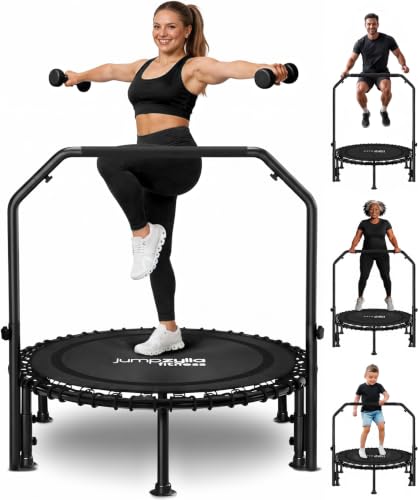
- Quiet, joint-friendly bungee system
- Four-level adjustable handlebar
- Supports up to 450 pounds
Best For: Low-impact cardio, HIIT, and recovery workouts
Largest Jumping Surface
ANCHEER 50-Inch Foldable Rebounder

- Roomy 50-inch hexagonal surface
- Uses 48 high-strength bungee cords
- Folds to less than a quarter of its size
Best For: Shared home workouts needing extra jumping space
Best Adjustable-Handle Pick

- Quiet 8mm bungee system
- Four-level foam handlebar
- Folds for compact storage
Best For: Adults and seniors seeking supported, low-impact indoor cardio
Best Fold-and-Go Option
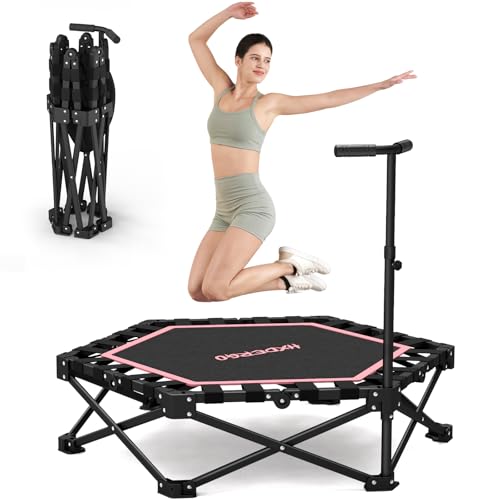
- Folds in seconds without installation
- Quiet elastic-band bounce
- Anti-slip feet and padded handle
Best For: Portable indoor, outdoor, and apartment-friendly workouts
Best Stability Upgrade
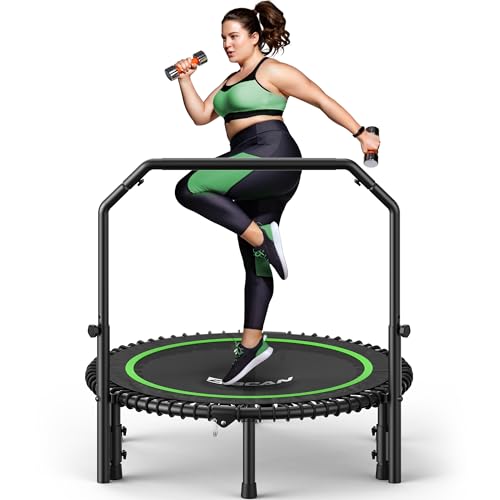
- Thickened 32mm alloy legs
- Reinforced three-height handlebar
- Quiet 8mm bungee bounce
Best For: Users prioritizing frame and handlebar stability
Compact High-Capacity Pick

- 440-pound capacity for adults and kids
- Folds to about 15 x 28.7 inches
- Quiet bungees and quick setup
Best For: Small-space users seeking a portable, high-capacity rebounder
Most Adjustable Support

- Three-position padded handlebar
- 40-inch and 48-inch options
- 80% pre-assembled with safety testing noted
Best For: Users wanting adjustable balance support and size choices
Best Handlebar Range
Foldable 40-Inch T-Bar Rebounder

- Five-level adjustable T-bar
- 440-pound capacity
- Compact fold and quiet bungees
Best For: Users seeking adjustable support in a compact, high-capacity rebounder
Smart Space-Saving Pick – Stamina 36-Inch Foldable Rebounder
For shoppers comparing rebounders for home workouts, the Stamina 36-inch model combines a compact footprint with workout tracking. Its steel frame, tension bands, foldable design, and included LCD monitor make it suited to straightforward cardio and low-impact exercise in smaller spaces.
Best For: Home users who want a compact rebounder with basic jump, time, and calorie tracking.
Pros:
- Foldable frame and detachable legs simplify storage.
- LCD monitor tracks jumps, workout time, and calories.
- Steel frame and 30 tension bands support up to 250 pounds.
- Includes access to the muuv coaching app for guided sessions.
Cons:
- The 36-inch frame offers less jumping space than larger models.
- Its listed weight capacity is lower than some options in this roundup.
- The warranty is 90 days for parts and one year for the frame.
The Stamina is a practical choice when storage and workout feedback matter more than a larger jumping surface or higher capacity. It is especially appealing for apartments, home gyms, and users who prefer guided sessions.
Adjustable-Handle Value – KENSONE 40-Inch Foldable Rebounder
The KENSONE is a versatile option among rebounders for home workouts, pairing a spring-based jumping surface with an adjustable foam handlebar. Its detachable parts and foldable construction make it easier to store, while the 330-pound listed capacity suits a broad range of users.
Best For: Adults and families seeking an adjustable-handle rebounder for indoor or outdoor use.
Pros:
- Adjustable foam handlebar helps users maintain balance.
- Heavy-duty steel frame, 32 springs, and rubber-tipped legs support stability.
- Foldable design stores under beds, sofas, in closets, or in a car.
- Pre-assembled jumping mat and illustrated instructions support setup in about 10 minutes.
Cons:
- Springs may produce more sound than a bungee-based design.
- The handrail, legs, and cover must be detached for folding.
- The model is listed at 40 inches, while the product title also references a 48-inch version.
Choose the KENSONE if balance support and flexible placement are priorities. Its handlebar and higher listed capacity make it a capable general-purpose rebounder, though shoppers seeking the quietest bounce may prefer a bungee system.
Quiet High-Capacity Choice – Jumpzylla 40-Inch Bungee Rebounder
For rebounders for home workouts that emphasize a quieter, lower-impact feel, this Jumpzylla model uses high-tensile bungee cords instead of traditional springs. The foldable frame, four-level handlebar, and 450-pound listed capacity give it a broad range of uses, from cardio and HIIT to balance and recovery work.
Best For: Users wanting a quiet, joint-friendly rebounder with strong support and compact storage.
Pros:
- High-tensile bungees are designed for quiet bouncing and reduced joint impact.
- Four-level adjustable, foam-padded handlebar supports different users.
- Reinforced frame and stainless-steel construction support up to 450 pounds.
- Semi-pre-assembled design folds for storage under beds, in closets, or in a trunk.
Cons:
- The supplied details identify the 40-inch model, while the title references multiple sizes and capacities.
- At 40 inches, its jumping area is smaller than the 50-inch alternative in this roundup.
- Outdoor use is mentioned, but storage and care requirements for outdoor exposure are not specified.
This model stands out for shoppers who want a quieter rebounder and a high listed weight capacity. Its adjustable handle and versatile workout positioning also make it useful for beginners, intense sessions, and lower-impact routines.
Largest Jumping Surface – ANCHEER 50-Inch Foldable Rebounder
The ANCHEER offers one of the roomier formats among rebounders for home workouts, with a 50-inch hexagonal jumping surface and 48 bungee cords. Its foldable frame and adjustable handlebar balance the larger footprint with practical storage features for home or garden use.
Best For: Users who want more jumping room and a foldable design for shared household use.
Pros:
- 50-inch hexagonal surface provides ample room for movement.
- Heavy-duty steel frame and 48 bungee cords are designed for stability.
- Three-level handlebar adjusts from 43.2 to 51.2 inches.
- Folds to less than a quarter of its full size and arrives 80% pre-assembled.
Cons:
- The larger surface may require more setup space during use.
- The supplied details do not state a maximum user weight.
- Although a lifetime after-sales warranty is mentioned, its precise coverage terms are not provided.
The ANCHEER is a strong fit when jumping space is the priority. Its 50-inch surface and adjustable handlebar make it suitable for varied users, while the substantial fold-down design helps offset its larger in-use footprint.
Best Adjustable-Handle Pick – 40-Inch Green Mini Rebounder
If you want rebounders for home workouts with a compact footprint and extra balance support, this 40-inch model combines a quiet bungee system with a height-adjustable foam handlebar. It folds for storage and arrives mostly assembled, making it practical for regular indoor cardio.
Best For: Adults, seniors, and users who want adjustable balance support for low-impact indoor exercise.
Pros:
- 8mm bungee cords provide a quieter, shock-absorbing bounce than metal springs.
- Four-level handlebar adjusts from 30 to 40 inches above the mat.
- Alloy-steel frame supports up to 440 pounds according to the product listing.
- Folds to 15 x 30 inches and takes about 10 minutes to set up.
Cons:
- Perimeter straps must be removed before exercising to avoid damage.
- The supplied details list both a 440-pound load claim and a 360-pound maximum weight recommendation, so verify the applicable limit.
This is a well-rounded choice for shoppers prioritizing quiet, joint-friendly movement, storage convenience, and a supportive handle. The strap-removal requirement and differing weight figures are worth checking before purchase.
Best Fold-and-Go Option – 42-Inch Rebounder With Handle
Among rebounders for home workouts, this foldable model stands out for quick storage and flexible placement. Its elastic-band bounce, anti-slip feet, and adjustable padded handlebar suit quiet indoor routines, while the fold-down design also makes it easier to transport.
Best For: Apartment dwellers, travelers, and families wanting a portable rebounder for indoor or outdoor use.
Pros:
- 24 elastic bands are designed for a smoother, quieter, joint-friendly bounce.
- Three-level handle adjusts from 40.5 to 44.5 inches and has foam padding.
- Opens or folds in seconds without installation and compacts to 14 x 30 inches.
- Anti-slip rubber feet help reduce vibration and protect floors.
Cons:
- The supplied information identifies the model as 42-inch and lists a 460-pound maximum recommendation, so confirm the exact configuration before ordering.
- The taller handle range may not suit every user or workout space.
This rebounder is especially practical when storage and portability matter as much as bouncing performance. It offers useful stability features for home workouts, but shoppers should confirm the selected size and capacity details.
Best Stability Upgrade – BCAN BT2 Quiet Rebounder
For rebounders for home workouts where stability is a priority, the BCAN BT2 uses thickened alloy legs, reinforced threading, and a strengthened handlebar. Its 8mm bungee cords are designed for quiet, low-impact bouncing, while the included setup process is intended to take about 10 minutes.
Best For: Users who want a sturdier-feeling frame and reinforced handlebar for consistent indoor exercise.
Pros:
- 32mm alloy legs with 10-turn reinforced threads are designed to reduce wobbling.
- 8mm bungees with a woven outer layer and natural latex core provide a quiet bounce.
- Reinforced handlebar adjusts across three heights from 2 feet 7 inches to 3 feet 2 inches.
- Arrives with 11 to 13 bungees pre-assembled and includes a manual and video tutorial.
Cons:
- The product details list a 150 kg maximum weight recommendation, while the title references 450/550-pound capacities; verify the exact size and limit.
- Some assembly is still required despite the partially pre-assembled design.
The BCAN BT2 is a compelling option for buyers who value reinforced construction and handlebar stability over the simplest setup. Confirm the capacity for the selected configuration before relying on it for your routine.
Compact High-Capacity Pick – Foldable 40-Inch Rebounder
If storage space is limited, this foldable 40-inch rebounder is a practical option among rebounders for home workouts. Its bungee-based design is intended to reduce noise, while the frame folds compactly after the legs are removed.
Best For: Adults and kids who want a high-capacity rebounder that can be stored under a bed, behind a sofa, or in a closet.
Pros:
- 440-pound maximum weight recommendation.
- Folds to approximately 15 x 28.7 inches for compact storage.
- Quiet bungees and rubber-tipped legs are designed to reduce noise.
- Arrives 60% pre-assembled and can be set up in about 10 minutes.
Cons:
- All six legs must be removed before folding.
- It does not include an adjustable handlebar for extra balance support.
This model emphasizes portability, capacity, and quieter indoor use. It is a strong fit for buyers who want a straightforward rebounder that can be put away after each workout.
Most Adjustable Support – BCAN SP2 Foldable Rebounder
The BCAN SP2 is a useful choice among rebounders for home workouts when you want a handhold for added control. Its padded handlebar offers three height settings, and the foldable frame is designed for easier storage once the handlebar and legs are removed.
Best For: Users who prefer guided balance support and want to choose between 40-inch and 48-inch versions with different weight capacities.
Pros:
- Adjustable, foam-padded handlebar with three height settings from 2 feet 6 inches to 3 feet 5 inches on the mat.
- Available in a 40-inch, 330-pound model or a 48-inch, 440-pound model.
- Arrives 80% pre-assembled, requiring attachment of the legs and handlebar.
- Tested through more than 3,000 continuous bounce cycles and to applicable ASTM safety standards, according to the supplied notes.
Cons:
- The base frame must be folded only after removing the handlebar and legs.
- The listed 40-inch version has a 330-pound maximum weight recommendation; the 440-pound capacity applies to the larger version.
With its adjustable support bar and two size options, the SP2 offers more configuration flexibility than a basic handle-free rebounder. It is particularly practical for households where users have different heights or support preferences.
Best Handlebar Range – Foldable 40-Inch T-Bar Rebounder
This 40-inch rebounder adds a five-level T-shaped handlebar to the compact design, making it a practical contender among rebounders for home workouts. The foam-covered bar provides a handhold, while the frame folds after the handlebar and legs are removed.
Best For: Adults and kids who want a compact, quiet rebounder with more handlebar height adjustment and a 440-pound capacity.
Pros:
- Five-level adjustable T-bar ranges from 27 to 35 inches off the ground.
- 440-pound maximum weight recommendation.
- Folds to approximately 15 x 28.7 inches for storage or transport.
- Quiet bungees, rubber-tipped legs, and a 60% pre-assembled design support indoor use.
Cons:
- The handlebar and all legs must be removed before folding.
- Its 40-inch surface may offer less room than a larger rebounder.
The adjustable T-bar is the main reason to choose this model over a simpler rebounder. It combines a compact storage footprint with a high weight rating and added stability for controlled bouncing.
How We Picked These Rebounders for Home Workouts
We focused on features that matter during regular indoor exercise: frame size, stated weight capacity, foldability, handlebar adjustability, bounce-system design, portability, and the amount of floor space required. We also considered whether each rebounder appears suited to beginners, frequent cardio sessions, or shared household use. Product specifications can vary by size, so check the exact configuration before ordering.
Quick Comparison
Smaller 36- to 40-inch rebounders are generally easier to store and better suited to compact rooms. Models measuring 42 to 50 inches provide more jumping area and may feel more comfortable for larger users, but they require additional clearance. Stated capacities in this selection range from about 330 to 550 pounds, although the user should still follow the manufacturer’s safety guidance. Adjustable handlebars are especially useful when multiple people share the rebounder or when you want extra balance support.
Key Buying Factors
Size and Available Space
Measure the usable floor area and leave clear space around the frame. Also check ceiling height, particularly if you plan to perform higher jumps. A compact model is easier to move, while a larger mat can provide more room for side-to-side movement.
Weight Capacity and Frame Stability
Choose a rebounder with a published capacity comfortably above the user’s weight rather than selecting the minimum rating. Look for a solid frame, secure feet, and a handlebar that does not wobble under light support. Capacity ratings are not a substitute for careful assembly and controlled movement.
Springs Versus Bungee Cords
Traditional springs can offer a firmer, more responsive feel, while bungee systems are often selected for a quieter, softer bounce. Neither design is automatically best; prioritize the feel, noise level, and maintenance requirements that fit your home.
Foldability and Storage
If the rebounder must be put away after every workout, confirm how it folds and whether the folded dimensions fit your closet or under-bed storage. Some compact models are portable but still need a dedicated space when assembled.
Handlebar Adjustment
An adjustable bar can improve confidence for beginners and accommodate different heights. It should lock securely at each setting. For advanced balance work, you may prefer a more open setup, but a bar remains useful for controlled warmups and recovery sessions.
Who Should Buy Which Rebounders for Home Workouts?
- For small rooms or frequent storage: Consider a 36- or 40-inch foldable rebounder.
- For taller or larger users: Look toward the wider models with a higher stated capacity and more jumping surface.
- For beginners: Choose an adjustable handlebar and a stable, low-impact design.
- For quieter workouts: A bungee-based rebounder may be preferable, especially in apartments or shared homes.
- For shared households: Prioritize adjustable support, a generous capacity rating, and a frame size that suits multiple users.
Before your first session, inspect the frame, feet, mat, fasteners, and handlebar, then place the rebounder on a level, nonslip surface. Start with low-intensity bouncing and follow the included assembly and safety instructions.