The best spotting scopes for astronomy can bridge the gap between binoculars and a full-size telescope, offering useful magnification in a more portable package. The right model can make the Moon, planets, bright star clusters, and daytime targets easier to observe.
This roundup compares 10 options across optical designs, apertures, magnification ranges, portability, and included accessories so you can choose a scope that fits your observing style and budget.
Best 10 Spotting Scopes for Astronomy Picks for 2026
Premium Schmidt-Cassegrain Pick

- 5-inch aperture and 1250mm focal length
- Compact six-pound optical tube
- Camera adaptable for digiscoping
Best For: Portable astronomy and long-distance viewing
Smart Imaging Pick

- 80mm aperture with autofocus
- App, remote, and dual-screen control
- Built-in 4K imaging and six-hour battery
Best For: Beginner-friendly digital stargazing
Compact Maksutov Pick

- 90mm Maksutov-Cassegrain optics
- 1250mm focal length in a portable design
- Includes backpack and 32mm eyepiece
Best For: Portable astronomy and mixed daytime use
Wide-Field Binocular Pick

- 70mm objectives for brighter night views
- 15x magnification with a wide field
- Tripod adapter and water-resistant housing
Best For: Wide-field stargazing and sky scanning
Bright Long-Range View

- 20–60x zoom with an 85mm objective lens
- HD glass and fully multi-coated optics
- Waterproof, fogproof, argon-purged body
Best For: Detailed astronomy viewing in changing outdoor conditions
Maximum Aperture Value

- Large 100mm aperture for bright viewing
- 25–75x zoom range for flexible magnification
- Includes tripod, case, and smartphone adapter
Best For: Low-light observation with an accessory-rich package
Balanced Outdoor Performance
- 20–60x magnification with an 80mm objective
- K9 prisms and fully multi-coated lenses
- Tripod, case, and cleaning cloth included
Best For: Weather-resistant astronomy viewing with a complete kit
Large-Aperture All-Rounder
Falcon 20-60x85 Spotting Scope

- 85mm objective with BAK4 and FMC optics
- 20-60x zoom with wide stated field of view
- Includes full-size tripod and phone adapter
Best For: Astronomy and outdoor observers wanting a large objective and full-height tripod
Portable Beginner Pick
SVBONY SV28 25-75x70 Spotting Scope
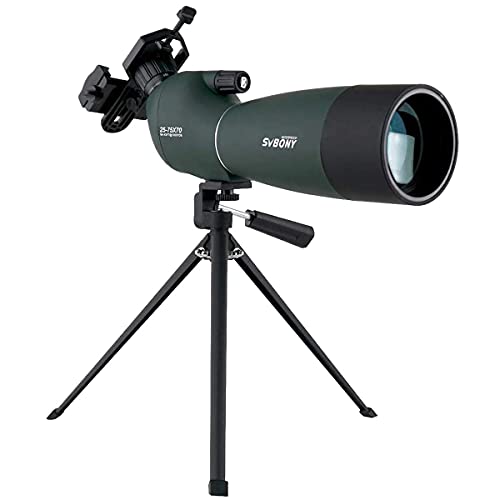
- 25-75x zoom with a 70mm objective lens
- Angled design with FMC coating and sunshade
- Includes desktop tripod and phone adapter
Best For: Beginners wanting a portable astronomy and outdoor-viewing setup
Maximum-Zoom Classic
Barska Colorado 30-90x90 Scope
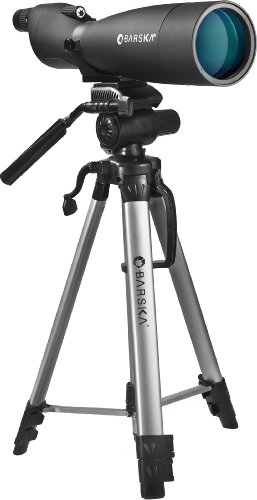
- Large 90mm objective for low-light viewing
- 30-90x magnification for long-distance observation
- Includes tall fluid-head tripod and sunshade
Best For: Stationary observers prioritizing aperture, reach, and included support
Premium Schmidt-Cassegrain Pick – Celestron C5
For shoppers comparing spotting scopes for astronomy, the Celestron C5 offers a substantial 5-inch aperture, 1250mm focal length, and f/10 design in a relatively compact six-pound package. Its camera adaptability also makes it a practical choice for visual observing and digiscoping.
Best For: Astronomy observers who want a portable, high-contrast scope that can also handle distant terrestrial targets and photography.
Pros:
- 5-inch Schmidt-Cassegrain optics with StarBright XLT coatings
- 1250mm focal length for detailed long-distance viewing
- Camera adaptable and accepts 1.25-inch eyepieces
- Includes a 25mm eyepiece, erect-image diagonal, finderscope, and carrying case
Cons:
- Manual focusing and manual operation require more hands-on use
- Camera adapter and T-ring are optional accessories
- An equatorial mount may add setup and transport considerations
The C5 is a strong all-purpose option when optical reach and upgrade potential matter more than the simplest setup. Its compact design helps offset the size typically associated with a 5-inch aperture.
Smart Imaging Pick – FASHIONARI Digital Telescope
This FASHIONARI smart telescope takes a different approach to spotting scopes for astronomy by combining an 80mm aperture with autofocus, app control, remote operation, and built-in 4K imaging features. It is designed for quick setup and convenient lunar, planetary, and long-distance viewing.
Best For: Beginners and casual observers who prioritize app-based control, built-in screens, and recording images or video.
Pros:
- Autofocus and mobile-app control simplify operation
- Built-in camera supports stated 30MP stills and 4K video
- Dual-screen viewing includes an adjustable eyepiece and foldable external screen
- Built-in 4500mAh battery provides up to six hours of operation
Cons:
- Electronic features require battery power
- Its digital workflow may be less appealing to users seeking a traditional manual scope
- Supplied specifications describe a tripod-mounted design rather than a larger astronomical mount
The FASHIONARI is best viewed as an accessible digital observing system rather than a conventional optical spotting scope. Its strongest advantage is convenience for users who want to view, capture, and share observations with minimal setup.
Compact Maksutov Pick – Celestron C90
The Celestron C90 is a compact Maksutov-Cassegrain option for shoppers seeking spotting scopes for astronomy without carrying a larger optical tube. Its 90mm objective, 1250mm focal length, and included 45-degree diagonal support both night-sky viewing and daytime observation.
Best For: Observers who want a portable, high-contrast scope for astronomy, birding, target shooting, and digiscoping.
Pros:
- Maksutov-Cassegrain design folds the light path into a compact body
- 90mm objective and 1250mm focal length support distant viewing
- Camera adaptable and accepts 1.25-inch eyepieces
- Includes a 32mm eyepiece, finderscope, erect-image diagonal, and backpack
Cons:
- Manual focus requires hands-on adjustment
- Camera adapters are optional rather than included
- Its supplied 45-degree diagonal is convenient for terrestrial use but not specifically optimized for astronomy
The C90 balances reach, portability, and versatility well. It is a sensible choice for users who want one compact scope for astronomical objects and daytime targets, especially when storage and transport are priorities.
Wide-Field Binocular Pick – Celestron SkyMaster 15×70
For a simple, wide-field way to explore the night sky, the Celestron SkyMaster 15×70 binoculars are a practical alternative among spotting scopes for astronomy. Their 70mm objectives, BaK-4 prisms, and 4.4-degree field of view are designed to provide bright views in dim conditions.
Best For: Stargazers who want binocular-style sky scanning and are comfortable mounting a larger pair on a tripod.
Pros:
- 70mm objectives gather light for nighttime viewing
- 15x magnification and a 4.4-degree field of view suit broad sky observation
- BaK-4 prisms and multi-coated optics support brighter, detailed views
- Built-in tripod adapter and water-resistant rubber-armored housing
Cons:
- Tripod is not included
- At 3.3 pounds, the giant binoculars are heavier than typical handheld binoculars
- Manual center focus offers less automation than electronic scopes
The SkyMaster is a good fit when wide-field viewing and straightforward binocular use are more important than high magnification or imaging features. A stable tripod is strongly suited to its size and weight.
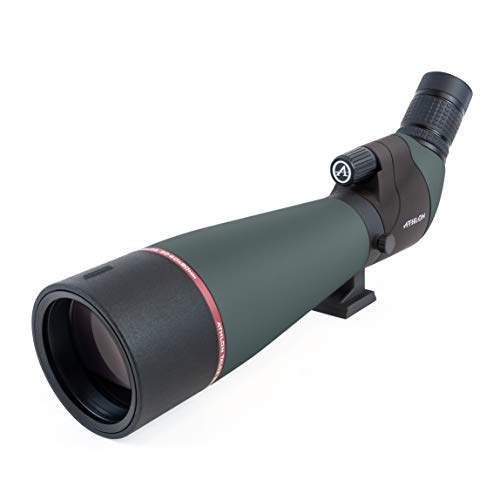
Bright Long-Range View – Athlon Argos HD 20-60×85
For astronomy enthusiasts seeking spotting scopes for astronomy, the Athlon Argos HD combines a large 85mm objective lens with 20–60x zoom magnification. Its HD glass, fully multi-coated lenses, and angled viewing design are suited to detailed observations across changing light conditions.
Best For: Stargazers who want a weather-sealed, high-magnification scope with a comfortable angled eyepiece.
Pros:
- 20–60x zoom and 85mm objective lens support detailed long-range viewing.
- HD glass and fully multi-coated lenses help produce bright, sharp, natural-color images.
- Waterproof, fogproof, and argon-purged construction supports use in changing weather.
- Rotating tripod ring, protective case, and lifetime warranty add practical value.
Cons:
- At 4.3 pounds and 16.9 inches long, it is not the most compact setup.
- A tripod is not listed among the included accessories.
The Argos HD is a strong choice when brightness, reach, and outdoor durability matter more than portability. Its 45-degree eyepiece is also convenient for extended viewing sessions.
Maximum Aperture Value – SVBONY SV28 25-75×100
The SVBONY SV28 stands out among spotting scopes for astronomy with its 100mm aperture, designed to gather more light for brighter viewing, especially in lower-light conditions. Its 25–75x zoom, FMC coating, included tripod, and smartphone adapter make it a versatile package for observation and recording.
Best For: Stargazers who prioritize a large aperture, high zoom range, and included accessories.
Pros:
- Large 100mm objective lens is designed for bright, detailed viewing in low light.
- 25–75x zoom provides substantial magnification flexibility.
- Fully multi-coated optics enhance light transmission.
- Includes a desktop tripod, carrying case, lens covers, and smartphone adapter.
Cons:
- The included desktop tripod may be less suitable for elevated outdoor viewing.
- Its large aperture and 2,560-gram weight make it less portable than smaller scopes.
- Manual focus requires hands-on adjustment when changing subjects or magnification.
With the largest objective lens in this group, the SV28 is appealing for viewers who want to emphasize brightness and detail. Plan on using a taller compatible tripod for comfortable outdoor astronomy sessions.
Balanced Outdoor Performance – Athlon Talos 20-60×80
The Athlon Talos is a practical option for spotting scopes for astronomy, pairing 20–60x magnification with an 80mm objective lens. Fully multi-coated lenses, K9 prisms with silver coating, and nitrogen purging support bright images and dependable use outdoors.
Best For: Buyers who want a weather-resistant astronomy scope with a tripod and carrying case included.
Pros:
- 20–60x magnification and an 80mm objective lens suit varied long-range viewing.
- K9 prisms with silver coating and fully multi-coated lenses support light transmission.
- Nitrogen purging and waterproof construction improve weather resistance and thermal stability.
- Includes a tripod, soft case, lens caps, and cleaning cloth.
Cons:
- Its 80mm aperture is smaller than the 100mm aperture on the SVBONY SV28.
- The scope uses manual focus and has a listed 1.33mm exit pupil at maximum magnification.
The Talos offers a well-rounded combination of magnification, outdoor protection, and included setup gear. It is a sensible pick for observers who want a complete kit without moving to the largest objective size.
Large-Aperture All-Rounder – Falcon 20-60×85 Spotting Scope
For shoppers comparing spotting scopes for astronomy, the Falcon 20-60×85 stands out for its large 85mm objective lens, broad 20-60x zoom range, and BAK4 prism with FMC coating. Its weatherproof build, full-size tripod, and phone adapter also make it a flexible choice for outdoor viewing beyond the night sky.
Best For: Buyers who want a large-aperture scope with a full-height tripod for astronomy, wildlife, and general long-distance viewing.
Pros:
- 85mm objective lens with BAK4 prism and FMC coating is designed to provide bright, clear images, including in lower light.
- 20-60x magnification and a stated 101-48 ft field of view at 1,000 yards offer flexible framing.
- Includes an adjustable 13.3- to 63-inch tripod, phone adapter, carrying bag, and cleaning kit.
- Waterproof and fogproof design supports use in changing outdoor conditions.
Cons:
- The 85mm optical tube and full-size tripod may be less convenient to transport than a compact setup.
- Manual focusing requires user adjustment while changing magnification or subject distance.
The Falcon is a practical pick when light-gathering potential and stable, adjustable support matter more than minimal pack size. Its included accessories make it ready for a range of observation tasks.
Portable Beginner Pick – SVBONY SV28 25-75×70 Spotting Scope
The SVBONY SV28 is a portable option among spotting scopes for astronomy, pairing 25-75x magnification with a 70mm objective lens and FMC coating. Its angled design, included desktop tripod, and phone adapter suit beginners who want a straightforward setup for viewing and sharing observations.
Best For: Beginners seeking a lightweight, portable scope for astronomy, camping, birding, or range use.
Pros:
- 25-75x zoom gives users a broad magnification range for changing viewing distances.
- 70mm objective lens and FMC coating are designed to support light gathering and image transmission.
- Includes a portable desktop tripod, universal phone adapter, carrying case, and lens covers.
- Waterproof construction and an integrated sunshade help accommodate changing outdoor conditions and glare.
Cons:
- The included desktop tripod may offer less height and flexibility than a full-size tripod.
- The listed warranty is 60 days, shorter than the one-year warranties specified for the other products here.
- The product is positioned as a beginner-to-novice scope, so advanced users may want more specialized features.
With its high stated maximum magnification and travel-friendly accessories, the SV28 is a sensible entry point for casual astronomy and daytime observation. The compact support setup keeps it convenient for car trips and camping.
Maximum-Zoom Classic – Barska Colorado 30-90×90 Scope
For buyers evaluating spotting scopes for astronomy, the Barska Colorado emphasizes a large 90mm objective and 30-90x magnification range for long-distance observation. It also includes a fluid-head tripod, built-in sunshade, waterproof construction, and carrying cases.
Best For: Observers who prioritize a large objective, high maximum magnification, and a tall included tripod for stationary viewing.
Pros:
- 90mm objective lens is designed to maximize light transmission in low-light conditions.
- 30-90x zoom supports detailed long-distance observation.
- Included tripod adjusts from 26.6 to 63.4 inches and features a two-way fluid head with quick-release platform.
- Waterproof body, fully coated optics, built-in sunshade, and protective cases add practical outdoor usability.
Cons:
- The listed close-focus distance is 32.8 feet, limiting suitability for nearby subjects.
- Its 20-inch optical tube and 90mm objective may be less compact for travel.
- The supplied details describe individual focus, which may be less convenient for quick adjustments than a central focus system.
The Colorado is best suited to a stable observation position where its large aperture and 90x upper magnification can be put to use. Its included tall tripod and glare-reducing sunshade make the package practical for extended outdoor sessions.
How We Picked These Spotting Scopes for Astronomy
We selected models that offer practical value for casual astronomy and dual-use viewing. Our comparison considers aperture, optical design, magnification range, focusing control, viewing angle, portability, tripod support, and the type of targets each scope can realistically handle. We also included astronomy binoculars and a digital telescope because they may suit buyers who value wide views, automation, or electronic imaging over traditional spotting-scope operation.
For astronomy, expectations matter. These instruments are generally best for the Moon, bright planets, star clusters, and terrestrial viewing. Deep-sky performance depends heavily on aperture, sky darkness, optical quality, and stability.
Quick Comparison
- Best for compact astronomy: Schmidt-Cassegrain and Maksutov designs offer long focal lengths in relatively short tubes.
- Best for wide-field stargazing: 15×70 binoculars provide a two-eyed viewing experience and broad sky coverage.
- Best for flexible magnification: 20-60x, 25-75x, and 30-90x zoom scopes make it easier to scan and then inspect targets.
- Best for convenience: Digital or autofocus telescopes can simplify locating and recording objects.
- Best for value: Entry-level 70mm to 80mm scopes can work well for lunar viewing when paired with a steady tripod.
Key Buying Factors for Spotting Scopes for Astronomy
Aperture and Optical Design
Larger objective lenses collect more light and can reveal finer detail, but they also increase size and weight. Refractors are simple and versatile, while Schmidt-Cassegrain and Maksutov designs provide compact bodies with high focal lengths. Binoculars offer comfortable two-eye viewing but typically have less magnification than zoom scopes.
Magnification and Stability
High magnification is useful only when the image remains steady. A substantial tripod with a smooth head is essential, especially above 40x. Do not choose a scope solely because it advertises the highest zoom setting; atmospheric turbulence and optical limitations can make the top end difficult to use.
Viewing Angle, Focus, and Accessories
Angled eyepieces are usually more comfortable for extended skywatching and sharing views with others. Straight scopes can be faster to aim at low elevations. Check whether the package includes a tripod, case, sunshade, or phone adapter, and confirm that the focus mechanism is precise enough for astronomical targets.
Who Should Buy Which Spotting Scopes for Astronomy?
Choose a compact catadioptric model if portability and lunar or planetary viewing are priorities. Select 15×70 binoculars if you want wide, immersive views of star fields and large clusters. An 80mm to 90mm angled scope is a sensible all-purpose choice for buyers who want astronomy plus birding, wildlife, or target spotting. Consider a 100mm model when light gathering and higher resolution matter more than carrying weight. Finally, choose a digital telescope if automatic locating, app control, or image capture is more important than a traditional optical viewing experience.