Choosing among treadmills for seniors means looking beyond motor power and top speed. Stable handrails, a low starting speed, simple controls, dependable stopping features, and a comfortable walking deck can make daily exercise feel more manageable.
We selected 10 senior-friendly options for different homes, mobility needs, and budgets. Use the comparison and buying advice below to narrow the list to a treadmill that supports confident, consistent walking.
Best 10 Treadmills for Seniors Picks for 2026
Most Supportive

- Full-length handrails and safety key
- Emergency stop button for added reassurance
- Six-layer cushioning and 300-lb capacity
Best For: Seniors and recovery users prioritizing maximum walking support
Best for Guided Workouts
NordicTrack T Series Treadmill

- Cushioned deck for lower-impact strides
- 0–10 mph speed and 0–10% incline
- Optional iFIT coaching and app connectivity
Best For: Active older adults wanting structured, progressive workouts
Best for Rehabilitation
Redliro Low-Speed Senior Treadmill

- Starts at an extra-slow 0.3 mph
- Front and side handrails for balance
- Folds with gas-spring assistance and wheels
Best For: Rehabilitation, recovery, and cautious beginner walking
Best Family-Friendly Value
CIIHI Senior Folding Treadmill

- 0.3 mph start with simple 0.1 mph adjustments
- Dual handrails and easy one-touch controls
- Folds for storage and supports up to 350 lb
Best For: Families sharing a compact treadmill with senior users
Best Compact Support
Redliro Long-Handrail Incline Treadmill
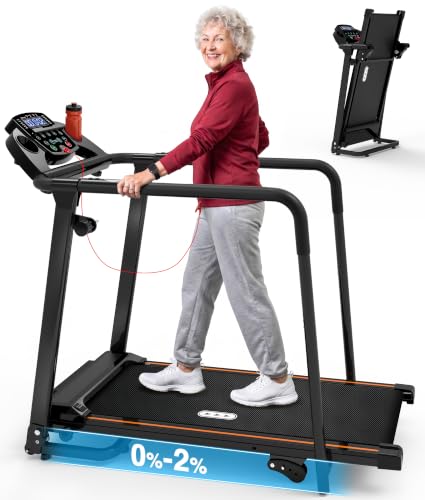
- Extended handrails support balance during walking
- 0–2% manual incline for adjustable intensity
- Foldable, wheeled design suits compact homes
Best For: Seniors seeking supported, low-impact walking in a small space
Best Shock Absorption
FYC Extended-Handrail Walking Treadmill

- Six-layer belt and spring deck target knee comfort
- Extended rails and safety key add fall protection
- 12 programs and app connectivity support family use
Best For: Seniors wanting cushioned walking with versatile household features
Best for Daily Walking
Redliro Long-Handrail Home Treadmill

- Long handrails support balance and walking confidence
- Three manual incline levels adjust daily intensity
- Folding frame and wheels simplify storage
Best For: Seniors establishing a convenient, low-impact home walking routine
Best Overall
Redliro 400-Lb Senior Walking Treadmill

- 400-lb weight capacity with a 47.6-inch belt
- 0.3-mph start and 0%-2% incline
- Long side rails and front bar for support
Best For: Seniors needing maximum capacity and steady, low-speed walking
Best for Easy Storage
Redliro Folding Treadmill with Long Handrails

- Full-length rails and an emergency safety key
- Compact folding design with functional wheels
- 0.5-5 mph speed range and 0%-2% incline
Best For: Home users who need supported walking and convenient storage
Best for Rehab-Friendly Controls
Redliro Low-Speed Walking Treadmill

- 0.3-mph start for gradual walking
- Extended rails with a front support bar
- Simple LCD plus 12 preset programs
Best For: Seniors and recovery users who need slow, controlled exercise
Most Supportive – YESOUL Senior Treadmill
For shoppers comparing treadmills for seniors, the YESOUL SW10 emphasizes stability and reassurance. Its full-length handrails, emergency stop button, safety key, and low 0.6–3.8 mph range make it suited to controlled walking at home.
Best For: Seniors and recovery users who prioritize extensive handrail support and emergency-stop protection.
Pros:
- Long handrails extend along the sides and front for added balance support.
- Emergency stop button and safety key help stop the belt if the user becomes unsteady.
- Six-layer cushioning and a 300-pound capacity support gentle, low-impact walking.
- Quiet brushless motor, LED tracking, phone stand, and cup holder add everyday convenience.
Cons:
- Its 3.8 mph maximum speed is intended more for walking than faster jogging.
- The treadmill is non-foldable, which may make storage more difficult.
- The 16-inch belt is narrower than some larger home treadmills.
The YESOUL is a practical choice when balance assistance matters more than workout intensity or compact storage. Its safety-focused design and gentle speed range fit daily walking routines.
Best for Guided Workouts – NordicTrack T Series Treadmill
The NordicTrack T Series is a more versatile option among treadmills for seniors who want walking now and room to progress. It offers cushioned deck support, speeds up to 10 mph, a 0–10% incline range, and optional iFIT-guided workouts.
Best For: Active older adults who want structured walking, incline training, and fitness-app connectivity.
Pros:
- KeyFlex cushioning is designed to reduce impact during walking or running.
- 0–10 mph speed and 0–10% incline ranges accommodate varied fitness levels.
- iFIT can provide guided workouts, automatic adjustments, and Google Maps routes with a membership.
- Bluetooth connectivity supports syncing with compatible fitness apps and heart-rate monitors.
Cons:
- It does not list the extended senior-specific handrails found on the other models.
- Many smart features require an iFIT Train membership.
- At 130 pounds, it is substantially heavier than the compact senior walking treadmills.
This model makes the most sense for seniors seeking a conventional home treadmill that can support walking, jogging, and progression. Buyers should factor the optional membership into the total cost of the connected features.
Best for Rehabilitation – Redliro Low-Speed Senior Treadmill
The Redliro stands out among treadmills for seniors because it starts at just 0.3 mph. That very low starting speed, combined with front and side handrails and a flat lowest incline setting, is useful for rehabilitation, recovery, and cautious daily walking.
Best For: Seniors, beginners, and rehabilitation users who need a very slow starting pace and multiple points of support.
Pros:
- 0.3 mph minimum speed allows highly controlled starts.
- Front and extended side handrails provide support while starting, walking, and adjusting posture.
- Flat deck setting and three manual incline levels accommodate joint-conscious routines.
- Folding design, gas-spring assistance, removable rails, and wheels help with storage.
Cons:
- The 41-inch deck is shorter than the NordicTrack walking surface.
- Incline adjustment is manual rather than automatic.
- Its 5.5 mph maximum speed may not suit users seeking faster running workouts.
For users who need to begin slowly, the Redliro offers one of the most accommodating speed ranges in this group. Its support rails and storage features further reinforce its focus on safe, practical home walking.
Best Family-Friendly Value – CIIHI Senior Folding Treadmill
The CIIHI combines senior-friendly controls with a family-capable design. For shoppers seeking treadmills for seniors, its 0.3 mph starting speed, dual handrails, simple display, and foldable frame provide a practical balance of support and convenience.
Best For: Households wanting a foldable treadmill that works for senior walking and broader family fitness needs.
Pros:
- Ultra-low 0.3 mph start with 0.1 mph increments supports gradual pacing.
- Front and side handrails help with standing, starting, and walking balance.
- Foldable frame, soft-drop system, and transport wheels simplify storage.
- Offers 12 preset programs, a 350-pound capacity, and a screen-off button for convenient operation.
Cons:
- Incline is limited to 0–2% and adjusted manually.
- The 41.5-inch deck may feel restrictive for users with a long stride.
- Its wider family-oriented speed range may offer more capability than some seniors need.
CIIHI is a strong compromise for shared households: it retains a slow, senior-appropriate start while offering higher capacity and preset programs for other users. Its folding design is especially useful in apartments or smaller rooms.
Best Compact Support – Redliro Long-Handrail Incline Treadmill
For shoppers comparing treadmills for seniors, the Redliro T4253A emphasizes balance support, simple controls, and compact storage. Its extended handrails, 0–2% manual incline, and 5 mph maximum speed make it suited to controlled walking at home.
Best For: Seniors who want extended handrail support, gentle incline options, and a foldable treadmill for smaller spaces.
Pros:
- Long handrails provide continuous grip assistance for walking and light rehabilitation exercise.
- 0–2% manual incline allows users to adjust intensity gradually.
- Foldable frame, transport wheels, and compact dimensions support convenient storage.
- Mute and screen-off controls help create a quieter, simpler workout experience.
Cons:
- The 39.3-inch deck is relatively compact for users who prefer a longer walking surface.
- Incline adjustment is manual rather than automatic.
- Its maximum speed is 5 mph, so it is oriented more toward walking than faster running.
With a 300-pound recommended weight capacity and straightforward progress tracking, this model is a practical choice for steady daily walking. Its strongest advantage is the combination of senior-focused handrails and space-saving design.
Best Shock Absorption – FYC Extended-Handrail Walking Treadmill
The FYC Q23L stands out among treadmills for seniors with its low-profile deck, extended handrails, and layered shock-absorbing construction. It also offers a broad speed range, simple display controls, and optional app connectivity for households with varied fitness needs.
Best For: Seniors who prioritize knee cushioning and safety features while wanting a treadmill that can also serve other family members.
Pros:
- Six-layer belt and eight spring shock-absorbing boards are designed to reduce knee impact.
- Full-size extended handrails, a low-profile platform, and a safety key support safer use.
- Large backlit display and straightforward buttons make core controls easier to read and operate.
- 12 preset programs, Bluetooth, and Fit Show app support add flexibility for household use.
Cons:
- The maximum 7.5 mph speed and multiple programs may be more capability than some users need for gentle walking.
- At 66 pounds, it is heavier than some compact walking treadmills.
- The supplied details do not specify a folding mechanism.
This is a versatile option for buyers who want cushioning and all-around support without limiting the treadmill to senior-only use. Its extended rails and safety key are particularly useful additions for users concerned about balance.
Best for Daily Walking – Redliro Long-Handrail Home Treadmill
For seniors building a consistent home walking routine, the Redliro long-handrail treadmill combines balance support with a compact footprint and 12 workout programs. Its three manual incline levels, quick-pause function, and easy-access maintenance design keep everyday use straightforward.
Best For: Seniors who want a compact walking treadmill with adjustable incline, progress goals, and convenient storage.
Pros:
- Extended handrails are designed to improve balance and confidence while walking.
- Three manual incline settings—0%, 1%, and 2%—allow gradual intensity changes.
- Folding design and transport wheels make it easier to move and store in small homes.
- Auto-lubrication features, mute control, and screen-off access simplify routine use.
Cons:
- The 39.3-inch by 14.8-inch belt may feel limited for users wanting a larger deck.
- Manual incline changes require stopping to adjust the setting.
- The 5 mph maximum speed is better suited to walking and light jogging than fast running.
This model is a strong fit for uncomplicated daily activity, particularly where storage space is limited. Its combination of long rails, gentle incline choices, and saved workout data makes it well suited to maintaining a regular routine.
Best Overall – Redliro 400-Lb Senior Walking Treadmill
For shoppers comparing treadmills for seniors, the Redliro 400-Lb model stands out for its extensive support features, very low starting speed, and spacious walking belt. It is designed for steady indoor walking, light rehabilitation, and gentle exercise.
Best For: Seniors or recovery users who want maximum weight capacity, long handrails, and a slow, controlled starting pace.
Pros:
- Extra-long side rails plus a sturdy front bar provide support when mounting, walking, and dismounting.
- Starts at 0.3 mph with 0.1-mph adjustments and offers a mild 0%-2% manual incline.
- Supports up to 400 pounds and has a 47.6-inch-long belt for added stride space.
- Large dual-data display shows key metrics, while soft-drop folding and wheels simplify storage.
Cons:
- At 94.3 pounds, it is relatively heavy to reposition compared with lighter models.
- The maximum 2% incline and 7-mph speed are better suited to walking and light exercise than advanced training.
This is the strongest choice when stability, capacity, and a particularly gentle starting speed matter most. Its large frame takes up more space, but the folding design and removable handrails help make storage more manageable.
Best for Easy Storage – Redliro Folding Treadmill with Long Handrails
This Redliro is a practical option among treadmills for seniors for users who prioritize continuous handrail support and convenient room-to-room movement. Its compact folded dimensions, simple controls, and gentle incline range suit everyday walking at home.
Best For: Seniors and recovery users who need full-length handrails on a lighter, easier-to-store treadmill.
Pros:
- Full-length handrails provide a steady grip from the beginning to the end of a walk.
- The 0%-2% incline range keeps the surface gentle while allowing modest progression.
- Rail controls, large display numbers, and a screen-off button simplify operation.
- External wheels work when folded or unfolded, and the folded unit measures 21.7 by 22.8 by 47.1 inches.
Cons:
- The 300-pound capacity is lower than the 400-pound model in this roundup.
- Its 0.5-mph minimum speed is not as slow as the 0.3-mph starts on the other listed Redliro models.
- The 46.8-inch deck may provide less walking room than a longer belt.
Choose this model if storage and mobility are priorities without giving up long handrails. It offers a useful 0.5- to 5-mph range for walking and light jogging, though its capacity and minimum speed are more limited.
Best for Rehab-Friendly Controls – Redliro Low-Speed Walking Treadmill
The Redliro JK06F offers several features that can make daily walking more approachable for seniors and convalescent users. With a 0.3-mph starting speed, extended handrails, straightforward LCD controls, and shock absorption, it is a flexible pick among treadmills for seniors.
Best For: Seniors and rehabilitation users who want very slow speed control, multiple handrail positions, and optional preset programs.
Pros:
- Dual extended side rails and a front bar provide continuous support and a natural gripping position.
- The 0.3-mph minimum speed allows gradual, low-impact walking.
- Backlit LCD tracks distance, calories, heart rate, speed, and time with simple buttons.
- A six-layer belt and shock-absorption system are designed to help reduce walking impact.
Cons:
- The 41-inch deck is shorter than the 47.6-inch belt on the 400-pound model.
- The maximum capacity is 300 pounds.
- Removing the handrails is required before folding, adding an extra storage step.
This model balances rehab-oriented speed control with family-friendly flexibility, including 12 preset modes and a removable handrail system. It is worth considering when gentle starts and simple monitoring are more important than a larger deck or higher weight rating.
How We Picked These Treadmills for Seniors
We focused on features that matter most for comfortable, controlled home walking rather than racing performance. The selection emphasizes accessible speed settings, extended or front handrails, emergency-stop provisions, shock absorption, folding designs, weight capacity, and controls that are easy to understand. We also included a range of formats, from compact walking treadmills to more feature-rich models for households that want incline options or app connectivity.
Because balance, stride length, and available space vary considerably, no single model is ideal for every older adult. Before buying, confirm the treadmill’s dimensions, usable walking-belt area, maximum user weight, and whether its controls can be reached comfortably while walking.
Quick Comparison
| Priority | Look For | Best Match Among These Types |
|---|---|---|
| Extra stability | Long, sturdy side rails and a front rail | Senior-focused models with extended handrails |
| Gentle starting pace | Very low minimum speed and gradual adjustment | Slow-start walking treadmills |
| Limited space | Folding frame or compact under-desk-style design | Foldable home walking treadmills |
| Incline walking | Selectable incline with secure footing | Models offering modest 0–2% incline or more |
| Higher user weight | Clearly stated, suitable weight capacity | Heavy-duty senior treadmills |
Key Buying Factors for Treadmills for Seniors
Handrails and Safety Controls
Prioritize rails that extend far enough to support getting on, walking, and slowing down. A tethered emergency stop button or safety key is useful, but it should be easy to attach and reach. A wide, uncluttered deck and strong contrast on the display can also improve confidence.
Speed Range and Controls
A low minimum speed is often more important than a high maximum speed. Look for gradual adjustments, clearly labeled buttons, and controls that do not require navigating a complicated touchscreen. If more than one person will use the treadmill, check whether each user can comfortably reach the controls.
Walking Surface, Cushioning, and Capacity
Choose a belt long and wide enough for the user’s natural stride, especially if they use a walker or tend to look down while walking. Shock absorption may reduce impact, but it cannot replace supportive footwear or medical guidance. Stay comfortably below the stated weight limit and verify that the frame feels stable during use.
Size, Noise, and Maintenance
Measure the entire operating area, including room for mounting and dismounting. Folding models save floor space but may still be heavy to move. Check transport wheels, noise expectations, lubrication requirements, warranty coverage, and whether assembly or service assistance is available.
Who Should Buy Which Treadmills for Seniors?
Choose a long-handrail model if steady support is your main concern or you want rails available throughout the walking surface. Choose a slow-start model if the user needs a particularly gentle beginning pace or is returning to activity after a long break. Choose a foldable treadmill when storage space is limited, provided the user can safely unfold and position it each time.
Choose a higher-capacity model when its published weight rating leaves a comfortable margin for the intended user. Choose an incline-capable treadmill for gradual training variety, but start flat and use incline only when balance and walking ability are already secure. Choose a more connected model only if app controls, guided workouts, or progress tracking will genuinely be used; simple physical controls are often the better choice for straightforward senior walking.
Regardless of the model, place the treadmill on a level surface with clear space around it, keep the safety key attached, and follow a clinician’s advice when balance, joint, heart, or neurological concerns are present.