The best treadmill depends on more than speed. Your available space, workout goals, preferred incline, noise tolerance, and budget all shape which machine makes sense at home.
We selected 10 treadmills spanning compact under-desk walking pads, foldable models, incline-focused machines, and app-compatible options so you can match features to your routine without overbuying.
Best 10 Treadmills Picks for 2026
Connected Home Training

- 10 MPH speed and 0–10% incline
- Foldable frame with KeyFlex cushioning
- iFIT-guided workouts and SmartAdjust
Best For: Interactive home workouts in a foldable treadmill
Interactive Incline Workouts

- 10 MPH speed and 0–12% incline
- Foldable design with ProShox cushioning
- iFIT connectivity and one-touch controls
Best For: Compact home cardio with guided incline workouts
Quiet Incline Training

- 15% auto incline with 15 levels
- Quiet 3.0HP brushless motor
- 92-pound foldable design with preset programs
Best For: Compact incline workouts, walking, and jogging
Under-Desk Walking

- 0.6–4 MPH walking speed range
- Slim no-assembly design with transport wheels
- LED display and included remote control
Best For: Light indoor walking at desks or in small spaces
Best High-Incline Pick
16% Foldable Incline Treadmill

- 16% incline for more demanding workouts
- 42-inch handrails and 400-pound capacity
- Folds to about 4 inches thick
Best For: Incline-focused home workouts with added support
Best Compact Walking Pad
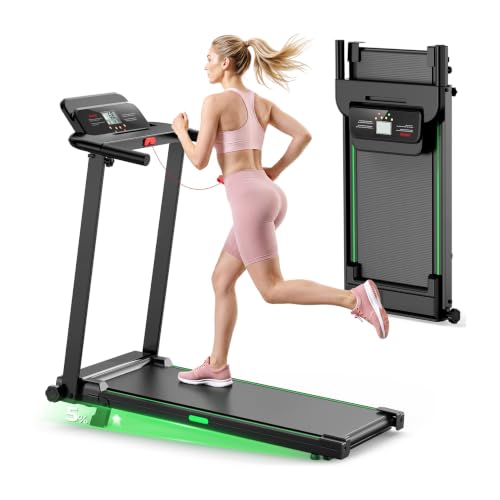
- Folds under beds or sofas
- 0.6–6.2 mph speed range
- 12 programs plus countdown modes
Best For: Walking and light jogging in compact spaces
Best Feature-Rich Option
5-in-1 App-Compatible Treadmill

- 0.6–7.5 mph across five workout modes
- 10% incline and 12 HIIT programs
- App compatibility and 400-pound capacity
Best For: Connected, versatile home training
Best with Extra Features
Foldable Treadmill for Small Spaces

- 2.0 HP motor with speeds up to 4 MPH
- Foldable design with front transport rollers
- LED tracking and remote-control operation
Best For: Walking and light jogging in compact homes or offices
Best Incline Treadmill
16% Auto-Incline Home Treadmill

- 0–16% automatic incline with 12 levels
- 3.0 HP brushless motor and 7.5 MPH top speed
- 350-pound capacity with six-layer cushioning
Best For: Hill workouts and more demanding home training
Best Convertible Walking Pad
Folding Treadmill with Removable Handle Bar

- Converts from supported treadmill to flat walking pad
- Three speed modes up to 4 MPH
- Remote, LED display, phone holder, and pause function
Best For: Home or office walking with flexible under-desk use
Connected Home Training – NordicTrack T Series T6.5S
The NordicTrack T Series T6.5S is a versatile treadmill for home users who want guided workouts, adjustable incline, and a foldable design. It reaches 10 MPH, offers a 0–10% incline, and includes cushioning intended to make regular walking or running more comfortable.
Best For: iFIT users who want interactive training and a treadmill that can fold for easier storage.
Pros:
- 10 MPH top speed supports walking, jogging, and running.
- 0–10% digital incline adds intensity and variety.
- Foldable frame and assisted lowering suit smaller workout spaces.
- iFIT can automatically adjust speed and incline during guided workouts.
Cons:
- Many connected features require an iFIT Train Membership.
- ActivePulse requires a compatible Bluetooth heart-rate monitor, sold separately.
- At 203 pounds, it is substantial to move despite the folding design.
Choose this treadmill if app-connected coaching and a 300-pound weight recommendation matter more than having a large display. Its 55-inch by 20-inch deck provides a practical balance for home cardio training.
Interactive Incline Workouts – ProForm Carbon Treadmill
The ProForm Carbon treadmill is designed for home runners who want straightforward controls and iFIT connectivity. Its 10 MPH speed, 0–12% incline, ProShox cushioning, and compact folding frame cover a range of walking, jogging, and running workouts.
Best For: Home exercisers seeking a compact treadmill with a slightly broader incline range and interactive iFIT training.
Pros:
- 0–12% incline provides extra room for hill-style workouts.
- 10 MPH maximum speed supports running and endurance sessions.
- One-touch speed and incline buttons simplify adjustments.
- Folding frame, device shelf, and ProShox cushioning add everyday convenience.
Cons:
- iFIT training and automatic adjustments require a Train Membership.
- The 18-inch-wide deck is narrower than some home treadmills.
- Heart-rate control requires a compatible Bluetooth monitor sold separately.
The ProForm Carbon is a sensible choice for users who want more incline than a basic walking treadmill without moving to a full-size commercial-style machine. Its 300-pound weight recommendation and folding design support regular home use.
Quiet Incline Training – MERACH T16 Foldable Treadmill
The MERACH T16 is a compact treadmill for home walking, jogging, and incline training. It combines a 15% auto incline with speeds up to 7.5 MPH, a brushless motor, a 300-pound capacity, and a foldable frame that suits apartments or other space-conscious setups.
Best For: Users who want strong incline capability, quiet daily cardio, and a relatively lightweight treadmill that is easy to store.
Pros:
- 15% auto incline creates challenging hill-style workouts.
- 3.0HP brushless motor is designed for smooth, quiet operation.
- Five-layer belt, shock-absorbing pads, and handrails support comfortable use.
- Arrives mostly pre-assembled and includes 15 preset programs.
Cons:
- 7.5 MPH maximum speed is below the limit of the two iFIT models.
- The 43.5-inch belt length may feel short for some runners.
- The listed warranty description is one year.
For incline-focused home workouts, the T16 offers notable capability in a 92-pound package. It is better suited to walking, jogging, and moderate running than to long-stride, high-speed training.
Under-Desk Walking – Compact Portable Walking Pad
Walking Pad Treadmill for Home Compact Walking Running Machine with Remote Control
Check Price On AmazonThis compact walking pad is a practical option for low-speed indoor walking at home or in an office. It runs from 0.6 to 4 MPH, includes a remote and LED display, and has a slim no-assembly design that can fit under beds, sofas, or desks.
Best For: Desk users and walkers who prioritize portability, simple controls, and easy storage over running performance.
Pros:
- Compact 40-inch by 19.2-inch footprint is easy to store.
- 0.6–4 MPH range suits walking and light-paced movement.
- Remote control adjusts speed or pauses the machine.
- Arrives with no assembly required and includes transport wheels.
Cons:
- 4 MPH maximum speed is not intended for full-speed running.
- It does not list an incline feature.
- The slim walking surface may provide less room than a conventional treadmill.
This walking pad makes the most sense for adding low-impact movement during work or daily routines. Its 265-pound weight recommendation and portable frame are useful, but users wanting incline training or faster running should consider a full treadmill instead.
Best High-Incline Pick – 16% Foldable Incline Treadmill
If you want treadmills that add more challenge than basic walking pads, this model stands out with a 16% incline, supportive raised handrails, and a 400-pound capacity. Its compact folding design and mostly pre-assembled setup also make it practical for home use.
Best For: Home users who want uphill walking or jogging, extra handrail support, and a higher-capacity treadmill.
Pros:
- 16% incline helps intensify leg and glute workouts.
- 42-inch handrails provide added grip and support.
- 3.0 HP motor, seven-layer shock absorption, and 400-pound capacity.
- Folds to approximately 4 inches thick and arrives 99% pre-assembled.
Cons:
- Maximum speed is 7.5 mph, so it is less suited to high-speed running.
- The compact 43.8-by-21.6-inch footprint may feel narrow for some runners.
This is a strong choice when incline training and stability matter most. The 12 preset modes, pause button, shock absorption, and compact storage add useful everyday convenience.
Best Compact Walking Pad – Foldable Incline Walking Pad
Among compact treadmills for home, this walking pad emphasizes easy storage and moderate-speed workouts. It offers a 0.6–6.2 mph range, manual incline support, preset programs, and transport wheels for convenient repositioning.
Best For: Apartment dwellers, home-office users, and walkers who need a lightweight treadmill that stores under furniture.
Pros:
- Folds to 40.5 by 18 by 4.7 inches for compact storage.
- 0.6–6.2 mph speed range supports walking and light jogging.
- 12 preset programs and three countdown modes help structure workouts.
- Transport wheels and a device holder improve everyday convenience.
Cons:
- 220-pound user capacity is lower than the other listed models.
- Manual incline requires adjustment rather than powered incline control.
- The 35-by-14.4-inch running area may feel limited for longer-stride runners.
This model prioritizes portability over maximum speed or capacity. Its compact folded profile and simple controls make it a practical option for walking routines in smaller spaces.
Best Feature-Rich Option – 5-in-1 App-Compatible Treadmill
For shoppers comparing versatile treadmills for home, this 5-in-1 model combines under-desk walking, jogging, running, and incline training in one machine. App compatibility, HIIT programs, remote control, and a 400-pound capacity make it designed for varied household workouts.
Best For: Users who want multiple training modes, connected workout features, and a treadmill that can transition between under-desk use and running.
Pros:
- 0.6–7.5 mph range covers under-desk walking through running.
- 10% incline and 12 HIIT programs support varied training.
- App compatibility enables custom plans, virtual training, and workout tracking.
- 3.0 HP brushless motor, seven-layer cushioning, and 400-pound capacity.
Cons:
- The supplied notes do not specify the folded dimensions.
- Its larger feature set may be more than needed for basic walking.
- Incline is adjustable, but the notes do not identify whether adjustment is manual or powered.
This is the most flexible pick of the group for households with different workout preferences. Its broad speed range and connected features add versatility, while the cushioning and high weight capacity support regular use.
Best with Extra Features – Foldable Treadmill for Small Spaces
If you want one of the more compact treadmills for light home or office workouts, this foldable walking pad emphasizes easy storage and simple speed control. Its 2.0 HP motor supports walking, jogging, and running speeds up to 4 MPH, while the remote and LED display make basic workout tracking straightforward.
Best For: Walking, light jogging, and under-desk-style exercise in apartments, offices, or other space-limited areas.
Pros:
- Compact, foldable design with front rollers for easier moving and storage.
- Three speed modes from 0.6 to 4 MPH for walking, jogging, or running.
- Shock-absorbing honeycomb blocks and a multilayer nonslip belt help reduce impact and noise.
- LED display tracks speed, distance, time, and calories, with remote-control operation.
Cons:
- Its 4 MPH maximum speed is better suited to walking and light running than fast training.
- Maximum user weight is 242 pounds.
This is a practical pick when storage space matters more than high-speed performance. The compact frame, foldability, and quieter cushioning design make it convenient for regular low-intensity movement at home or work.
Best Incline Treadmill – 16% Auto-Incline Home Treadmill
Among these treadmills, this model is the strongest choice for users who want more challenging home workouts. Its 0–16% automatic incline, speeds up to 7.5 MPH, and 350-pound capacity provide more training flexibility than a basic walking pad, while the foldable design remains suitable for smaller spaces.
Best For: Hill-style workouts, walking, jogging, and moderate home running for users who want automatic incline adjustment.
Pros:
- One-button 0–16% auto incline with 12 adjustable levels.
- 3.0 HP brushless motor supports speeds from 0.6 to 7.5 MPH and operation below 50 dB.
- 350-pound maximum user capacity and a six-layer cushioned nonslip belt.
- Folds without tools and includes built-in wheels for storage under a bed or in a closet.
Cons:
- Its 58-pound frame and larger running setup may be less convenient to move than a basic walking pad.
- The listed deck width is 22.8 inches, so users should confirm available floor space before buying.
This treadmill is the most versatile option here for progressive home training. The automatic incline and higher speed ceiling make it suitable for more demanding sessions, while cushioning, folding, and a quiet motor add everyday practicality.
Best Convertible Walking Pad – Folding Treadmill with Removable Handle Bar
This versatile option combines the feel of a compact treadmill with the flexibility of an under-desk walking pad. It includes a removable handle bar, three speed modes, a phone holder, and a foldable frame, making it one of the more adaptable treadmills for home or office use.
Best For: Users who want a compact treadmill that can switch between supported walking and flat under-desk use.
Pros:
- Removable handle bar allows use as either a supported treadmill or flat walking pad.
- Three modes cover walking, jogging, and running up to 4 MPH.
- Five-layer nonslip belt and a 90 x 38 cm running area provide cushioning and traction.
- LED display, remote control, pause function, phone holder, and built-in wheels add convenience.
Cons:
- Handle-bar folding requires unscrewing the fixed bolts.
- The 4 MPH maximum speed is limited for faster running workouts.
- Maximum user weight is 264 pounds.
Choose this model if flexibility is your priority. Its removable handle bar and compact folded size support both traditional walking and under-desk use, although the slower top speed makes it better for light cardio than performance running.
How We Picked These Treadmills
We focused on practical home-use features: usable speed ranges, incline capability, folding or compact designs, stated weight capacity, motor performance, controls, workout programming, and portability. We also considered whether each format suits walking, jogging, running, desk use, or limited-space living.
Because specifications and availability can vary by model, verify the current listing for deck dimensions, warranty coverage, assembly requirements, and maximum user weight before purchasing. A treadmill should provide a comfortable safety margin rather than operate constantly at its limits.
Quick Comparison
| Best For | Look For | Common Trade-Off |
|---|---|---|
| Under-desk walking | Low profile, remote control, quiet operation | Limited speed and no substantial handrail |
| Daily walking and jogging | Folding frame, stable deck, moderate incline | Heavier and less portable |
| Running workouts | Longer belt, higher top speed, stronger motor | More floor space, noise, and cost |
| Hill training | Automatic incline with a broad range | Added complexity and price |
| Connected training | App compatibility, programs, device holder | Some features may require subscriptions |
Key Buying Factors for Treadmills
Size, Deck, and Storage
Measure both the operating footprint and the folded dimensions, then leave clearance around the machine. Walkers may manage with a shorter deck, while runners generally need more length to avoid shortening their stride. Check whether the folding mechanism is easy enough to use regularly.
Speed, Incline, and Motor
Choose a machine whose top speed exceeds your normal pace. Incline adds intensity without requiring faster running, but automatic adjustment is more convenient than manual repositioning. Motor horsepower is only one specification; deck stability, belt quality, and the manufacturer’s duty rating matter too.
Comfort, Safety, and Noise
Look for responsive controls, a visible display, emergency safety features, and a handrail that feels secure. Cushioning can reduce impact, although too-soft decks may feel unstable. In apartments or shared rooms, prioritize quiet operation and use a protective mat.
Capacity and Maintenance
Compare the stated user-weight limit with your weight and equipment, leaving a meaningful buffer. Plan for routine belt lubrication or adjustment when required, and confirm that replacement parts and service support are available.
Who Should Buy Which Treadmills?
Choose a walking pad if you want light activity during work, live in a small space, or need a machine that can be stored easily. These models are best for walking rather than sustained running.
Choose a foldable treadmill with a handle for regular walking and occasional jogging when storage matters. It offers more stability and versatility than a low-profile pad while remaining easier to move than a full-size unit.
Choose an incline model if you want hill-style workouts, greater calorie demand, or more training variety at moderate speeds. Confirm that the incline range and adjustment method match your expectations.
Choose an app-compatible or full-size treadmill if structured workouts, running performance, and long-term progression are priorities. You will usually give up some portability, but gain a larger deck, stronger stability, and more useful training features.