Mikolo Folding Squat Rack review is for buyers who want one wall-mounted station to cover squats, pulldowns, rows, flyes, and pull-ups without giving up an entire garage.
It is a strong fit when floor space is tight but training variety still matters.
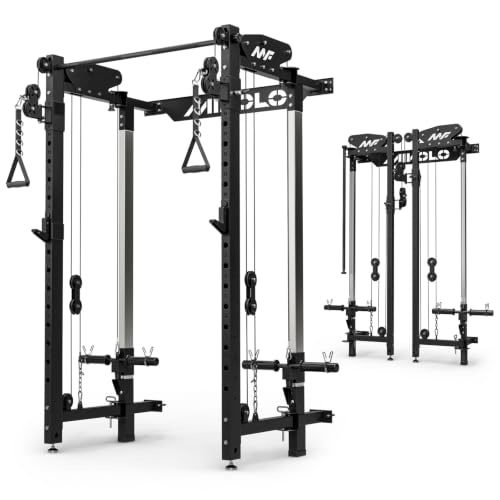
Folding Squat Rack Review Summary
The Mikolo Folding Squat Rack makes sense for a home gym where the rack has to disappear when the workout is over.
Its main advantage is consolidation: a power rack, cable crossover machine, lat pulldown, pull-up bar, and functional trainer all live in one unit, so you can train a lot of movements without building a room around separate machines.
It is especially appealing for a garage, basement, or compact training room because the listing emphasizes a folded footprint of about 3 square feet and an expanded footprint of about 9.5 square feet.
That kind of layout is the whole point of this product.
If you want a fixed machine feel in a small space, this is far more practical than buying a standard squat stand and later trying to add a separate cable stack.
At the same time, this is not a minimalist rack.
The feature set is broad, the wall-mounted design is demanding, and the product is clearly aimed at buyers who will actually use the attachment ecosystem.
If you only need a simple squat stand, this is too much machine. If you want one compact unit that can anchor nearly all of your strength work, it is a compelling option.
Review Scorecard
| Category | Score | Buyer-focused rationale |
|---|---|---|
| Space efficiency | 10/10 | Folds down for storage and is explicitly designed for cramped home gyms. |
| Exercise versatility | 10/10 | Combines rack work, cables, pulldowns, pull-ups, and multiple trainer modes. |
| Strength potential | 8/10 | 2×2 inch 14-gauge steel and up to 1000 lb listing claim suggest serious use. |
| Training convenience | 9/10 | Five adjustable settings and a single-handed pulley adjustment simplify day-to-day use. |
| Stability confidence | 8/10 | Wall mounts plus four ground support feet improve the planted feel of the system. |
| Setup complexity | 6/10 | Wall-mounted hardware and a larger feature set mean more planning than a basic rack. |
Key Features and Specifications of Folding Squat Rack
The headline feature is the folding wall-mounted format.
Mikolo says the rack expands to about 9.5 square feet when open and folds down to about 3 square feet when not in use.
That matters because it changes the buying decision from “can I fit a rack?” to “can I fit a rack that disappears afterward?”
The machine is built around five modes: folded, semi-open, power rack, functional trainer, and cable crossover machine.
That is a meaningful range for a single product.
You are not just getting a frame for barbell lifts; you are getting a compact cable-based training station that can support accessory work, unilateral work, and higher-volume upper-body training.
The listing also calls out an independent dual cable crossover system with a 1:1 pulley ratio.
For buyers, that usually means the cable work is meant to feel direct and practical rather than like a token add-on.
It is a major reason this rack is more interesting than a plain folding rack with a few attachments.
Build details are straightforward and useful:
- 2×2 inch 14-gauge steel construction
- Reinforced screw-in wall mounts
- Four adjustable ground support feet
- Up to 1000 lb listed capacity
- Detachable pull-up bar
- Premium pulley system
- Single-handed adjustable pulley with 15 height options
The exercise list is broad enough to show the intended use case.
Mikolo says the unit supports more than 80 full-body exercises, including squats, bench presses, seated rows, cable flyes, bicep curls, and kickbacks.
That makes it a real all-in-one home gym package rather than a novelty rack with a cable arm bolted onto it.
Pros and Cons of Folding Squat Rack
Pros
- Saves space in a way that matters for garages, basements, and smaller training rooms
- Combines multiple machines into one footprint
- Supports both barbell lifting and cable-based accessories
- Dual pulley crossover setup opens up supersets and drop sets
- Five operating modes make the rack adaptable as training changes
- Adjustable pulley height adds convenience for different movements
Cons
- Wall-mounted installation is less flexible than a free-standing rack
- The integrated design may be overkill if you only need basic squat and bench work
- More moving parts usually means more planning during setup and more attention to use
- Buyers who want a simple, portable rack will not need this level of complexity
The most important tradeoff is obvious: you are buying capability in exchange for installation commitment.
That is a fair bargain if your space is limited and you will use the cable functions regularly.
Who Should Buy Folding Squat Rack?
This product is a good match for home gym owners who want a serious all-in-one station and are willing to mount it properly.
It fits best if you train in a garage or basement, want a rack that can fold away, and value cable work as much as barbell work.
It also makes sense for families or shared training spaces.
The dual cable crossover design is useful when more than one person wants to train at once, and the adjustable modes can cover different strength styles without requiring separate machines.
You should consider skipping it if you want a rack that can be moved around easily, if your walls cannot support a mounted system, or if your training is mostly just squats, bench presses, and pull-ups.
In that case, a simpler rack may be easier to live with and cheaper to build around.
Training Versatility of Folding Squat Rack
Power Rack and Barbell Work
As a rack, this is aimed at the usual heavy lifts: squats, bench presses, and pull-ups.
The steel frame, wall mounting, and ground support feet are all there to give the system a more anchored feel than a lightweight folding solution.
Cable Crossover and Functional Training
The dual cable crossover setup is the feature that separates this from an ordinary folding rack.
It supports exercises like flyes, rows, curls, and kickbacks, and it creates more room for supersets and accessory work than a pure barbell station.
Adjustability and Daily Use
The single-handed pulley adjustment and 15 height options are small but important details.
They make the machine more practical for everyday use, especially if you move between upper-body isolation work and compound training often.
Fit for Small Spaces
The real selling point is the balance of size and function.
A rack that folds down to roughly 3 square feet is useful only if it still feels like a full training system when opened, and this one is clearly designed around that idea.
Alternatives to Folding Squat Rack
If you want a simpler power rack, look at Rogue RML series for a more straightforward strength-training setup.
If you want a compact folding wall rack with strong brand recognition, compare PRx Performance folding squat rack options.
If you want a full-featured home gym with cables and a rack in one system, REP Fitness wall-mounted functional trainer is worth checking.
If you want a more traditional cable-machine approach, RitFit functional trainer products are a common alternative path.
Is Folding Squat Rack Worth It?
Yes, if your priority is to combine rack training and cable training in a compact footprint.
Mikolo’s folding wall-mounted design is the main reason to buy it, and the feature set supports that pitch well.
It is best for a buyer who wants a true home-gym centerpiece, not a temporary rack.
If you do not need the cable crossover, pulldown, and multi-mode versatility, the value drops quickly because the installation and complexity become harder to justify.
For the right space and the right training style, though, this is a smart and unusually space-efficient all-in-one setup.