Refoss Smart Home Energy Monitor is a focused choice for buyers who want circuit-level visibility, local control, and solar-aware energy management.
This Refoss Smart Home Energy Monitor review is for homeowners who care more about practical control than app gimmicks.
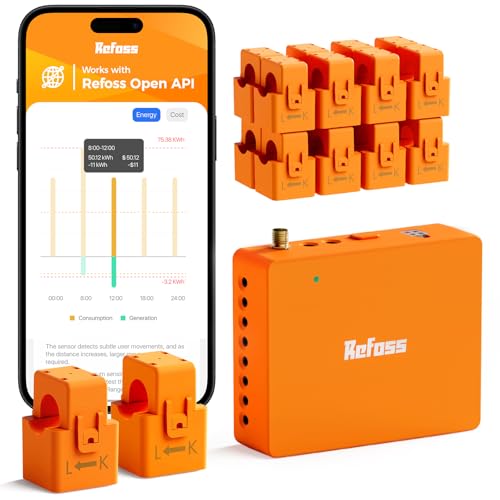
Refoss Smart Home Energy Monitor Review Summary
If you are asking whether the Refoss Smart Home Energy Monitor is worth it, the answer depends on how seriously you want to track and manage electricity use.
It is best for homeowners with a panel they want to understand in detail, especially if they care about local privacy, Home Assistant integration, and long-term usage records.
Verdict: this is a strong fit for buyers who want to see where power is going, not just a whole-home estimate.
The combination of 18 monitored circuits, local web access, Open API support, MQTT, WebSocket, and CSV export makes it more serious than a basic consumer energy gadget.
Review Scorecard
| Category | Score | Why it scores this way |
|---|---|---|
| Circuit visibility | 9/10 | Monitors up to 18 circuits, including main and branch channels, which gives detailed home-level insight. |
| Local control | 10/10 | Built around local web UI, Open API, MQTT, and WebSocket rather than cloud-only dependence. |
| Solar usefulness | 9/10 | Explicitly designed for solar metering, surplus routing, and time-of-use optimization. |
| Data history | 9/10 | Stores minute-through-yearly usage views and keeps daily data for 5 years with CSV export. |
| Installation practicality | 7/10 | Supports common system types and backward sensor flipping, but this is still panel hardware. |
| Alerting value | 8/10 | Smart alerts for unusual usage can help catch failing appliances before bills spike. |
Key Features and Specifications of Refoss Smart Home Energy Monitor
Refoss positions this as a panel-based energy monitoring system for people who want more than rough estimates.
The listing says it supports single-phase, split-phase, and 3-phase 4-wire Wye systems, which broadens compatibility for many home electrical setups.
It monitors 18 individual circuits in total, with 2 main sensors rated up to 200A and 16 branch sensors rated up to 60A.
That split matters because it lets you separate whole-home draw from more specific branch loads, making the data more actionable.
The privacy story is one of the product’s most important differentiators.
Refoss says it includes a built-in local web UI, Open API, MQTT, and WebSocket support, plus Home Assistant integration through Refoss_RPC.
For buyers building a smart home around local automation, that is a meaningful advantage.
The device also emphasizes long-term visibility.
The listing states it records data minute-by-minute, hourly, daily, weekly, monthly, and yearly, with daily data retained for 5 years and exportable as CSV without a subscription.
Other useful details from the listing:
- ETL certified
- 2-year warranty
- External high-gain antenna for Wi-Fi stability
- Solar and net metering optimization features
- Smart alerts for unusual appliance energy use
- One-tap sensor reversal in the app if a clamp is installed backward
For buyers comparing categories, the short version is this: Refoss is less about casual monitoring and more about structured energy management.
Pros and Cons of Refoss Smart Home Energy Monitor
Pros
- Detailed 18-circuit monitoring gives far better visibility than basic whole-home meters.
- Local-first control is a major benefit for privacy-minded buyers.
- Home Assistant, MQTT, Open API, and WebSocket support make it integration-friendly.
- Solar metering and peak-demand handling are genuinely useful if you have panels.
- Long history retention and CSV export help with audits and trend analysis.
- Smart alerts can surface high-draw appliances before they become a bigger problem.
Cons
- This is installed electrical hardware, so it is not as simple as a plug-in gadget.
- The feature set is strongest for buyers who will actually use dashboards, automations, or exports.
- The value is lower if you only want a quick monthly estimate of usage.
- Panel-level work may be overkill for renters or people without access to the electrical box.
Who Should Buy Refoss Smart Home Energy Monitor?
Buy it if you want to understand energy usage at the circuit level and act on that information.
It makes the most sense for homeowners who want to identify waste, track appliance behavior, and build automations around actual power data.
It is also a strong fit for solar owners.
The listing specifically calls out surplus solar routing, net metering management, and peak-demand optimization, so buyers with panels should get more value from it than buyers who only want consumption snapshots.
This monitor is also a better match for local smart home users than cloud-dependent buyers.
If you already use Home Assistant or prefer local APIs and MQTT, Refoss is aligned with that workflow.
Skip it if you are not comfortable with panel hardware, do not need branch-circuit detail, or simply want a low-effort consumer app.
The feature set is powerful, but that power only matters if you will use it.
Local Energy Monitoring and Automation Fit
Circuit-Level Visibility
The biggest practical advantage here is granularity.
Monitoring 18 individual circuits means you can separate HVAC, kitchen loads, laundry, and other major uses instead of guessing from a single household total.
Privacy and Integration
Refoss leans hard into local control, and that is one of the reasons this product stands out.
A built-in local web UI, Open API, MQTT, and WebSocket support make it a serious fit for people who want their energy data available inside their own network.
Solar and Peak Demand Use
If your home has solar, this is more than a passive meter.
Refoss says the system can help redirect surplus solar to medium-power appliances and reduce low-value grid feed-in, which is the kind of detail that matters when you are optimizing real household economics.
Alerts and Long-Term Tracking
The 5-year daily data retention and CSV export are especially useful for budget tracking, appliance troubleshooting, and spotting unusual consumption patterns.
The smart alerts also add a practical layer of protection if a device starts drawing more than it should.
Alternatives to Refoss Smart Home Energy Monitor
If you want similar energy-monitoring hardware, look at Emporia Vue, Sense Energy Monitor, or IotaWatt.
Each is worth comparing if you want to balance app style, installation approach, and ecosystem fit.
Emporia is a common alternative for buyers who want strong household energy visibility with a widely recognized consumer monitoring setup.
Sense is often the comparison point for buyers who want a simpler energy insight experience.
IotaWatt is a better search term for people who care most about flexible monitoring and technical control.
If your priority is local automation, compare each alternative carefully against the Refoss local-control stack.
The right choice is the one that fits your home wiring, your smart home platform, and how deeply you plan to use the data.
Is Refoss Smart Home Energy Monitor Worth It?
Yes, if your goal is serious home energy visibility and you will use the data.
Refoss is worth it for homeowners, solar users, and local-smart-home buyers who want circuit-level monitoring, long history retention, and offline-friendly control.
It is not the best fit for casual users who only want a simple app and a rough bill estimate.
But if you want a monitoring system that can support actual energy decisions, Refoss Smart Home Energy Monitor is a practical, feature-rich buy.