The best calf stretchers for home make it easier to build consistent mobility work into your daily routine. This roundup compares slant boards, foot rockers, wooden incline wedges, and stretching straps for different budgets, spaces, and comfort preferences.
Whether you are addressing tight calves, limited ankle mobility, plantar fascia discomfort, or pre-exercise stiffness, the right design should feel stable, adjust easily, and support controlled stretching without forcing your range of motion.
Best 10 Calf Stretchers for Home Picks for 2026
Physician-Trusted Pick

- Focused rocker design for calves and feet
- Slip-resistant pads help stabilize stretching
- Fits shoes up to size 12; 250-lb recommended limit
Best For: Dedicated plantar fascia, Achilles, and tight-calf stretching
Most Adjustable

- Five incline positions from 15 to 35 degrees
- Anti-slip treads and side handle
- Solid 9-pound hardwood construction
Best For: Adjustable stretching, warmups, recovery, and rehab routines
Best for Higher Weight Capacity

- Stated support up to 300 pounds
- Curved, angled surface supports foot positioning
- Nonslip plastic design fits shoes up to 12.5
Best For: Compact home stretching with a higher stated weight capacity
Best Portable Slant Board
Five-Angle Wooden Stretch Board

- Five angles from 23 to 45 degrees
- Folds and weighs 4.6 pounds
- Includes workout poster and instructions
Best For: Portable calf stretching at home, in the gym, or while traveling
Best Strap-Style Option
Comness Foot and Calf Stretcher
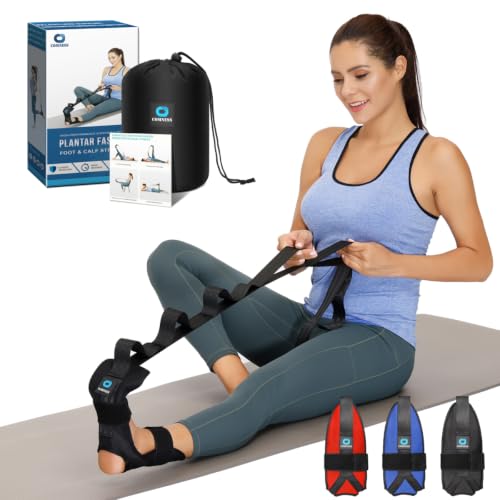
- Six-loop strap supports adjustable stretching positions
- Targets feet, calves, hamstrings, and quadriceps
- Portable design includes a carrying pouch
Best For: Beginners and travelers who want a versatile stretching strap
Best Adjustable Slant Board
Portable Wooden Calf Stretch Board

- Five incline settings from 23° to 45°
- Textured surface and EVA base support traction
- 460-pound capacity with included training guide
Best For: Progressive calf stretching, ankle mobility, and squat variations
Best Deep Stretch Design

- Heel lock is designed for a deeper calf stretch
- Folding ABS body supports portable use
- Slip-resistant heel pad and door-jam groove add stability
Best For: Targeted daily calf stretching, mobility, and recovery routines
Best Adjustable Pick
Professional Wooden Slant Board
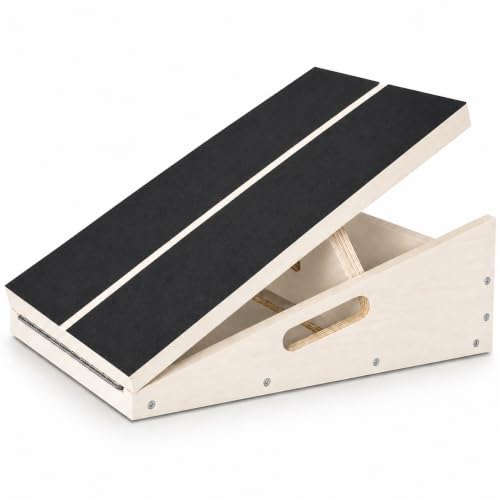
- Five angles from 15° to 35°
- 500 lb capacity with stable wood construction
- Textured top, carry handle, and 3-year warranty
Best For: Progressive calf stretching and multi-purpose home mobility workouts
Best Lightweight Option
Portable Wooden Calf Stretch Board

- Weighs about 4.5 to 5 pounds
- Four positions from 30° to 45°
- Designed for home, office, gym, or clinic use
Best For: Portable stretching, squats, and general mobility routines
Best for Compact Mobility Work

- Four angles from 20° to 40°
- Compact design with built-in carry handle
- 500 lb capacity and non-slip surface
Best For: Portable home mobility, heel stretches, and squat training
Physician-Trusted Pick – ProStretch Original
For shoppers comparing calf stretchers for home use, the ProStretch Original is a compact rocker designed to position the foot for a focused lower-leg stretch. Its slip-resistant rubber pads and included QR-code guide make it practical for regular routines, while the fit is limited to adult shoes up to size 12 and a recommended 250-pound weight limit.
Best For: Adults seeking a dedicated foot rocker for tight calves, plantar fasciitis-related discomfort, or Achilles and lower-leg stretching.
Pros:
- Rocker design helps isolate and stretch the lower-leg muscles, tendons, and ligaments.
- Slip-resistant rubber strips help limit movement during use.
- Made in the U.S.A. and backed by a one-year warranty.
- Stretching guide is included through a QR code.
Cons:
- Recommended for users up to 250 pounds.
- Fits adult shoes only up to size 12.
- Requires socks and rubber-soled athletic shoes.
This is a focused option rather than a multipurpose board, making it a good match for buyers who want a simple, shoe-based calf and foot stretching tool from an established design.
Most Adjustable – StrongTek Wooden Slant Board
The StrongTek Wooden Slant Board is a larger, adjustable choice for calf stretchers for home, office, or travel. Its five incline positions let users vary the challenge, and the hardwood construction, anti-slip treads, and side handle support a stable setup without assembly.
Best For: Users who want adjustable calf and ankle stretching for warmups, recovery, squats, or rehabilitation exercises.
Pros:
- Offers five angles from 15 to 35 degrees.
- Anti-slip safety treads support stable foot placement.
- High-quality Lauan hardwood plywood is designed for durability.
- Side handle improves portability, and no assembly is required.
Cons:
- At 9 pounds, it is heavier than compact rocker-style stretchers.
- The larger board requires more storage space.
- Its wooden platform may be more than needed for buyers seeking a simple foot rocker.
Choose this model if adjustability and a substantial platform matter more than minimal size. The multiple angles also make it easier to progress gradually or tailor the stretch to a specific routine.
Best for Higher Weight Capacity – Curved Foot Rocker
This curved foot rocker is a straightforward option for calf stretchers for home, targeting the calves, ankles, and feet with an angled surface. Its nonslip design, one-size fit for shoes up to 12.5, and stated 300-pound support make it useful for beginners and experienced users alike.
Best For: Users who want a compact foot rocker with a curved, supportive surface and a 300-pound stated weight capacity.
Pros:
- Curved surface is designed to follow the shape of the foot.
- Angled construction encourages consistent foot positioning.
- Supports up to 300 pounds according to the supplied specifications.
- Nonslip surface helps provide a steady stretch.
Cons:
- Fits shoe sizes only up to 12.5 US.
- The 180-day warranty is shorter than some competing options.
- Plastic construction may feel less substantial than a wooden slant board.
This rocker emphasizes comfort, stability, and a broad user fit. It is a sensible pick when you want a small, ready-to-use device rather than adjustable incline settings.
Best Portable Slant Board – Five-Angle Wooden Stretch Board
For shoppers seeking portable calf stretchers for home or gym use, this wooden slant board offers five adjustment levels and folds for transport. At 4.6 pounds, it is lighter than many full-size boards, while the included workout poster and instructions provide a basic starting point for stretching the calves, heels, ankles, and legs.
Best For: Beginners and experienced exercisers who want a lightweight, foldable board with multiple incline settings.
Pros:
- Five angles range from 23 to 45 degrees for varied stretching intensity.
- Folding design and 4.6-pound weight improve portability.
- Can be used with one or both feet.
- Includes a workout poster and instructions.
Cons:
- The supplied specifications list a 300-pound maximum weight recommendation, despite a product highlight mentioning 460 pounds.
- No warranty is provided.
- The thin, lightweight design may feel less substantial than heavier wooden boards.
This is a practical travel-friendly choice for users who value adjustable angles and easy storage. Verify the weight guidance before purchase, especially if you need a higher-capacity platform.
Best Strap-Style Option – Comness Foot and Calf Stretcher
If you want calf stretchers for home that are easy to pack away or take on the go, this Comness stretching strap offers a flexible, low-profile option. Its foot cradle and six-loop webbing let you adjust your hand position for foot, calf, hamstring, and leg stretches.
Best For: Beginners, travelers, athletes, and anyone seeking a versatile strap for home stretching or physical-therapy-style routines.
Pros:
- Six-loop design supports multiple stretching positions and intensity adjustments.
- Cradle-style construction is designed to support the foot during stretching.
- Can target the arch, calf, quadriceps, hamstrings, and lower back.
- Includes a carrying pouch and instruction manual.
Cons:
- Requires active hand control rather than providing a fixed stretching platform.
- Results may depend on technique and the user’s ability to maintain tension.
This is a practical choice when portability and versatility matter more than a rigid, guided stretch. The cotton, neoprene, nylon, and polyester construction packs easily for home, office, gym, or travel use.
Best Adjustable Slant Board – Portable Wooden Calf Stretch Board
For structured calf stretchers for home, this wooden slant board provides five selectable incline angles. It can support gradual calf and ankle mobility work while also serving as a heel-elevation platform for squats and other lower-body exercises.
Best For: Users who want adjustable intensity, a stable board for two-foot stretching, and a tool that also fits mobility and squat routines.
Pros:
- Five angle settings range from 23° to 45° for progressive stretching.
- Textured PVC surface and non-slip EVA base help provide traction.
- Supports up to 460 pounds while weighing about 4.5 pounds.
- Arrives assembled and includes a training poster and instruction guide.
Cons:
- Its rigid board format takes more storage space than a strap.
- Users need to check that the support panel is securely positioned before use.
With its broad platform, adjustable angles, and 15.75-by-11.8-inch footprint, this is a strong fit for a dedicated home mobility area. The wooden construction and portable design also make it suitable for an office, gym, or physiotherapy setting.
Best Deep Stretch Design – CalfPRO Slant Board
If you prefer calf stretchers for home that guide the heel and ankle into position, the CalfPRO uses a leveraged heel lock rather than a simple flat wedge. Its compact, folding design is intended for targeted calf stretching, ankle mobility, warmups, and post-workout recovery.
Best For: People seeking a more focused heel-and-calf stretch for daily mobility, exercise preparation, recovery, or standing-related tightness.
Pros:
- Patented heel lock is designed to create a deeper, controlled stretch.
- Soft, slip-resistant TPR heel pad supports comfort and stability.
- Heavy-duty ABS construction holds more than 300 pounds.
- Folds flat and includes a door-jam groove for portable use.
Cons:
- Its one-position heel-lock design offers less angle adjustment than a multi-angle slant board.
- The focused design may take some practice to position comfortably.
CalfPRO stands out for users who want a dedicated, guided stretch rather than a general-purpose incline board. It is especially convenient for short daily routines because it folds flat and can be used at home, at the gym, or while traveling.
Best Adjustable Pick – Professional Wooden Slant Board
For shoppers comparing calf stretchers for home, this wooden slant board stands out for its five angle settings and high weight capacity. It supports calf stretching, ankle mobility, warm-ups, calf raises, squats, and balance work, with a textured top and slip-resistant base for controlled use.
Best For: Home users who want broad angle adjustability, a sturdy wooden platform, and equipment that can also support strength and mobility exercises.
Pros:
- Five adjustable angles from 15° to 35° allow gradual progression.
- 500 lb capacity and reinforced wooden construction provide a stable platform.
- Textured surface, slip-resistant base, carry handle, exercise guide, and 3-year warranty add practical value.
Cons:
- At 3.85 kg, it is heavier than some portable slant boards.
- The maximum incline is 35°, lower than some competing options.
This is a versatile choice for buyers who want one calf stretcher for stretching, ankle mobility, squats, and warm-ups. Its five settings and sturdy design make it especially useful for gradually adjusting exercise intensity.
Best Lightweight Option – Portable Wooden Calf Stretch Board
Among calf stretchers for home, this portable wooden slant board is designed for simple stretching and weight-bearing exercises. Its lightweight build and four adjustable positions make it suitable for calf work, squats, ankle mobility, physical therapy routines, and use at home, in an office, gym, or clinic.
Best For: Beginners, older adults, and users who want a lightweight board for flexible placement and general stretching or rehabilitation routines.
Pros:
- Lightweight design weighs about 4.5 to 5 pounds for easy transport.
- Four incline positions range from 30° to 45°.
- Suitable for multiple fitness levels and settings, including home, office, gym, and physiotherapy clinics.
Cons:
- Its starting angle of 30° may be less gentle than boards offering lower settings.
- The supplied notes do not specify a weight capacity or non-slip surface.
This board is a practical pick when portability matters more than maximum adjustability. The higher-angle range can suit users seeking a more pronounced stretch, while its compact form makes it easy to move between workout spaces.
Best for Compact Mobility Work – TEMI Wooden Slant Board
This TEMI slant board is one of the more compact calf stretchers for home, with a built-in handle and adjustable wedge positions. Its wooden construction, anti-slip surface, and 500 lb capacity support calf stretching, heel stretches, squats, ankle mobility, balance training, and rehabilitation-focused routines.
Best For: Users who want a compact, easily carried board with several incline options for mobility drills, squat positioning, and lower-body training.
Pros:
- Four adjustable angles—20°, 25°, 30°, and 40°—support varied exercises.
- Compact 11.8-by-15.7-inch design and built-in handle make it easy to transport.
- 500 lb capacity, wooden base, and soft non-slip surface provide a stable exercise platform.
Cons:
- It offers fewer angle settings than the five-position Professional Slant Board.
- The supplied notes list a 1-year warranty, shorter than the 3-year warranty of the first product.
The TEMI is a strong fit for home users who prioritize portability without giving up a high weight capacity. Its 20° starting angle and 40° maximum provide useful flexibility for stretching, squat training, and mobility progressions.
How We Picked the Best Calf Stretchers for Home
We focused on the features that matter during regular home use: stability, adjustability, portability, surface grip, weight capacity, ease of storage, and the type of stretch each product supports. The selection includes fixed and adjustable slant boards, foot-rocker designs, and strap-based stretchers so you can match the tool to your mobility goals and available space.
We also considered whether a product can support more than basic calf stretching. Some options are useful for ankle-mobility drills, squats, Pilates, physical therapy exercises, or gentle foot work. Product claims about pain relief should be treated cautiously; persistent or severe symptoms warrant advice from a qualified healthcare professional.
Quick Comparison
| Type | Best For | Main Advantage | Potential Trade-Off |
|---|---|---|---|
| Adjustable slant board | Progressive stretching | Multiple incline levels | Usually larger than a strap |
| Wooden slant board | Stability and strength | Rigid, supportive platform | Heavier and less compact |
| Foot rocker | Simple daily mobility | Fast, guided movement | Less customizable than a board |
| Stretching strap | Portability and gentle control | Lightweight and inexpensive | Requires more balance and technique |
Key Buying Factors for Calf Stretchers for Home
Adjustability and Stretch Intensity
Choose an adjustable board if your flexibility is changing or multiple people will use it. Several incline settings let you begin gently and increase the stretch gradually. A fixed wedge can be simpler, but it should place your foot at a comfortable angle without causing strain.
Stability, Grip, and Capacity
A broad base, non-slip feet, textured surface, and sturdy construction help prevent sliding. Check the listed weight capacity, especially for standing stretches, squats, or rehabilitation exercises. Wooden boards can feel particularly solid, while compact rockers may be easier to position but offer a smaller contact area.
Size, Portability, and Storage
Measure the space where you plan to use and store the stretcher. Portable boards and straps suit apartments, offices, and travel; larger wooden models may be preferable if you want a dedicated home exercise setup. Handles or a foldable design can make heavier equipment easier to move.
Comfort and Intended Use
Foot-rocker designs can provide a guided stretch with less setup, while boards are better for sustained standing stretches and ankle-mobility work. Straps allow more control over intensity and can accommodate seated exercises, but they demand careful positioning. Stop if you feel sharp pain, numbness, or unusual discomfort.
Who Should Buy Which Calf Stretchers for Home?
- For beginners: Choose a foot rocker or a low, adjustable incline that makes it easy to control intensity.
- For progressive mobility training: An adjustable slant board offers room to increase the angle as flexibility improves.
- For maximum stability: Select a wide wooden board with strong grip and a clearly stated weight capacity.
- For small spaces or travel: A stretching strap is the easiest option to pack and store.
- For mixed workouts: Look for a sturdy board that supports calf stretches, squats, ankle drills, and physical-therapy-style exercises.
The best Calf Stretchers for Home are the ones you can use consistently and safely. Prioritize stable construction, a manageable stretch angle, and a design that fits your routine rather than choosing solely by maximum capacity or the number of advertised exercises.