A doorway pull-up bar can add effective back, arm, shoulder, and core exercises to a home gym without taking up floor space. The best options under $50 vary significantly in fit, grip design, installation method, and stability.
This roundup compares 10 affordable pull-up bars to help you choose a model that matches your doorway, training goals, and preferred level of convenience.
Best 10 Pull Up Bars Under 50 Picks for 2026
Heavy-Duty Doorway Pick
Ally Peaks Multi-Grip Pull-Up Bar

- 440-pound stated capacity
- Multi-grip design for varied exercises
- Silicone door-frame protection
Best For: High-capacity, versatile doorway workouts
Simple Adjustable Choice
CAP Barbell Doorway Chin Up Bar
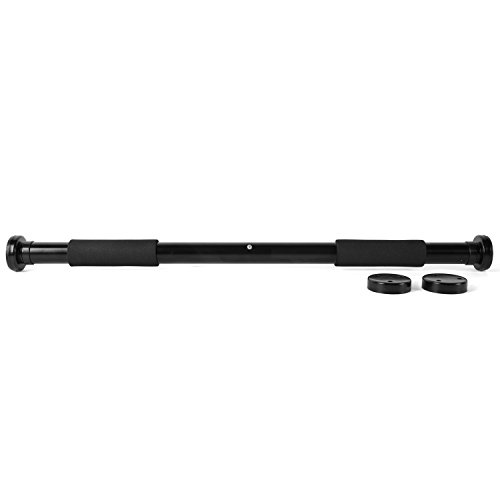
- Fits 24.75- to 36.5-inch frames
- Padded non-slip foam grips
- Includes installation brackets
Best For: Basic pull-up and core workouts
Secure-Lock Pick
Sportneer No-Drill Doorway Pull-Up Bar

- 440-pound stated capacity
- Dual-gear safety lock
- Requires compatible solid wood frame
Best For: Secure no-drill training on suitable door frames
Wide-Doorway Pick
JFIT Deluxe Multi-Exercise Pull-Up Bar
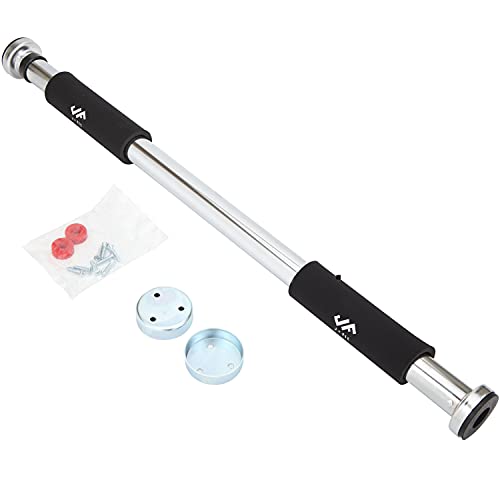
- Fits doorways up to 40 inches
- Three grip positions
- Screw-mounted brackets included
Best For: Wider doorways and secure installed workouts
Best Balanced Doorway Bar
Sunny Health & Fitness Adjustable Chin Up Bar

- Fits 28- to 38-inch doorways
- Anti-rotation design supports stability
- Three grip positions with padded handles
Best For: Portable, repeatable home workouts
Best for Heavy-Duty Use
Sportneer No-Drill Adjustable Pull Up Bar

- Fits 29.5- to 37-inch doorways
- Dual gear locks and PVC friction mats
- Manual-rated load limit is 297 pounds
Best For: Compatible solid wood door frames
Best for Grip Variety

- Fits 19- to 39-inch doorways
- Three padded grip positions
- Removes quickly without screws
Best For: Versatile upper-body workouts at home
Most Adjustable
Ally Peaks Doorway Pull-Up Bar

- Fits 21.65–39.37-inch-wide doorways
- 500-pound stated maximum capacity
- Silicone protection for door frames
Best For: Users who need broad doorway-size adjustability
Best Multi-Grip Option

- Multiple grip positions for varied training
- Fits 23–31-inch-wide doorways
- 440-pound stated maximum capacity
Best For: Portable, padded workouts in standard doorways
Best Reinforced Design
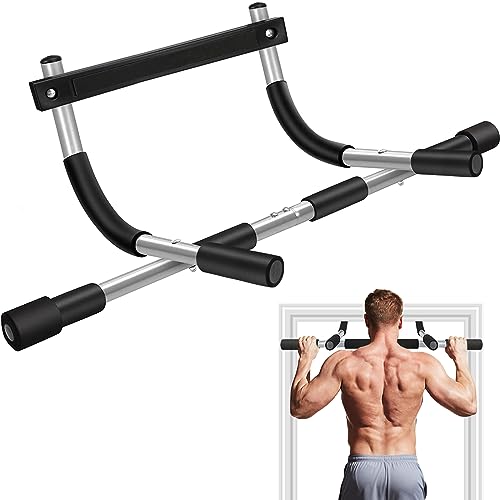
- 1.7mm bar with center reinforcement screws
- No-drill installation for standard doorways
- 440-pound stated maximum capacity
Best For: Standard-doorway workouts with added bar stability
Heavy-Duty Doorway Pick – Ally Peaks Multi-Grip Pull-Up Bar
If you want pull up bars under 50 with a high stated weight capacity, the Ally Peaks doorway bar is a versatile option for home workouts. Its steel construction supports up to 440 pounds and its multi-grip design accommodates pull-ups, chin-ups, dips, push-ups, and hanging crunches.
Best For: Users seeking a high-capacity, no-drill doorway bar with multiple exercise options.
Pros:
- Rated for up to 440 pounds and made from 1.7mm thickened steel.
- Supports several exercises, including pull-ups, dips, push-ups, and hanging crunches.
- Double silicone protection helps reduce marks on the door frame.
- Fits standard doorways measuring 24 to 32 inches wide.
Cons:
- Fit depends on specific doorway depth, trim height, and trim thickness.
- Requires checking the bar’s security before each use.
The Ally Peaks stands out among pull up bars under 50 for its combination of capacity, multi-grip functionality, and added door-frame protection. Verify your doorway measurements before ordering.
Simple Adjustable Choice – CAP Barbell Doorway Chin Up Bar
The CAP Barbell Doorway Chin Up Bar is a straightforward choice among pull up bars under 50 for basic upper-body and core training. It adjusts from 24.75 to 36.5 inches and includes brackets for doorway installation and sit-up exercises.
Best For: Beginners and home exercisers who want an adjustable bar for pull-ups, chin-ups, and core work.
Pros:
- Adjusts to fit many standard door frames from 24.75 to 36.5 inches.
- Padded foam handles provide a more comfortable, non-slip grip.
- Supports pull-ups, chin-ups, leg raises, knee lifts, crunches, and sit-ups.
- Includes weight-bearing and non-weight-bearing brackets.
Cons:
- Maximum recommended weight is 220 pounds.
- Includes a 30-day manufacturer warranty.
With its familiar brand, adjustable width, and included brackets, this CAP bar is a practical entry-level pick. Its lower weight rating makes it better suited to moderate-duty use than heavy-load training.
Secure-Lock Pick – Sportneer No-Drill Doorway Pull-Up Bar
For shoppers comparing pull up bars under 50, the Sportneer model emphasizes a locking system and heavy-duty construction. It uses a dual-gear lock, large PVC contact mats, and steel tubing rated for up to 440 pounds, but it requires a solid wood door frame between 29.5 and 37 inches wide.
Best For: Users with compatible solid wood door frames who prioritize a secure, no-drill installation.
Pros:
- Supports up to 440 pounds with 3mm outer and 1.5mm inner steel pipes.
- 360-degree rotatable dual-gear locks help prevent loosening.
- No-drill design includes large PVC mats and four metal fixed points.
- Independently tested to ASTM, EN957, and CA65 standards according to the listing.
Cons:
- Designed only for solid wood door frames.
- Fits a narrower range of 29.5 to 37 inches.
- Strong adhesion may peel paint or plaster when removed.
This Sportneer bar offers substantial construction and a security-focused design, but compatibility is the key buying consideration. Measure carefully and avoid using it on unsuitable or painted surfaces without testing first.
Wide-Doorway Pick – JFIT Deluxe Multi-Exercise Pull-Up Bar
The JFIT Deluxe is a useful option when shopping for pull up bars under 50 and needing extra doorway width. Its telescoping design fits openings from 25.25 to 40 inches, while three grip positions and a 300-pound rating support varied upper-body workouts.
Best For: Exercisers who need a wider doorway fit and prefer screw-mounted bracket security.
Pros:
- Fits doorways from 25.25 to 40 inches wide.
- Offers wide, neutral, and close grip positions.
- Neoprene grips cushion hands and can be removed for cleaning.
- Supports pull-ups, chin-ups, dips, sit-ups, and crunches.
Cons:
- Requires screws and a screwdriver or drill for bracket installation.
- Its 300-pound capacity is lower than some heavy-duty alternatives.
- Installation is less portable than a no-drill bar.
The JFIT is a strong fit for wider doorways and users who want a more fixed bracket setup. Choose it over a no-drill model if you are comfortable installing the included hardware for added mounting security.
Best Balanced Doorway Bar – Sunny Health & Fitness Adjustable Chin Up Bar
If you are comparing pull up bars under 50, this Sunny Health & Fitness model offers a practical mix of adjustability, grip variety, and doorway protection. It fits 28- to 38-inch doorways and installs without screws or drilling, provided you have a rigid, load-bearing frame.
Best For: Home users who want a portable, multi-grip bar with alignment and anti-rotation features.
Pros:
- Adjusts to fit 28- to 38-inch residential door frames.
- Anti-rotation safety feature helps prevent twisting during use.
- Offers wide, neutral, and reverse grip positions with padded foam handles.
- Side markers and a built-in leveler support even, repeatable setup.
Cons:
- Requires a rigid, load-bearing doorway frame.
- Its rated maximum weight is 330 pounds, lower than some competing options.
This is a well-rounded choice for buyers prioritizing convenient installation, comfortable grips, and stable positioning over the highest stated weight capacity.
Best for Heavy-Duty Use – Sportneer No-Drill Adjustable Pull Up Bar
Among pull up bars under 50, the Sportneer stands out for its adjustable 29.5- to 37-inch range and locking hardware. It is designed for solid wood door frames, uses large PVC friction mats, and should be used according to the manual’s 297-pound limit despite the higher advertised and tested figures.
Best For: Users seeking a strongly secured, no-drill bar for compatible solid wood door frames.
Pros:
- Dual gear locks and four metal fixed points help resist loosening.
- Large PVC mats add friction without drilling.
- Spirit levels and arrow markers make setup easier.
- Adjusts from 29.5 to 37 inches and includes an integrated, sweat-resistant handlebar.
Cons:
- Only intended for solid wood door frames; painted or plastered surfaces may be damaged.
- The manual specifies a 297-pound maximum load, below the 440-pound product claim.
- Longer extension distances may reduce load capacity.
The locking system and setup aids are appealing, but the strict frame requirements and conflicting capacity information make careful measurement and adherence to the manual essential.
Best for Grip Variety – MOMODA Doorway Pull Up Bar
For shoppers browsing pull up bars under 50, the MOMODA offers a straightforward doorway setup with multiple grip positions and a broad fit range. It uses leverage rather than screws, fits doorways from 19 to 39 inches, and is designed for quick installation and removal.
Best For: Beginners and home users wanting one removable bar for varied upper-body exercises.
Pros:
- Fits door frames approximately 19 to 39 inches wide.
- Provides narrow, wide, and neutral grip positions.
- Supports pull-ups, chin-ups, dips, sit-ups, and other listed exercises.
- Padded foam handles and self-tightening lock nuts support comfort and stability.
Cons:
- Requires a compatible doorway within the stated width range.
- Although listed at 440 pounds, the product notes do not provide a separate usage-limit clarification.
This is a versatile option for users who want broad doorway compatibility and exercise variety, especially when easy removal matters.
Most Adjustable – Ally Peaks Doorway Pull-Up Bar
For shoppers comparing pull up bars under 50, the Ally Peaks stands out for its unusually broad doorway adjustability. It fits doorways 21.65 to 39.37 inches wide and accommodates 4.7- to 8.27-inch depths without requiring screws in the frame.
Best For: Users who need a highly adjustable bar for varied doorway sizes and want multiple exercise options.
Pros:
- Five width and two thickness adjustment levels support precise fitting.
- Heavy-duty 1.7mm chrome steel construction has a stated 500-pound maximum capacity.
- Silicone contact points and removable pads help protect the door frame.
- Supports pull-ups, push-ups, dips, and hanging crunches.
Cons:
- Its broad feature set may be more than needed for basic pull-ups.
- Doorway dimensions and trim height still need to be checked before purchase.
The wide adjustment range and double silicone protection make this a particularly flexible pick, especially for shoppers whose doorframe does not match common fixed-size bars.
Best Multi-Grip Option – TOPOKO Doorway Chin-Up Bar
Among pull up bars under 50, the TOPOKO is a practical choice for standard doorways and varied upper-body training. Its 36-inch bar fits 23- to 31-inch-wide openings, uses a no-drill lever attachment, and includes padded grip areas.
Best For: Home users who want a portable, padded doorway bar for pull-ups and additional upper-body exercises.
Pros:
- Multiple grip positions support different pull-up and chin-up styles.
- Heavy-duty steel construction is rated for up to 440 pounds.
- Foam padding helps protect the doorframe and improve grip comfort.
- Assembly tools and instructions are included.
Cons:
- Its compatible doorway range is narrower than the Ally Peaks model.
- It is not suitable for doorways outside the listed width and depth ranges.
The TOPOKO balances portability, padding, and exercise variety well, but careful measuring is essential because it is designed for a more limited range of standard doorframes.
Best Reinforced Design – Upgrade Doorway Pull-Up Bar
This upgraded doorway bar is a solid contender among pull up bars under 50 for standard openings. It installs without drilling, fits 23- to 31-inch-wide doorways, and adds center screws to help keep the 1.7mm horizontal bar secure.
Best For: Users seeking a no-drill bar with reinforced horizontal-bar stability and padded doorframe contact points.
Pros:
- Center screws are designed to address looseness in the horizontal bar.
- Heavy-duty construction carries a stated maximum of 440 pounds.
- Foam grips and top padding help protect the frame and improve comfort.
- Supports pull-ups, wide-grip push-ups, sit-ups, and arm and shoulder exercises.
Cons:
- It only fits doorways 23 to 31 inches wide and 4.7 to 7.5 inches deep.
- It requires assembly, despite its no-drill installation design.
The reinforced center design gives this model a stability-focused edge, while its standard-size fit and multipurpose setup make it a versatile home workout bar.
How We Picked the Best Pull Up Bars Under 50
We focused on the features that matter most in an inexpensive doorway bar: adjustability, stated weight capacity, grip variety, installation style, portability, and compatibility with common door frames. We also considered whether each design supports more than one exercise, such as pull-ups, chin-ups, neutral-grip pulls, and elevated push-ups.
Because doorway construction varies, advertised capacity should not be treated as a guarantee for every installation. A secure fit depends on the frame, trim, bar position, and correct setup. Always follow the manufacturer’s instructions and inspect the bar before each workout.
Quick Comparison
| Best For | Look For |
|---|---|
| Basic chin-ups and pull-ups | Simple straight bars with secure width adjustment |
| Multiple grip positions | Multi-grip handles and padded contact points |
| Higher stated capacity | Heavy-duty steel construction and reinforced supports |
| Renters and portability | No-drill installation and tool-free adjustment |
| Small or unusual doorways | Clearly specified width range and frame compatibility |
Key Buying Factors for Pull Up Bars Under 50
Doorway Fit and Adjustment
Measure the usable opening—not just the door slab—and check the required frame depth. An adjustable bar is useful only when its range matches your doorway. Narrow, wide, or unusually trimmed frames may require a model with more precise width adjustment.
Installation and Stability
No-drill bars are convenient for apartments and quick storage, but they rely heavily on proper contact with the frame. Look for broad supports, secure locking or tension mechanisms, and clear setup instructions. Avoid using a bar on damaged, loose, or unusually shallow trim.
Construction and Capacity
Steel construction can improve rigidity, while padded contact points help protect hands and door surfaces. Treat the listed weight limit as a maximum specification, not a target. Include your body weight and any added load, and choose a model with a sensible margin.
Grip Options and Comfort
A straight bar is compact and versatile. Multi-grip designs can provide chin-up and neutral-grip positions that may feel more comfortable, but they are usually larger and may fit differently around the doorway.
Who Should Buy Which Pull Up Bars Under 50?
Choose a simple adjustable straight bar if you want an affordable option for standard pull-ups, chin-ups, and hanging work. It is often the easiest design to store and reposition.
Pick a multi-grip model if varied hand positions are important or if straight-bar training bothers your wrists. Confirm that the extra handles do not interfere with your door frame or available clearance.
For frequent workouts or heavier users, prioritize reinforced construction, a high stated capacity, and a wide, stable support design. Renters and beginners may prefer a no-drill model, provided their frame is structurally sound and within the listed dimensions.